

Benötigen Sie wasserdichte Steckverbinder?Angebot anfordern →
A North American roadway lighting contractor ordered a container-scale shipment of PVLinkTech IP68 waterproof connectors in 2025. Customer name withheld by agreement; the specification logic below is real and repeatable.
A North American roadway lighting contractor ordered a container-scale shipment of PVLinkTech IP68 waterproof connectors in 2025. Customer name withheld by agreement; the specification logic below is real and repeatable.
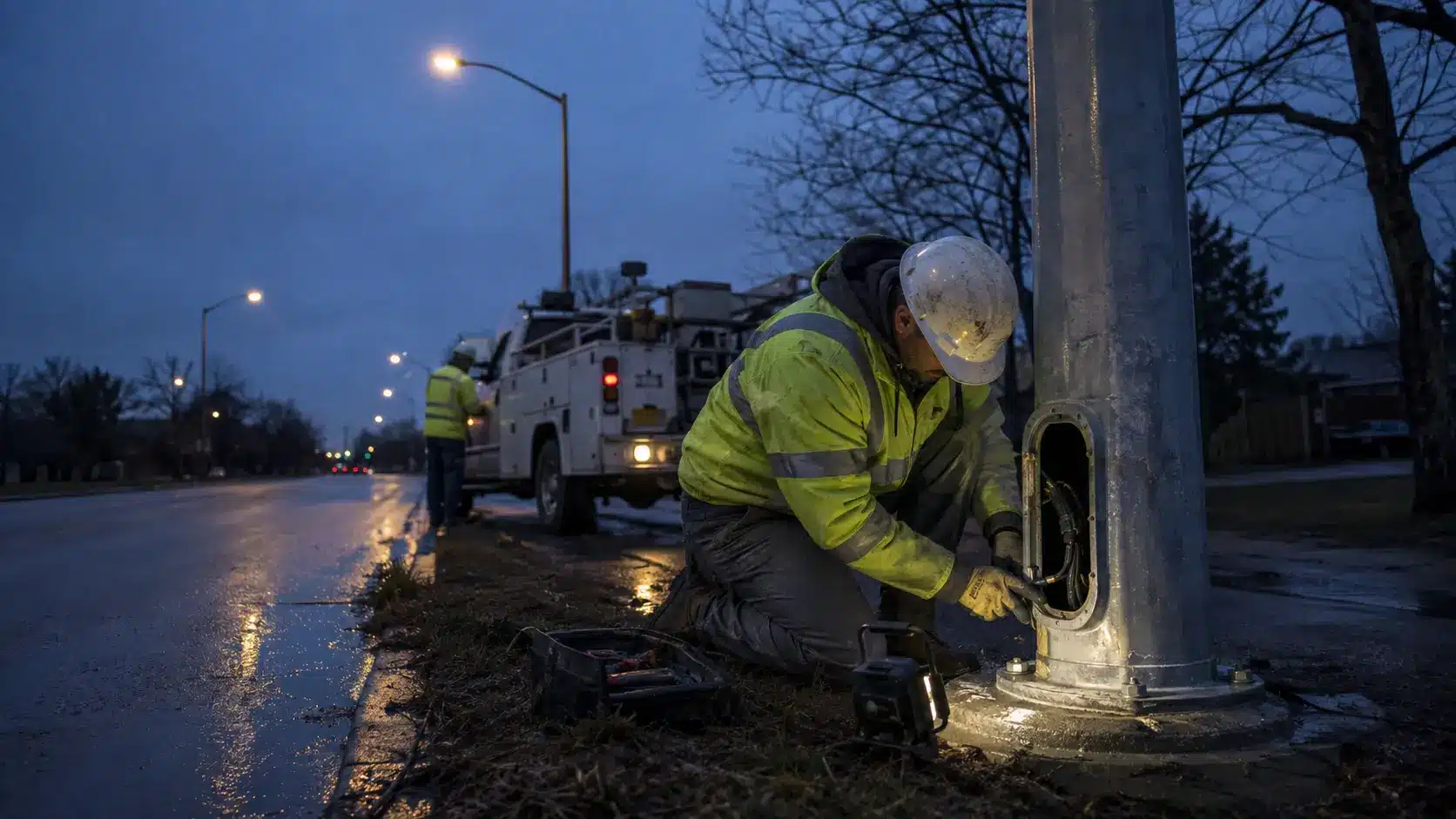
In 2025, a North American roadway lighting contractor took delivery of a container-scale order of PVLinkTech IP68 waterproof connectors for street light wiring. The customer is a lighting contractor, not a module OEM and not a distributor: the kind of company that wins a job, then has to wire street after street of poles on a schedule. Their name stays off this page by agreement. What follows is the engineering logic behind the order, because a street light waterproof connector purchase at container scale is never about one part. It is about a family of parts that all have to survive the same pole, the same handhole, and the same crew.
This case covers the application problems that drive this kind of specification, the M68x IP68 series that fits them, and the certification checks that matter for U.S. and Canadian 120 V, 208 V, and 277 V circuits.
| Market | North America (U.S./Canada) |
| Client type | Roadway and street lighting contractor (name withheld by agreement) |
| Year delivered | 2025 |
| Order scale | Container-scale, multiple connector configurations in one program |
| Product line | M68x IP68 waterproof connector series: inline and branch models across the 2 to 6 pole range, with screw and screwless terminal options |
| Key ratings | IP68 as mated assembly; 450 V AC system rating; M684 rated 24 A (ETL 10 A, 300 V AC); M685 rated 32 A (ETL 18 A, 300 V AC); -40 °C to +105 °C |
An LED head on a pole keeps its own weather. The wiring below it does not. On a roadway installation, the transition from feeder cable to luminaire cable happens in a handhole at the pole base, and handholes flood. Rain runs down the pole, groundwater sits around the base, snow melt pools in spring. A connection rated for a dry housing interior is the wrong part the moment water reaches it. For this class of work, every connection point inside the pole has to survive submersion, not just splash, so ingress protection dominates any street light waterproof connector specification. IP68, tested as a complete mated assembly with the gland compressed, is the practical baseline for handhole wiring.
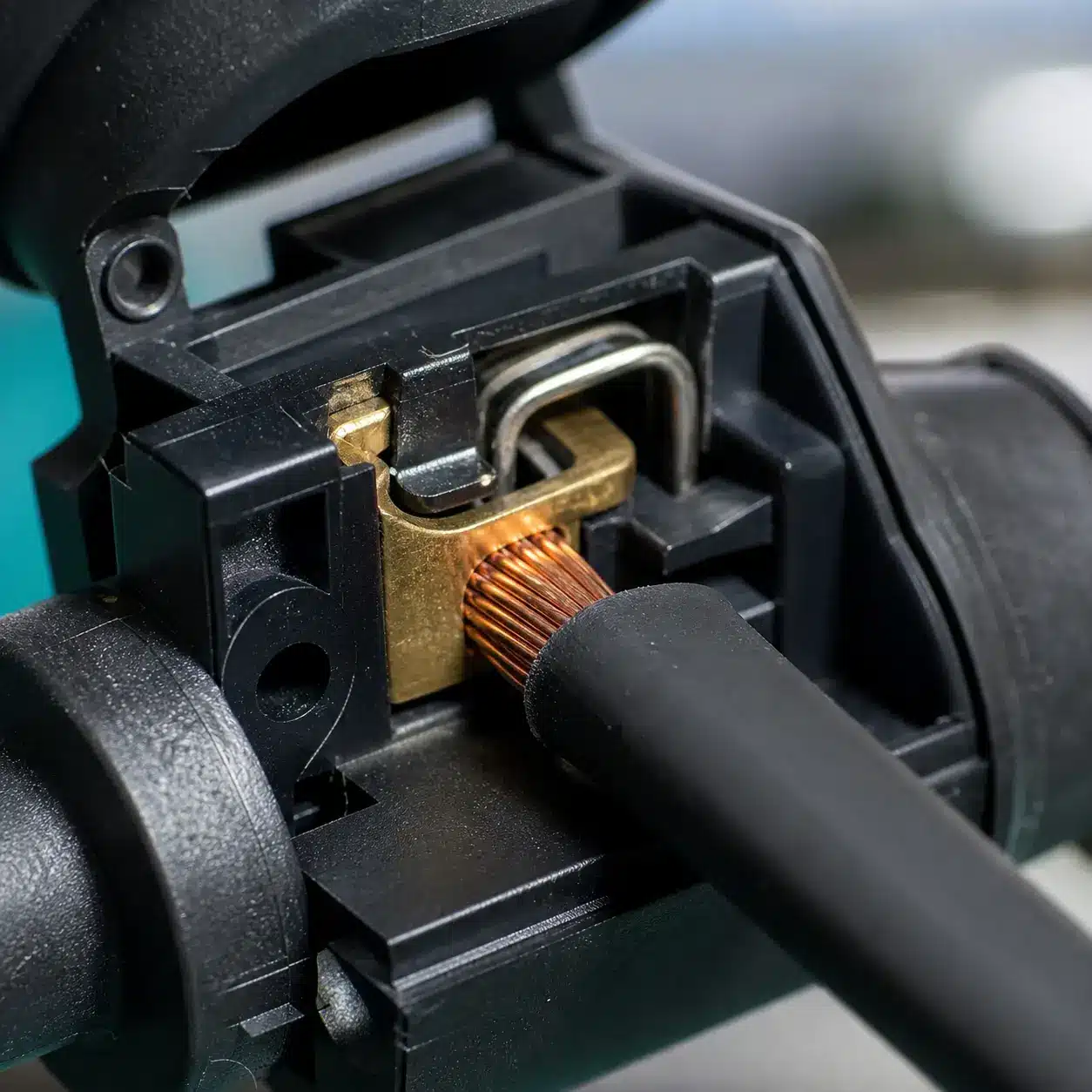
Roadway lighting is installed by crews working against traffic and weather, often gloved, often in a hurry. A screw terminal that depends on exact installation torque is a quality lottery across hundreds of poles. Thermal cycling from day to night and vibration from nearby traffic then do the rest: a lightly torqued screw backs out, contact resistance climbs, and the pole goes dark at 2 a.m., weeks after the crew has packed up. For terminations that see this environment, spring-clamp screwless contacts hold constant force without relying on installer discipline. The M68x series covers both approaches in one family: crews that already run a torque-controlled process keep screw terminals, while handhole and driver-side joints can use the spring-clamp parts. One connector family, two termination behaviors, same spare parts.
Street lighting is daisy-chained. One supply leaves a cabinet, runs pole to pole, and at each pole a tap feeds the driver. That topology creates a real mix of connection jobs: an inline join for the through feeder, a branch point where the tap leaves the feeder, and a short run up to the driver inside the head. A contractor ordering at container scale does not want three different brands and three different termination philosophies for those three jobs. They want a coordinated family where pin count and current rating scale with the wiring point, and where the branch version for fixture-to-fixture runs uses the same sealing system as the inline version at the handhole.
The M68x IP68 waterproof connector series covers the jobs a street light waterproof connector program needs: inline models for feeder and driver connections, branch models where one supply feeds several fixtures, and termination in screw or screwless form. All models share the same sealing architecture, the same 450 V AC system rating, and the same -40 °C to +105 °C operating range, which keeps inventory and field spares simple on a large order.
| Reihe | Polen | Bewertung | Kündigung | Typical wiring role |
|---|---|---|---|---|
| M682 / M683 | 2 or 3 | 17.5 A | Not stated | In-line joins for luminaire supply and low-current control wiring |
| M684 | 2 to 6 | 24 A (ETL 10 A, 300 V AC) | Screw and screwless two-way terminal designs | Driver-to-luminaire connections and multi-pole feeds |
| M685 | 2 to 5 | 32 A (ETL 18 A, 300 V AC) | Screw / screwless variants; branch (1-in to 3/4-out) versions | Higher-current feeds and daisy-chaining multiple fixtures from one supply |
Three specification points make this family work for North America specifically:
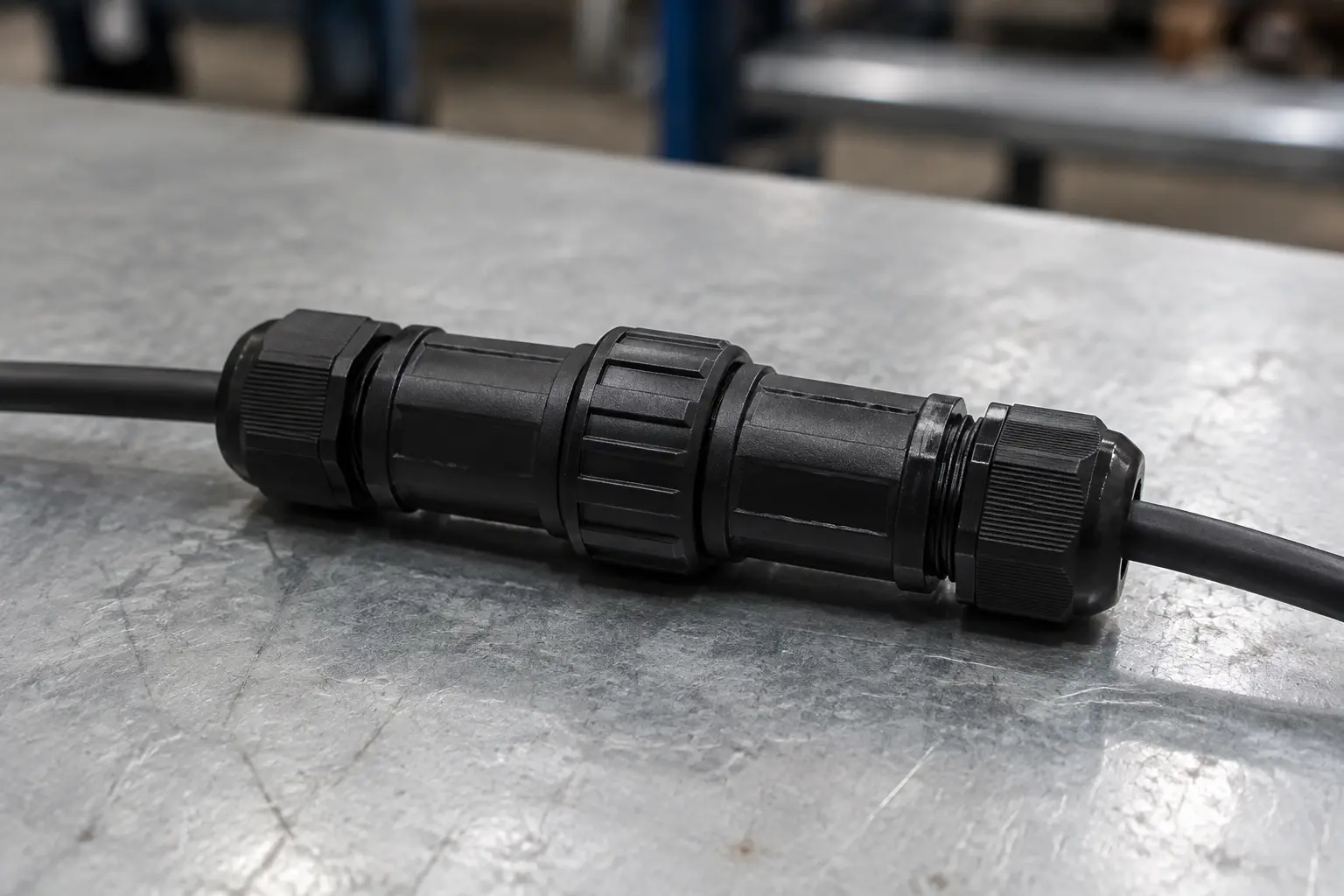
An IP rating is a test condition, not a magic property. For the M68x series, IP68 holds when the connector is correctly mated and the gland is compressed on a cable within its specified range. Inside a pole handhole, that means three practical rules for the installing crew: seat the contacts fully before closing, seat the gland on the cable instead of tightening by feel, and inspect the sealing ring when a connector is reopened after years of service. The same discipline applies to the IP68 waterproof junction box range used where a single feeder splits to multiple circuits inside one sealed enclosure. None of this is exotic. It is the difference between a connection that survives ten winters and one that fails in the first storm season.
Before loading, the batch went through the standard factory control flow documented on our Seite zur Qualitätskontrolle: incoming material verification, assembly and termination checks, and sample-level testing on the finished connectors. Certification files for the shipped models travel with the batch documentation, and the ETL listing values for the 300 V AC models are maintained per model; the current list lives on our Seite „Zertifikate“. If your project requires a specific model’s certification document before ordering, request it up front and we will send the file for review rather than assert a listing we cannot show.
Every container-scale street light waterproof connector program follows the same four steps, and this one was no different. The flow is worth describing because the checkpoints are where connector specs get fixed before they become field failures.
The confirmed facts of this case are the ones above: a 2025 container-scale delivery of the M68x IP68 series to a North American roadway lighting contractor, with the ETL 300 V AC models in the series matched to the 120 V, 208 V, and 277 V circuits common on U.S. roadway work. Field performance beyond those confirmed facts is not part of this page. We follow a simple rule: we publish project-specific figures only when project records back them up. Ask for the project summary pack under NDA and we will share what the records support.
Two compliance layers matter on a street light waterproof connector order. The first is the connector’s own ratings: the M68x series is rated IP68 as a mated assembly per the IP-Code classification, operates across -40 °C to +105 °C, and carries a 450 V AC system rating. The second is market listing for the U.S. and Canada: the M684 and M685 models carry ETL certification at 300 V AC, which covers the common street light supply voltages of 120 V, 208 V, and 277 V. Where a roadway specification also calls for surge protection on the luminaire circuit, the LED-Überspannungsschutzgerät range offers 277 V AC ETL/CQC and 320 V AC TUV/CE variants; selection there is model- and market-specific and is confirmed against the project requirement before quotation. For the difference between the two common ingress ratings, see Wasserdichte Steckverbinder nach IP67 vs. IP68.
Street and roadway lighting is the headline application, and the wiring points repeat across the category: the handhole connection at the pole base, the through-feeder join, the branch tap to the luminaire, and the short driver feed inside the head. The same connector family and the same selection logic carry over to related outdoor lighting jobs where the environment is similar: area and parking lighting, tunnel lighting, and landscape circuits where fixtures sit in water-prone locations. The choice of model still comes down to current, pin count, and cable diameter at each specific point.
If you are building a specification for roadway lighting connectors, send us the same three things that drive every quote for this kind of work: the wiring points and electrical load, the supply voltage and country of installation, and any standard or listing your spec names. We will return a matched list of models with ratings and certification notes, plus samples where the program size justifies them. For quantity programs we prepare a packaged quotation with unit pricing and lead times.
Three things: an ingress rating that holds where the part actually sits (a flooded pole handhole needs IP68, not splash resistance), a termination that does not depend on perfect installer torque in the field, and a current and voltage rating matched to the circuit, including market listings such as ETL at 300 V AC for U.S. 277 V systems.
Yes for the M684 and M685 models. They carry ETL certification at 300 V AC, which is above the 277 V phase-to-neutral voltage on 480Y/277 V roadway systems and also covers 120 V and 208 V circuits. Confirm the model and request its certification document before ordering; listings are model-specific.
Spring-clamp screwless terminals keep constant contact force without depending on installation torque, which suits gloved, hurried field crews and vibration-heavy locations. Screw terminals remain the familiar workflow for crews with a torque-controlled process. The M68x series offers both in the same family, which lets a contractor standardize spares while matching each crew’s practice.
M685 offers branch versions with one input and three or four outputs for daisy-chaining multiple fixtures, rated 32 A with ETL 18 A at 300 V AC. Where the wiring point needs a sealed enclosure rather than an inline connector, the M686 IP68 junction box family handles one feed to two or more outputs inside a single box.
IP68 means the part meets the stated immersion test conditions as a correctly mated assembly with the gland compressed on the specified cable range. Real service life depends on installation quality, cable choice, and whether the seal is disturbed later. Two field rules carry most of the risk: never tighten the gland on an undersized cable, and inspect the sealing ring if a connection is reopened after long service.
Yes. Container-scale mixed-configuration programs are standard: multiple pin counts and configurations produced against one BOM, one QC flow, and one set of batch documentation. For quantity programs, send the wiring points and voltages and we will prepare a packaged quotation with unit pricing and lead times via the quotation page.
We publish project-specific figures only when project records back them up. Ask for the project summary pack under NDA and we will share what the records support. For certification documents on specific models, contact [email protected].

LASSEN SIE UNS IHRE VERBINDUNGSLÖSUNG ENTWICKELN
Share your application, specifications, and estimated quantity. Our team will recommend a suitable connector solution and provide a quotation.
Geringe Mindestbestellmenge · OEM & ODM · Unterstützung bei der Produktauswahl · Schnelle Angebotserstellung