

Benötigen Sie wasserdichte Steckverbinder?Angebot anfordern →
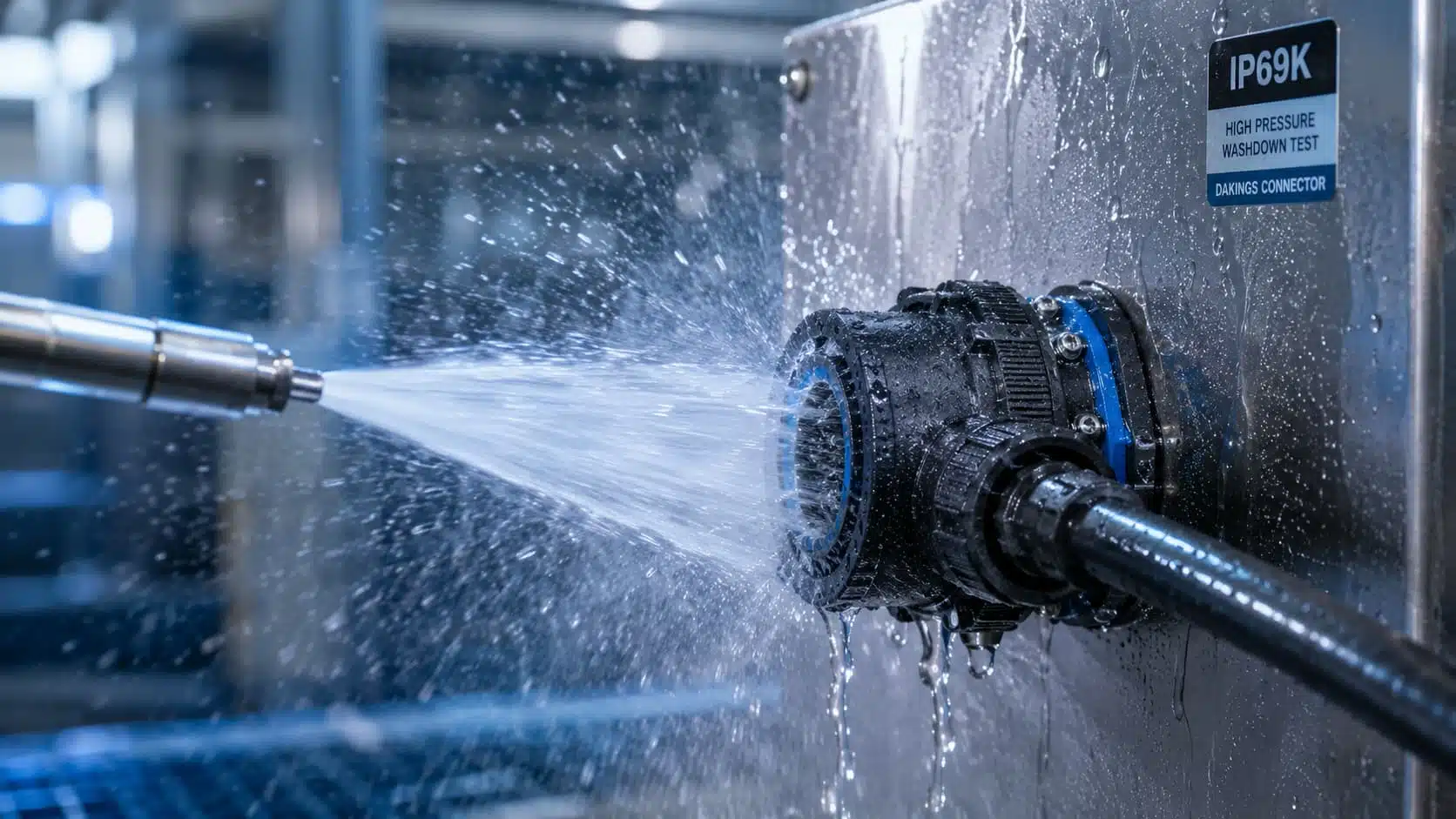
IP68 vs IP69K: Why IP68 Does Not Mean High-Pressure WashdownWhen You Need IP66, IP69, or IP69K
The IP68 vs IP69K comparison is a test-condition question: immersion and high-pressure jets are different exposures. IP68 addresses immersion under conditions the manufacturer declares, usually a depth and a duration. A jet test is a separate exercise: water at a defined pressure, temperature, distance, and angle, aimed at the product. Passing one does not prove the other. To select a connector for a washdown environment, match the rating to the real cleaning protocol, the installation state and the cable entry, and ask the supplier which exact test produced the rating.
This article compares IP68 vs IP69K in practical terms: what each test actually does, how the connector state changes the result, and which rating fits which cleaning environment. The goal is to help you specify a connector that survives the cleaning your equipment actually gets, and to give you the questions to ask before you buy.
Die IP code has two independent digits. The first digit covers solids, the second covers water. For water, the tests are not a simple ladder. IPX7 (temporary immersion) and IPX8 (continuous immersion) test whether an enclosure keeps water out while submerged. IPX5 and IPX6 test water jets. IPX9 and IPX9K test high-pressure, high-temperature jets. These are different tests for different hazards, and passing one does not imply passing another.
That is why an IP68 connector can fail a washdown. IP68 says the connector survived continuous immersion under agreed conditions, for example 1.5 m for 30 minutes or a deeper, longer condition the manufacturer specifies. It says nothing about a pressure washer held 150 mm away, at 80 °C, at 80 to 100 bar. Two suppliers can both quote you IP68, and unless you compare test conditions, you are comparing nothing. For a closer look at immersion ratings, see our comparison of Wasserdichte Steckverbinder nach IP67 vs. IP68.
The failure is not hypothetical. Cleaning teams routinely point hot, high-pressure lances at equipment that was rated only for rain or immersion. Gaskets soften at 80 °C, snap-fit latches pop open, and a seal that holds against static water pressure gets pushed aside by a directed jet. In food, beverage, dairy, pharmaceutical and car wash plants, the cleaning protocol is the specification, and the rating must be selected against it.
Part of the confusion is marketing. IP68 is an easy claim to sell: continuous immersion sounds stronger than anything else on the datasheet, and many buyers never look past the two digits. But the people who actually clean the equipment do. A dairy line gets hosed with 75 °C water at 80 bar every night. A car wash arch blasts cold water at short range all day. In those plants, an IP68 sensor in the spray path fails, not because the immersion rating was wrong, but because it was the wrong test for the hazard.
IP68 vs IP69K Test Differences: IP66, IP68, IP69 and IP69KTo answer the IP68 vs IP69K question properly, the table below summarizes the water tests behind each rating. All values are from IEC 60529 (including Amendment 2:2013, which introduced IPX9) and ISO 20653:2023, which replaced the 2013 edition and defines IPX9K.
| Bewertung | Standard and clause | What the test does | Key conditions |
|---|---|---|---|
| IP66 | IEC 60529, IPX6 | Powerful water jets from any direction | 12.5 mm nozzle, 100 L/min, 100 kPa (1 bar) at 3 m, at least 3 min |
| IP67 | IEC 60529, IPX7 | Temporary immersion | Top of enclosure 150 mm below surface, bottom at least 1 m, 30 min |
| IP68 | IEC 60529, IPX8 | Continuous immersion | Conditions agreed between manufacturer and user, typically deeper and/or longer than IP67 |
| IP69 | IEC 60529 AMD2:2013, IPX9 | High-pressure, high-temperature water jets | 80 °C water, 80 to 100 bar, 14 to 16 L/min, 100 to 150 mm, four angles, 30 s each |
| IP69K | ISO 20653:2023, IPX9K | High-pressure, high-temperature washdown | 80 °C water, 80 to 100 bar, 14 to 16 L/min, 100 to 150 mm from nozzle, rotating turntable, four angles, 30 s each |
IP69 and IP69K are often treated as the same rating, and the test conditions are close to identical: 80 °C water, 80 to 100 bar, 14 to 16 L/min, from 100 to 150 mm, at four angles. The difference is the standard behind the label. IP69 (IPX9) comes from IEC 60529 Amendment 2:2013, which applies to general enclosures. IP69K (IPX9K) comes from ISO 20653, written for road vehicle electrical equipment, and it is the convention in food and beverage plants. When a supplier quotes either rating, ask which standard and edition the test followed, and ask for the report that matches it.
The practical difference between IP66 und IP69K is the gap between 100 kPa und 8,000 to 10,000 kPa. That is 80 to 100 times more pressure, delivered 20 times closer to the surface, in water that is hot enough to soften seals and housings. IP66 is a strong hose from 3 m away. IP69K is a sanitation lance a hand’s length from the product, at four angles, on a rotating table.
Tested with a strong water hose at 3 meters away under ambient temperature.
Tested with hot water lance at 100–150 mm on a rotating turntable from 4 angles.
Higher pressure pushes water past seal interfaces that low-pressure spray cannot reach. A connector that passes IP66 may leak at IP69K because the jet deforms the seal lip.
80 °C changes material behavior. Nylon and PC housings soften, O-rings lose compression force, and internal air pressure can push moisture in. A rating tested at ambient temperature tells you nothing about hot water.
IP69K is tested at 100 to 150 mm. A few extra centimeters of standoff in your cleaning protocol reduces the effective load on the connector, but you cannot assume it.
IP66 is tested from any direction at distance. IP69K adds a rotating turntable and four fixed angles, which covers the seams that a single-direction jet can miss.
IP66 runs at least 3 minutes. IP69K runs 30 s at each of four angles, about 2 minutes total per cycle. In real plants, cleaning happens daily or several times per shift, so cycle count and cumulative exposure matter more than the single test.
One more point on the ratings themselves: passing IP69K does not automatically cover IP68, and passing IP68 does not cover the jet tests below it. The water tests are independent. A connector that passes the IPX9K washdown test has not been immersion-tested unless the supplier ran that test as well. If your application includes both washdown and standing water, state both exposures and ask for both reports.

An enclosure rating is tested on one object. A connector rating is tested on an assembly, and the result depends on the state of that assembly. This is where connector buyers get burned more often than enclosure buyers.
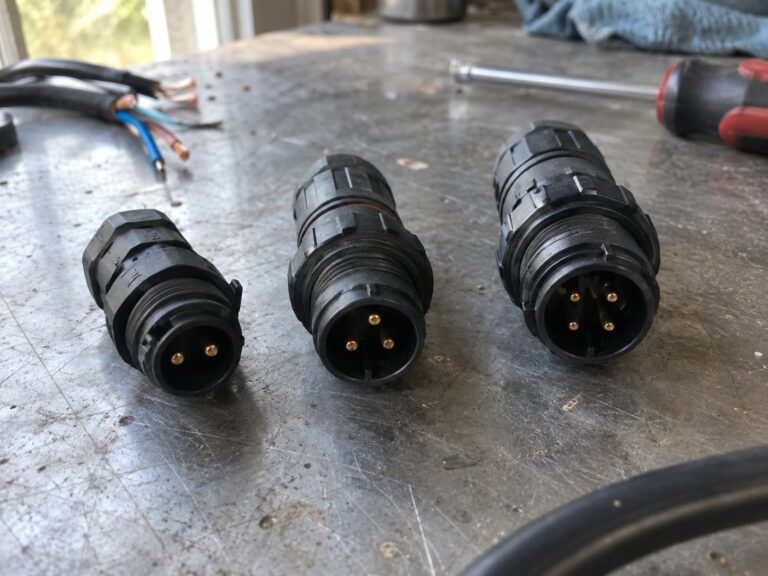
The seal design decides how a connector behaves under a hot jet. An O-ring compressed between two housings holds up well if the compression stays within its working range, but 80 °C water softens the housing and can reduce that compression. A screw-locked connector keeps the seal loaded even as materials soften; a snap-fit latch can pop open when the plastic loses stiffness. Epoxy-potted assemblies remove the air path entirely, which is why they appear in the harshest cleaning zones, but they also make field service harder. If you are choosing between a threaded and a snap-fit connector for a washdown area, the threaded option is usually the safer call.
Our standard practice at PVLinkTech is to quote an IP rating together with the assembly state it was tested in. If you are comparing quotes, ask every supplier for that statement in writing.
The IP68 vs IP69K choice depends on the actual exposure, not the largest number available.If your application sits in the first rows of the table, our IP67 and IP68 waterproof connector range covers the common outdoor cases.
| Anwendung | Exposure during service | Rating to specify | Anmerkungen |
|---|---|---|---|
| Solar PV and outdoor equipment | Rain, dust, occasional hose-down | IP66 covers jets, IP67 covers brief immersion. For rooftop PV, IP67 with rated cable assembly is common. | |
| LED lighting, signage, facades | Rain, occasional cleaning | Confirm the cable entry seal, not just the housing. | |
| Equipment submerged in water | Continuous immersion | The depth and time must be written into the datasheet or the order. | |
| Food, beverage, dairy, pharma washdown | Hot high-pressure cleaning, daily | Confirm the test state, the seal material, and the nozzle distance used in the test. | |
| Car wash and vehicle equipment | Cold high-pressure jets | Distance and pressure vary by bay; measure your own lance before specifying. | |
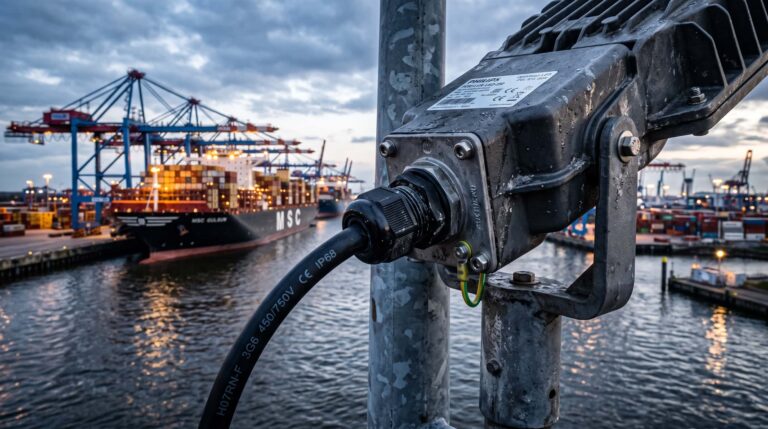
| Marine and dock equipment | Splash, waves, occasional immersion | Salt water is not covered by the standard tests; ask about material selection. |

The table is a starting point. Every plant has its own cleaning schedule, chemical use and nozzle distance, and those variables change the answer. Different zones of the same plant often need different ratings. The production line itself may be IP69K because it is hosed down; the control cabinet on the wall, cleaned less often and from farther away, may only need IP66. Walk the plant with the cleaning crew once and map the actual spray patterns before you write the specification. That map is worth more than any datasheet.
Send these with every inquiry for a washdown environment. They are also the fields our quote form asks for, so you can copy them directly.
Each of these answers changes the recommendation. A 60 °C wash at 20 bar from 500 mm is a different problem from an 80 °C wash at 100 bar from 150 mm, even though both are called pressure washing. The closer the nozzle and the hotter the water, the closer you get to IP69K territory.

A rating on a datasheet is a claim. Before you commit a washdown connector to production, verify it in four steps.
The datasheet line “IP68” means nothing without the test conditions. Ask for the test report or the clause reference.
The report must cover the complete assembly you intend to use: connector, cable and mating pair. A bare housing that passed the test does not certify your assembly.
The report should state the mated condition, the mounting method and the cable OD used during the test.
IEC 60529 with Amendment 2:2013, or ISO 20653:2023. Also note whether the test was third-party or self-declared; for critical applications, ask for a third-party report.
The IP68 vs IP69K decision should begin with the actual cleaning conditions, rather than simply choosing the highest IP number on the table.The fix is less dramatic but reliable: write down your cleaning conditions and send them with the inquiry. PVLinkTech engineers work with IP67, IP68 and IP69K sealing designs. Tell us your washdown parameters and the connector family you are considering, and we will confirm the rating and the test state for your assembly, then quote accordingly. Standard products are available from one piece for evaluation.
Send your wash pressure, water temperature, distance, duration and installation state to request a waterproof connector quote.

LASSEN SIE UNS IHRE VERBINDUNGSLÖSUNG ENTWICKELN
Share your application, specifications, and estimated quantity. Our team will recommend a suitable connector solution and provide a quotation.
Geringe Mindestbestellmenge · OEM & ODM · Unterstützung bei der Produktauswahl · Schnelle Angebotserstellung