

¿Necesitas conectores estancos?Solicitar un presupuesto →
A battery energy storage system depends on multiple connection layers working together—from battery modules and racks to cabinets, PCS equipment and control systems. Each layer has different current, voltage, safety and installation requirements, and the complete system is only as reliable as its weakest connection point.
High-current DC circuits must maintain stable contact performance, while control and monitoring connections need clear identification and organized routing. In battery racks and cabinets, limited space, heat generation and maintenance access also influence connector selection and cable assembly design.
This page explains the main connection layers in Battery Energy Storage Solutions, shows where high-current connectors, touch-safe interfaces and custom cable harnesses fit, and helps system integrators select a matched connection approach for battery modules, racks, cabinets and PCS systems.
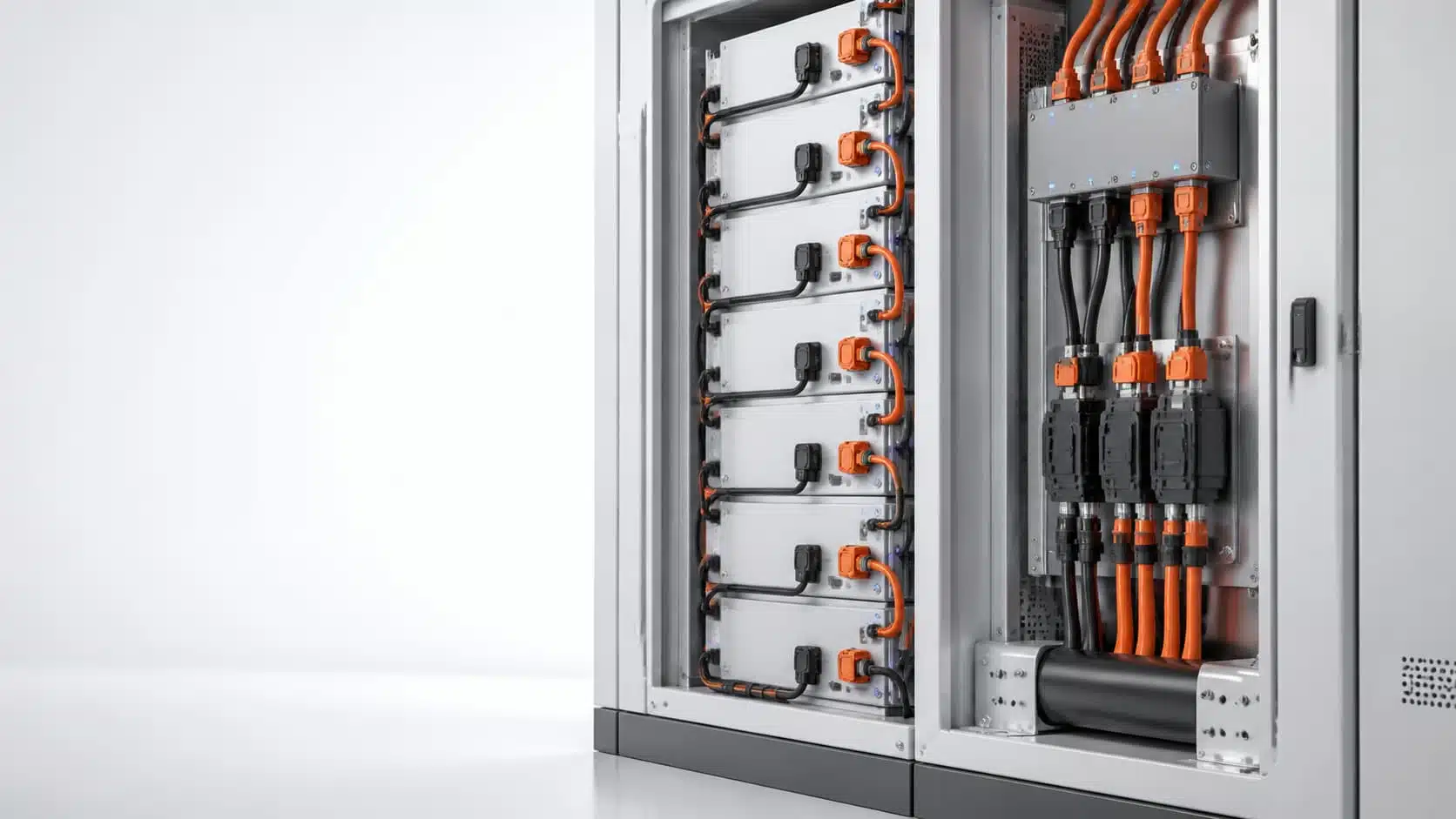
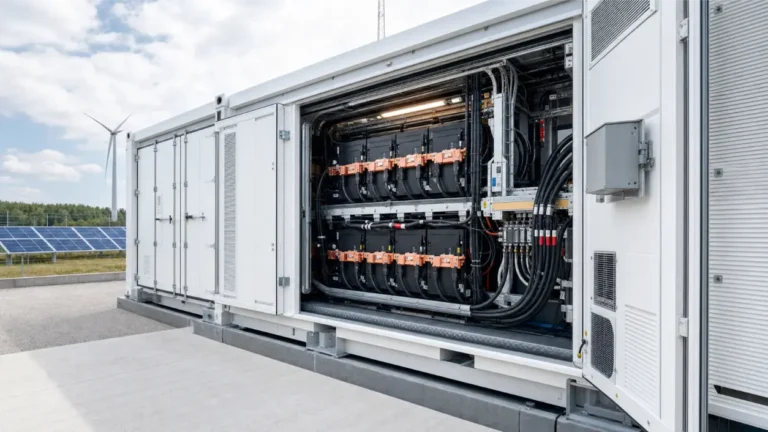
Battery Energy Storage Solutions depend on five connected layers: battery modules, battery racks, cabinet and busbar distribution, PCS interfaces, and BMS control and monitoring. Each layer has different current, voltage, safety and cable-routing requirements, but the complete BESS is only as reliable as the connection between them.
Battery modules are the starting point of the DC power path. Their connections must support stable contact performance within compact layouts, where cable length, conductor size and connector orientation can directly affect assembly efficiency and maintenance access.
Battery racks collect module-level connections into a larger power system. As current capacity increases, connector selection, cable routing and secure locking become more important for keeping each rack organized and serviceable.
Cabinet and busbar connections distribute power between racks, protection devices and other equipment inside the enclosure. This layer often has limited installation space, so matched high-current connectors and correctly configured cable assemblies help simplify installation and reduce unnecessary routing complexity.
PCS connections form the interface between stored battery energy and the power conversion system. These power and interface connections should match the electrical requirements and physical layout of the cabinet or container system, while allowing practical access for inspection and replacement.
BMS, control and monitoring connections carry the information needed to supervise battery status, temperature, alarms and system operation. Clear identification and custom signal cable assemblies help separate low-voltage control wiring from high-current power paths and make servicing more efficient.
These five layers are not independent. A poorly matched power connector, an unclear control harness or difficult cable routing can affect installation, maintenance and system availability. A complete Battery Energy Storage Solutions approach starts with the full connection path, then matches connectors and cable assemblies to each layer.
Creemos tu solución de conectividad
Indíquenos su aplicación, las especificaciones y la cantidad estimada. PVLinkTech le ayudará a seleccionar una solución de conectores práctica para aplicaciones de cableado impermeable, solar, de almacenamiento de energía, de señal, de conexión por presión o de ensamblaje de cables a medida.
Envíenos los requisitos de su producto, los detalles de la aplicación y la cantidad estimada. Nuestro equipo analizará su solicitud y le recomendará una solución de conectores adecuada.