

¿Necesitas conectores estancos?Solicitar un presupuesto →

PVLinkTech Technical Blog · Guide for Panel Builders, Electrical Contractors & OEM Buyers · Reviewed by the PVLinkTech Engineering Team
Waterproof connector pin count comes from the circuit you are wiring, not from what looks tidy on a drawing. A single circuit pair needs two pins, for example the DC positive and negative of a PV string. Add a protective earth and you are at three, which is where most Class I lighting and pump circuits land. A second circuit, or three phases with a neutral, pushes the count to four. What the count cannot tell you is how much current those contacts will carry. That depends on the series, and on site the two decisions get made together.
[Image 1, real photo required: three waterproof connectors laid side by side on a workshop bench, 2-pin, 3-pin and 4-pin, photographed from above at a hand-held angle]Alt: 2 pin vs 3 pin vs 4 pin waterproof connectors side by side, showing how waterproof connector pin count changes the housing
Five questions settle the waterproof connector pin count in practice, and the order matters.
Count the conductors that have to stay isolated from each other. One circuit pair takes two pins, and a second circuit takes two more unless both circuits can share a neutral.
Next, decide whether the load needs a protective earth. Fixed Class I equipment does, and that one requirement turns more two-pin jobs into three-pin orders than anything else on this list.
Most of the surprises come from the current rating. Our 17.5 A M682 and M683 stop at three pins, the 24 A M684 runs from two to six, and the 32 A M685 from two to five.
If a supply and a control pair have to travel in the same shell, that decides the count as well. A five or six pin M684 can spare contacts for a control pair, but those signal positions carry far less current than the power positions.
Last, think about whether anyone will open the joint again on site. A spare position is only worth paying for if the housing has a sealed entry for it.
Ordering by the wrong word is one of the easiest mistakes to make, because a connector sold as 3-pin is often one circuit pair plus earth, which an electrician would call 2-pole with earth. Ask for a three-pole connector without saying more and you may receive three switched conductors with no earth. A waterproof connector pin count written without the pin assignment does not tell you what the connector can do.
| Término | Where you meet it | What it counts |
|---|---|---|
| Pin, contact | US and Asian catalogs, electronics | Individual conductive elements in the connector |
| Pole | IEC style drawings, switchgear | Conductors switched or protected together |
| Way | UK trade counters, terminal blocks | Positions in a block |
| Core | Cable datasheets | Insulated conductors inside the cable |
| Position, cavity | Connector drawings | Numbered slot inside the housing |
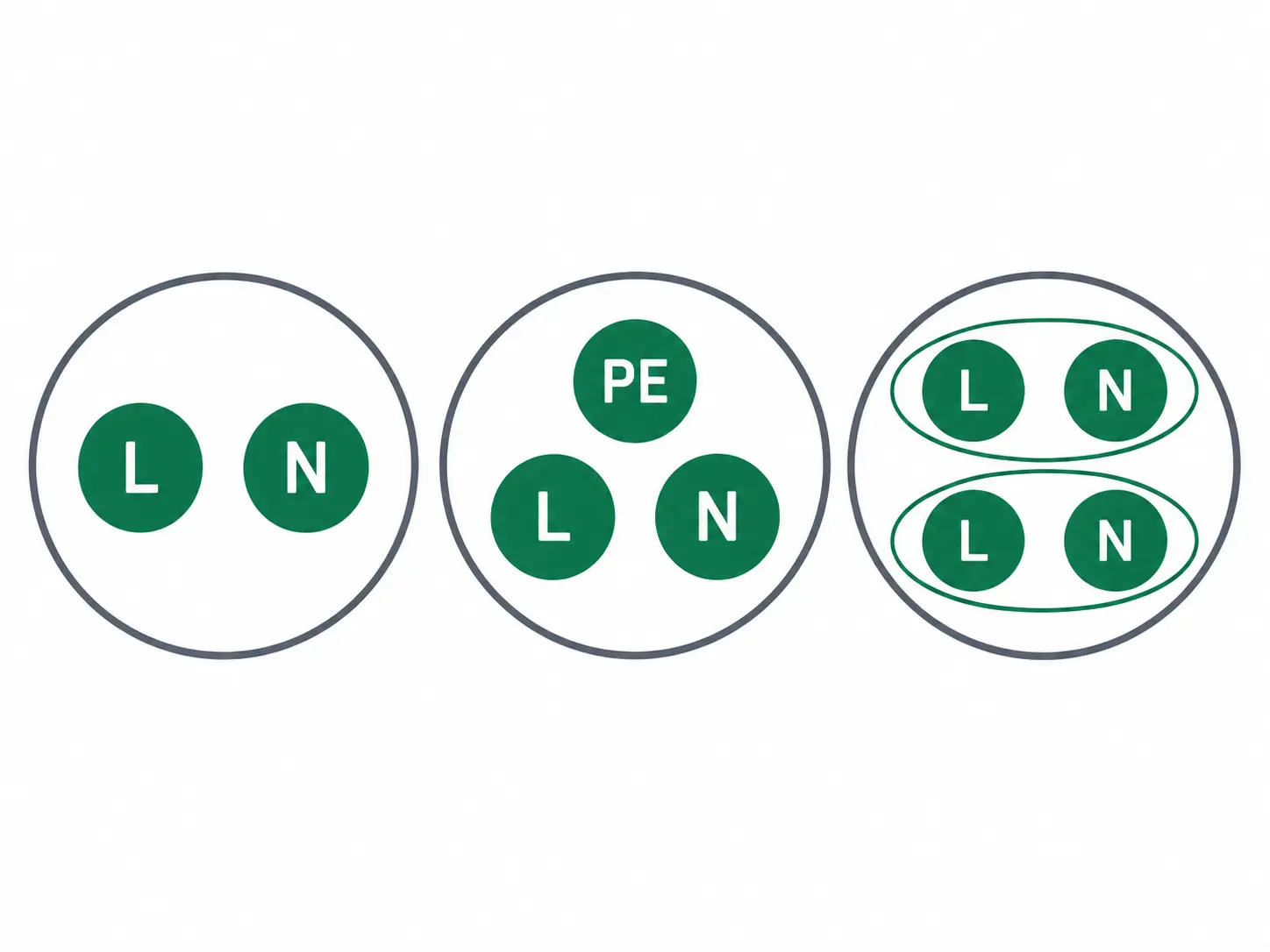
[Image 2, design in Canva or PowerPoint, do NOT AI-generate: pin assignment graphic for 2-pin L and N, 3-pin L N PE, and 4-pin two circuits]Alt: Wiring assignment for a 2 pin, 3 pin and 4 pin waterproof connector, showing which conductor lands on each pin
Every isolated conductor pair needs its own contact pair. A single-phase luminaire with no earth is a two-pin job, and the same luminaire in Class I construction is three pins. Two independent 230 V feeds sharing one neutral are three pins; two that must never share a neutral are four. Drawing the circuit first settles the waterproof connector pin count before the layout goes out for review.
A Class I equipment design relies on a protective earth conductor, so the earth takes up one contact whether or not any current flows through it. This is the most frequent reason buyers step from two pins to three, and it is a safety requirement rather than a preference. Class II equipment is double insulated and usually suits a two-pin connector. Where a fixture sits on a metal pole or frame in a wet location, treat the earth as mandatory.
The rating belongs to the series, not to the pin count. Inside one series it holds as pins are added: every M684 model, from the two pin versions up to the six pin M684-C, is rated 24 A at 450 V AC under IEC, and every M685 version from two to five pins is rated 32 A. What changes with the series is how many poles are available and what conductor size the terminal accepts. The 17.5 A M682 and M683 take 0.5 to 1.5 mm2 and stop at three pins; the 24 A M684 takes 0.5 to 2.5 mm2 and reaches six; the 32 A M685 reaches five.
Industrial installations often need a supply and a control pair in the same connector, which is where four, five and six pin housings sit. A six pin M684 carries three circuit pairs in one sealed shell, provided the circuits are allowed to share a housing. Signal positions carry far less current than the power positions, and that is the part buyers tend to miss.
The count also works as a mechanical key. A two-pin plug will not enter a three-pin socket, and a four-pin plug will not enter a two-pin housing, because the shells are moulded differently. Sites that standardise the waterproof connector pin count across their fixtures end up with fewer wrong pairings. Where connectors of the same count sit close together, colour coding or labelled cable ends do the rest of the work.
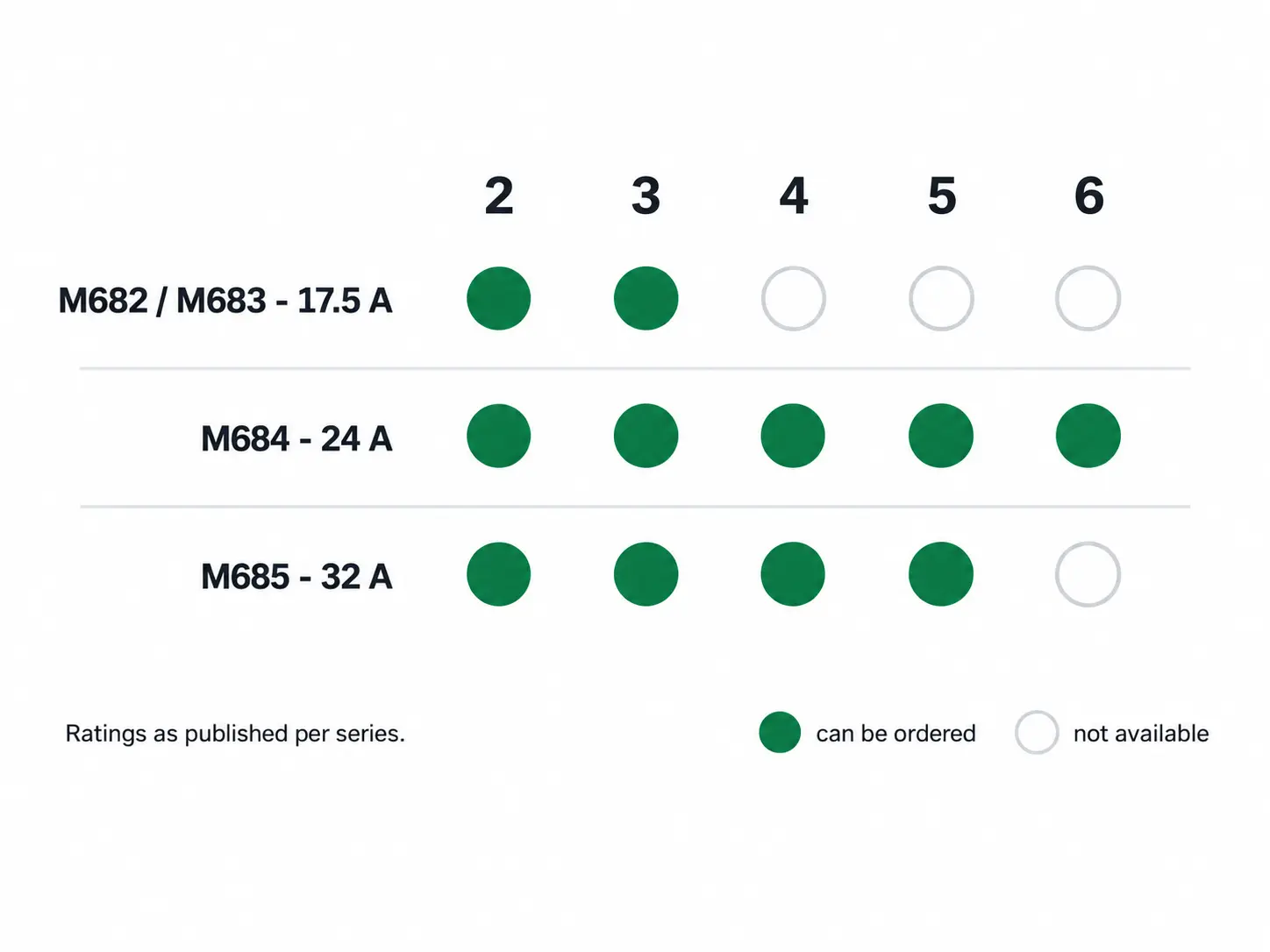
[Image 3, design in Canva or PowerPoint, do NOT AI-generate: chart of available pin counts per series, M682 and M683 at 17.5 A covering 2 to 3 pins, M684 at 24 A covering 2 to 6 pins, M685 at 32 A covering 2 to 5 pins]Alt: Available pin counts per waterproof connector series at 17.5 A, 24 A and 32 A
Our IP68 range covers three current classes, and the waterproof connector pin count on offer in each one is listed below.
| Serie | Rescisión | Pin counts | Corriente nominal | Gama de conductores | Diámetro exterior del cable |
|---|---|---|---|---|---|
| M682-A/B/C | Screw terminals | 2, 3 | 17.5 A, 450 V AC | 0.5-1.5 mm2 | 3-6.5 / 5-9 mm |
| M683-A/B | Screw terminals | 2, 3 | 17.5 A, 450 V AC | 0.5-1.5 mm2 | 5-10 / 4-8 / 7-12 mm |
| M684 series, A to Y | Screw terminals, T and X also screwless | 2, 3 on most models; 4 on A and X; 5 on B; 6 on C | 24 A, 450 V AC (ETL 10 A, 300 V AC) | 0.5-2.5 mm2 | 4-8 / 7-12 mm |
| M685-AL to E | Screw terminals | 2, 3, 4, 5 | 32 A, 450 V AC (ETL 18 A, 300 V AC) | 0.5-2.5 mm2 | 4-8 / 8-12 / 10-14 mm |
| M684-T / M684-X | Spring clamp push-in (screwless) option | 2, 3 (T) and 4 (X) | 24 A, 450 V AC | 0.5-2.5 mm2 | 4-8 / 7-12 mm |
The waterproof connector pin count makes more sense read by series than read left to right. The 17.5 A models stop at three pins, the 24 A models reach six, and the 32 A models reach five. Adding pins inside one series does not lower the rating, so a six pin M684-C carries the same 24 A as the two pin version. What does not exist is a six pin 32 A connector. When that request arrives, the answer is usually a five pin M685 feeding a junction box.
Conductor size follows the series too. The 17.5 A M682 and M683 take 0.5 to 1.5 mm2, while the 24 A and 32 A families both take 0.5 to 2.5 mm2 whatever the pin count. Cable outside diameter runs from 3 mm to 14 mm depending on the model and which waterproof ring is fitted.
[Image 4, real photo required: installer terminating a 3-pin M682 or M684-T waterproof connector inside a street light pole handhole]Alt: Terminating a 3-pin waterproof connector in a street light pole handhole with L, N and PE
| Solicitud | Usual pin count | Series to start from | ¿Por qué? | What to check |
|---|---|---|---|---|
| PV string, DC | 2 | PV4 solar connector range | Positive and negative only, no earth on the string side | Voltage rating for 1500 V DC systems |
| LED street light, Class I | 3 | M682, M683, M684-T | L, N and protective earth | Earth continuity through every joint |
| Single-phase pump or motor | 3 | M685 (32 A class) | L, N and earth | Inrush current against the rating |
| Three-phase load | 4 or 5 | M684 (4 pin), M685 (4 or 5 pin) | Three phases plus earth, plus neutral if required | Keying between the 4 and 5 pin versions |
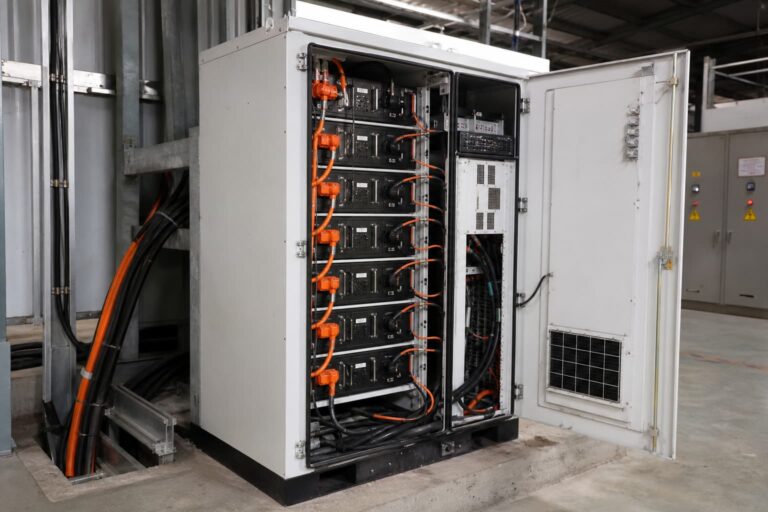
| Battery or BESS rack connection | 2 | Gama de conectores para el almacenamiento de energía | High current DC pairs | Current per pin and cable size |
| Indoor and outdoor fixtures close together | Colour coded 2 and 3 pin | M682, M683 | Physical keying difference | Standardise on two counts across the site |
| One run feeding several fixtures | 2-pin pairs plus an IP68 junction box | M686 junction box series | Splitting at a box avoids running a heavy multi-pin cable | Sealing of the box, not the connector count |
One row is worth reading twice. Buyers who need to feed several fixtures often reach for a high pin count connector first, then find that a six pin cable is stiff enough to fight them inside a pole handhole, and that the extra contacts cost money nobody uses. Four fittings off one run are usually easier to wire as 2-pin pairs meeting at a junction box. Three-phase work is the other case worth watching: four pins, or five where three-phase power is distributed with a neutral.
A short checklist keeps the waterproof connector pin count order clean:
Circuit list, with each conductor named (L, N, PE, signal, DC+ and DC-). Voltage and current per conductor, not a single system figure. Conductor size per position, including the largest cable you will ever fit. Equipment class, so the earth question is answered early. Termination preference: screw terminals, spring clamp push-in, or crimp. Ambient temperature and the IP rating you need at the joint. Mating cycles expected over the life of the installation. Certification the project requires.
If the wiring method matters more than the waterproof connector pin count, read the difference between a conector hermético de rosca and a conector impermeable sin tornillos first, because on site the two get decided together. We build both, including the M684-T in 2 and 3 pin and the M684-X in 4 pin, where the same housing is available in either style. A side by side comparison of the methods sits in Conectores estancos sin tornillos frente a conectores estancos con tornillos.
Three-pin screw connectors do most of the outdoor lighting work, and four-pin versions turn up when a second circuit or a signal pair shares the housing. Every series here is IP68, tested at 2 M for 120 hours, and rated from -40°C to +105°C. On a joint that sits in a wet location, that seal matters more than the count. The Código IP entry is the reference for what the two digits promise.
Quick answers to common questions about waterproof connector pin counts, circuit selection, power, signal, and typical applications.
It works as long as the housing is rated for the voltage and current, and the spare contacts stay sealed and unassigned. Some sites do this on purpose so one connector type covers everything on the job.
Going the other way does not work, since a 2-pin housing cannot carry two circuits.
No. Waterproof connector pin count determines how many circuits can be carried, not the total current rating.
Current capacity depends on the connector series and its electrical design. For example, the M684 series is rated up to 24 A. When you order two pins or six pins, the current rating does not automatically increase with the pin count.
Not always. The terms can sometimes be used interchangeably, but the wiring arrangement matters.
In our range, a 3-pin M684-T can be used as one circuit pair plus a protective earth. A 3-pole connector from another supplier may instead be designed for three switched conductors with no earth connection.
Always confirm the wiring function before ordering.
Usually not. A DC solar string normally carries positive and negative conductors, so a 2-pin connector is commonly sufficient.
The equipment enclosure or metal frame is typically grounded separately rather than through the string connector.
Yes, when the connector housing has enough poles and the circuit design allows it.
A six-pin M684 can use three contacts for power and three for signal, provided that the circuits remain within the connector’s voltage, current, insulation, and application limits.
Keep in mind that signal contacts are still physically larger than the contacts used in many compact data connectors.
Six pins is the practical ceiling in this range, and the M684-C is the model that reaches it.
The M685 series adds split variants such as 1-in / 2-out and 1-in / 4-out. For applications that require more branch points, a sealed junction solution may be more practical.
Ver cajas de conexiones estancas IP68Waterproof connector pin count follows the circuit, so draw the circuit first and then check what the series can carry. A DC pair or a single unearthed feed needs two pins. An earth conductor makes it three, and the M682, M683 and M684-T all cover that case. Four pins appear when a second circuit or three phases share the shell. Past that, split the run at a junction box instead of buying a very wide connector.
Send us your circuit list with the current and conductor size for each position, and we will confirm the housing, the pin assignment, and the termination style that fits.
Request a waterproof connector quote

CREEMOS JUNTOS TU SOLUCIÓN DE CONEXIÓN
Share your application, specifications, and estimated quantity. Our team will recommend a suitable connector solution and provide a quotation.
Pedidos mínimos reducidos · OEM y ODM · Asistencia en la selección de productos · Respuesta rápida a las solicitudes de presupuesto