

Benötigen Sie wasserdichte Steckverbinder?Angebot anfordern →
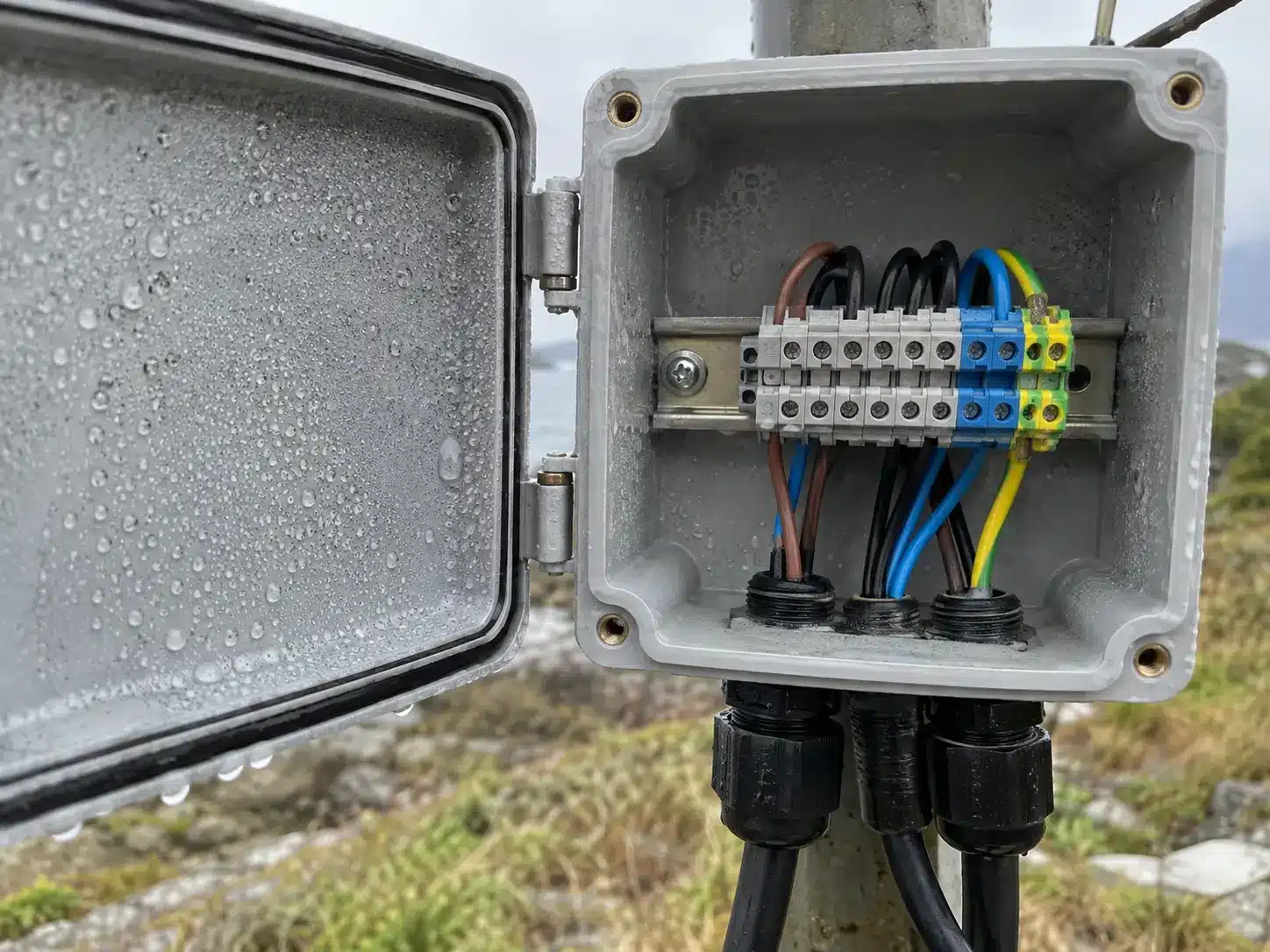
Junction box condensation is water that comes out of the air sealed inside the enclosure. Nothing has to pass through a gasket for the box to end up wet. Afternoon heat expands the trapped air, night cooling contracts it, and each cycle pulls humid air back in through cable entries and gasket faces. Droplets land on the lid, the terminal screws, and the gland threads, and by the time someone opens the cover, junction box condensation looks exactly like a leak. Seven measures keep an outdoor box dry, and one habit common in some regions removes the ingress protection you paid for.
| Artikel | Value or rule |
|---|---|
| Main water source | Temperature cycling of the air inside the box, not water through the seal |
| Assemblies, IEC 61439-1 | Indoor assemblies assumed at 50% RH at +40°C; outdoor assemblies up to 100% at +25°C, with occasional moderate condensation |
| Cable junction boxes, DIN EN IEC 60670-1 clause 12.2 | Enclosures rated IPX1 to IPX6 must allow a 5 mm drain hole; IPX8 housings sit outside that clause |
| Boxes in damp or wet locations, NEC 314.15(C) | Field drainage openings of 3 mm to 6 mm (1/8 in to 1/4 in) are permitted, and only in listed boxes |
| IP68, IEC 60529 | Dust-tight plus continuous immersion; the M686 range is tested at 2 m for 120 hours |
| M686 ratings | 2-way to 6-way, 24 A at 450 V AC, 0.5-2.5 mm², -40°C to +105°C, ENEC, CE, ETL, UKCA, CB |
| Term you may see | What it means here |
|---|---|
| Sweating | Condensation on the inside surfaces, with nothing leaking |
| Breathing, pumping effect | Air leaving and re-entering through seals as the temperature changes |
| Breather vent, climate gland | A rated membrane that passes air and blocks water, sometimes built into a cable gland |
| Desiccant, silica gel | An absorbent sachet that stops working once saturated |
| Potting, gel fill | Filling the cavity so no air is left to condense |
| Weep hole, drain plug | An opening that drains water and breaks the IP rating on a sealed box |
Warm air holds more water vapor than cold air, and a closed enclosure gives the moisture behind junction box condensation nowhere to go. Sun on the lid raises the internal temperature above the ambient swing, and when it falls again the vapor condenses on the coldest surfaces first: the lid, the back wall and the metal parts.
The pressure side of the same cycle does the rest. Sealed enclosures are not gas-tight in the sense that matters here: internal pressure rises during the day and a little air escapes past gaskets and entries, then at night the box runs at a slight negative pressure and draws outside air back in. Over a season, that repeated pull is how moisture reaches the inside of a box whose cover was never opened.
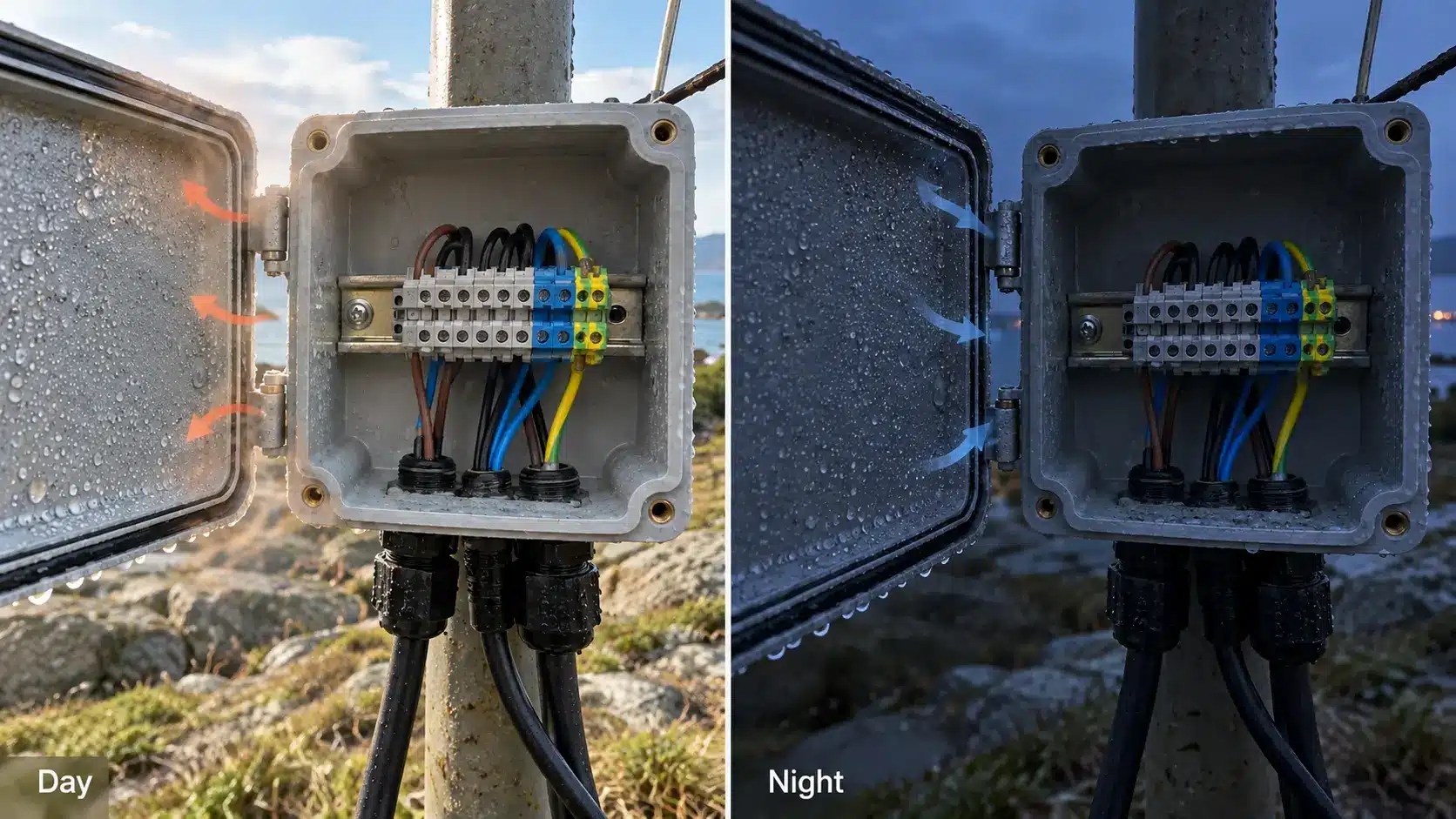
Some of the moisture is inside before the box is closed. A cover shut in the rain, a cable pulled from a wet drum, a gland tightened with a wet hand: all three leave vapor in a volume that will later be warm. Stranded conductors carry water along the core, so a wet cut end matters even when the entry is sealed.
Enclosure standards assume this happens. IEC 61439-1 assumes 50% relative humidity indoors and up to 100% outdoors, with occasional moderate condensation written into the normal service conditions. A box sealed to a high IP rating has fewer chances to shed moisture. Enclosure makers publish the same background in their own notes on condensation in closed housings.
An IP rating is a two-digit classification under IEC 60529: the first digit covers solids and contact, the second covers water. IP68 adds dust-tightness to protection against continuous immersion, with the depth and duration set by the manufacturer. PVLinkTech tests the M686 junction box range at 2 m for 120 hours.
The test happens from the outside. Nothing in the rating describes junction box condensation forming inside a housing, and neither digit promises that the interior stays dry. The comparison worth reading is between IP67 und IP68, which sets out what each immersion condition asks of a product.
Most wet outdoor boxes are diagnosed by whichever explanation the technician already believed. The evidence usually separates the two causes without equipment: dry the inside, close the cover as it was installed, and look again after the next cold night.
| What you find | Most likely cause | What to do next |
|---|---|---|
| Fine droplets across the lid and inner walls, dry underneath | Condensation | Review entries, assembly conditions and pressure equalization |
| Water standing at the lowest point, one cable wet inside its gland | Water entering or traveling in along that cable | Re-terminate, re-seal the entry, add a drip loop |
| Tide marks or rust on one side of the gasket only | Gasket or sealing face failure | Replace the gasket or gland, re-torque evenly |
| Terminals damp in the morning, dry by noon | Condensation evaporating as the box warms | Clean and protect the terminals, remove the moisture source |
| Droplets only after clear cold nights | Condensation cycle | Repeat the check on the next cold night |
Replace the enclosure only after the cause is known. A new box installed the same way collects the same water, because junction box condensation follows the installation rather than the product.
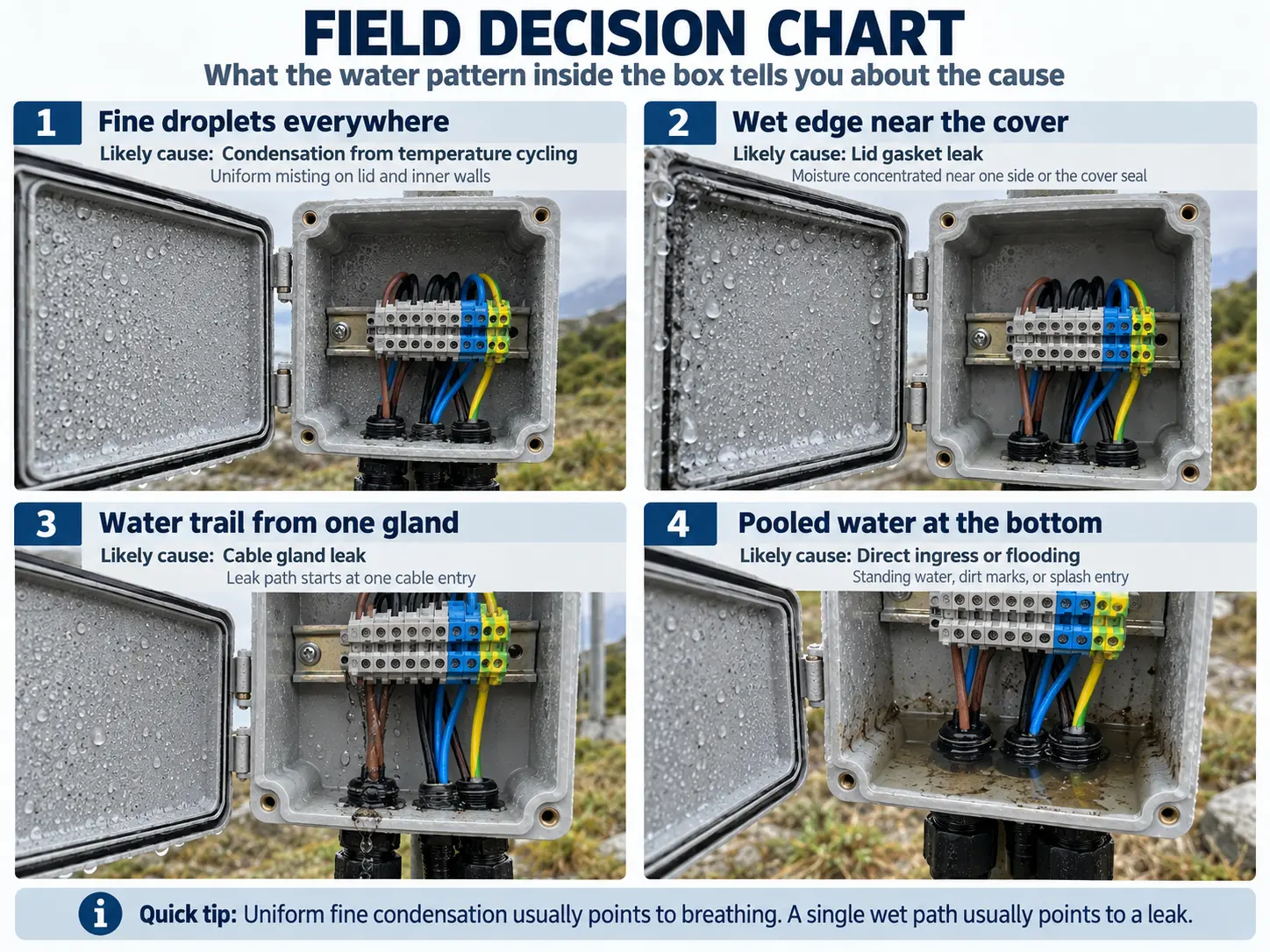
Field decision chart: what the water pattern inside the box tells you about the cause.Alt: Field decision chart for telling junction box condensation apart from a water leak
Cheapest first. The last item on the list is a habit rather than a purchase.
The moisture that starts junction box condensation is usually in the air when the cover closes. Work indoors or under cover, let wet cable ends dry, and avoid finishing a termination in the rain. A desiccant sachet added now does more work than the same sachet added a year later.
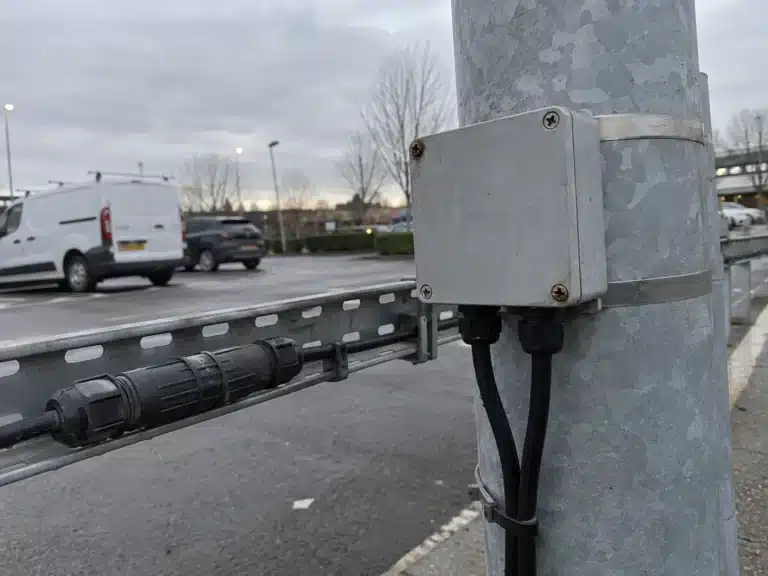
Entries are where junction box condensation is won or lost, and each one has to be closed at the right size. Match the gland to the jacket outside diameter, tighten to the stated torque instead of by feel, and plug every entry the layout does not use. Point entries downward and leave a drip loop so water running down the cable falls clear. Installations that get rewired often are better served by schraubenlose, wasserdichte Steckverbinder at the branch point, since every re-termination disturbs a seal.
In a sealed enclosure, pressure equalization is the standard answer to junction box condensation. A breathable element with a microporous membrane lets air move in and out as the temperature changes while blocking liquid water, which removes the negative pressure that pulls humid air past the seals. Two details decide whether it helps: the element has to be rated for the enclosure’s IP level, and the membrane has to stay clean, since paint, dust and oil turn the vent into a sealed plug.
Desiccant works only where somebody will service it. Capacity is finite, and a spent sachet does nothing. On a pole or in a pit nobody visits, junction box condensation keeps coming after the sachet is used up.
Potting removes the air instead of managing it. Fill the cavity with gel or resin and there is nothing left to condense, which is why the method survives in splice enclosures. The cost is access: a potted box cannot be inspected, re-terminated or extended, and heat has to leave through the housing.
Where the enclosure is large and the daily swing is wide, a low wattage heater controlled by a thermostat or hygrostat keeps the internal air a few degrees above the dew point, so moisture stays as vapor. It needs a supply, and it needs a control device somebody has to set correctly.
The position of the box decides how much junction box condensation an installation will see. A box in a low spot that holds water, in full sun, or in the spray line of a sprinkler runs wetter than the same box under a canopy. Metal housings shed heat faster than plastic and reach the dew point sooner.
The four practical answers differ in what they do to the rating and to future access. Decide on those two columns before price.
| Verfahren | Effect on the IP rating | Serviceable afterwards | Wartung | Fits best |
|---|---|---|---|---|
| Breathable pressure equalization element | Keeps the rating when the element matches it | Ja | Inspect the membrane for paint, dust and oil | Sealed outdoor boxes with a low heat load |
| Drainage opening in the box | Breaks the rating unless the box was designed with one | Ja | Keep the opening clear of debris | Enclosures designed for it under the cable junction box standard, IPX1 to IPX6 |
| Potting or gel fill | Keeps the rating | Nein | Keine | Joints that will never be reopened |
| Anti-condensation heater | Keeps the rating | Ja | Verify the thermostat or hygrostat setting | Larger enclosures with a wide daily temperature swing |
Most junction box condensation that reaches a terminal arrives through a detail rather than a failed product. An oversized gland compresses unevenly and starts leaking within months, so check the gland against the jacket outside diameter before you tighten it. Bring cover screws down in a cross pattern so the gasket compresses evenly. Replace a gasket that has gone hard. Deburr any hole drilled on site, and treat an unused entry as a live risk until it is plugged.
[Image 4, real photo required: a technician closing a box lid with the cable entering from below through a correctly sized gland and a drip loop hanging clear of the entry, tools on the ground, natural daylight]Alt: Correct cable entry orientation and drip loop on an outdoor junction box after sealing
Where a layout keeps growing, the choice between a box and a connector changes the moisture exposure. A waterproof junction box or a connector takes a different amount of air into the system, and more joints along a run mean more places where one weak seal matters.
One safety line applies to everything above: isolate the circuit and verify that it is dead before opening any enclosure.
A large cavity holds more air, and more air means more vapor. How much junction box condensation an installation has to manage starts with the enclosure design. Each additional way is another entry that has to stay sealed, which is why unused entries add risk without adding function. An integrally molded gasket that survives repeated opening keeps the rating across maintenance. A potted box trades that access away.
| M686 junction box range | Spezifikation |
|---|---|
| Möglichkeiten | 2-way (1 in / 1 out) through 6-way (1 in / 5 out); 8-way, 10-way and 14-way models also exist |
| Rated current (IEC) | 24 A at 450 V AC |
| ETL-Bewertung | 10–15 A bei 300 V Wechselstrom |
| Conductors | 0.5-2.5 mm² (12-14 AWG) |
| Cable gland outside diameter | 3-6 / 4-8 / 8-12 / 10-14 mm |
| Betriebstemperatur | -40 °C bis +105 °C |
| Schutz | IP68, tested at 2 m for 120 hours |
| Zertifizierungen | ENEC, CE, ETL, UKCA, CB; RoHS |
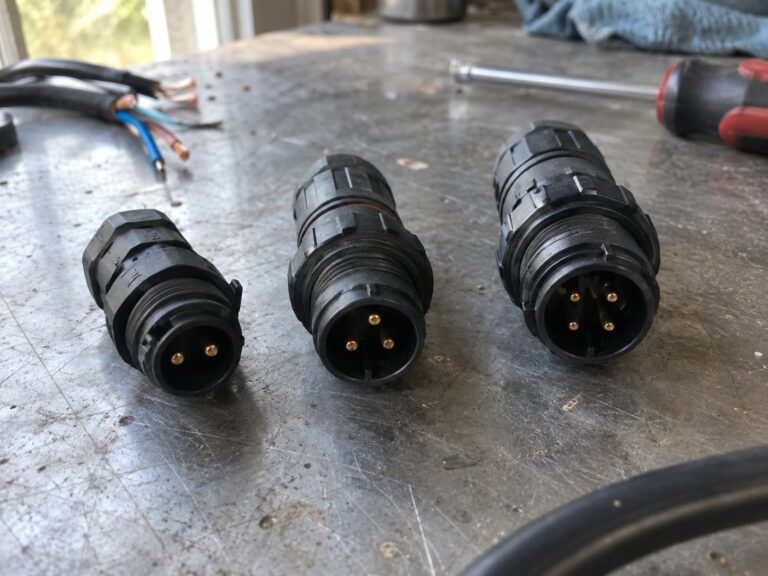
Die M686 IP68 wasserdichte Anschlussdose range is built as a sealed box that can be opened: an integrally molded gasket holds the rating without potting, so a joint can be inspected and re-terminated. Where a project mixes buried runs, pole entries and cabinet feeds, the Wasserdichte Anschlusslösungen für den Außenbereich overview shows how the ranges are put together.
The expensive mistakes are rarely about the wrong accessory. Treating an IP68 rating as a guarantee against junction box condensation is the first one, and it leads straight to replacing boxes that were never the problem. Drilling a drainage hole in a sealed housing is the second: the water leaves, and so does the protection you specified. Keeping desiccant as the only measure on an unvisited site fails quietly over one season.
Two more are common in the field. Unsealed entries and glands left loose are the most common route for junction box condensation to reach a joint that was terminated correctly. Position costs nothing to change: a box moved out of standing water and out of the afternoon sun carries less moisture. Where salt air or chemical exposure is also present, the priority order shifts, and the coastal and salt-spray selection notes cover the cases where corrosion sets the specification.
Because the box is sealed, not dry. Moisture enters as vapor with the air during assembly and through small pressure-driven exchanges at seals and entries, then condenses on cold internal surfaces when the temperature drops. The seal did its job: it kept liquid water out and kept the trapped vapor in.
No. IP68 describes protection against dust and continuous immersion from outside, tested under the conditions the manufacturer specifies. Internal condensation is not part of that test, and a tightly sealed housing can hold moisture longer than a ventilated one. Junction box condensation needs its own measures.
Only if the box was designed with one, or where the code allows it on a listed box. Clause 12.2 of DIN EN IEC 60670-1 requires enclosures rated IPX1 to IPX6 to allow a 5 mm drain hole, and NEC 314.15(C) permits an approved field opening of 3 mm to 6 mm in listed damp or wet location boxes, per NEMA guidance. Neither applies to a sealed IP68 housing, where drilling removes the rating. Use pressure equalization instead.
They preserve it when the element is rated to the same level as the enclosure and installed with the correct torque. A rated breathable element lets air pass while blocking liquid water, so the enclosure still meets its immersion condition, and it is the standard fix for junction box condensation.
Rarely on its own. Desiccant has a fixed capacity, saturates with use, and has to be replaced, which suits a cabinet with a service routine. On a pole, in a pit, or on a structure that is inspected once a year, sealing, pressure equalization, and correct cable entries do more against junction box condensation for the same effort.
Dry the interior, close the cover exactly as installed, and inspect after a cold night. Even droplets on the upper surfaces and dry walls below point to junction box condensation. Water pooled at the lowest point or a wet cable core inside its gland points to an entry fault. Fix the cause, not the box.
Send the mounting position, the number of ways, the cable outside diameters, and the temperature range the installation sees. We will confirm the M686 configuration and the gland sizes that match your cable, and quote the box and accessories together.

LASSEN SIE UNS IHRE VERBINDUNGSLÖSUNG ENTWICKELN
Teilen Sie uns Ihre Anwendung, die technischen Anforderungen und die voraussichtliche Stückzahl mit. Unser Team wird Ihnen eine passende Steckverbinderlösung empfehlen und Ihnen ein Angebot unterbreiten.
Geringe Mindestbestellmenge · OEM & ODM · Unterstützung bei der Produktauswahl · Schnelle Angebotserstellung