

Need waterproof connectors?Request a Quote →
Battery storage connection solutions carry the full DC current through every joint in a battery energy storage system, from cells to packs, racks, cabinets and the inverter. If one joint is mismatched, the first symptom is heat or voltage drop, and the last is a string that fails years before the cells around it. PVLinkTech engineers the complete DC path for residential ESS, commercial storage and utility-scale battery projects with the CN series, from CN06 module links at 70 A to CN14 container junctions at 500 A, all rated 1500 V DC. Every connector carries UL 1977 and UL 4128 certification.
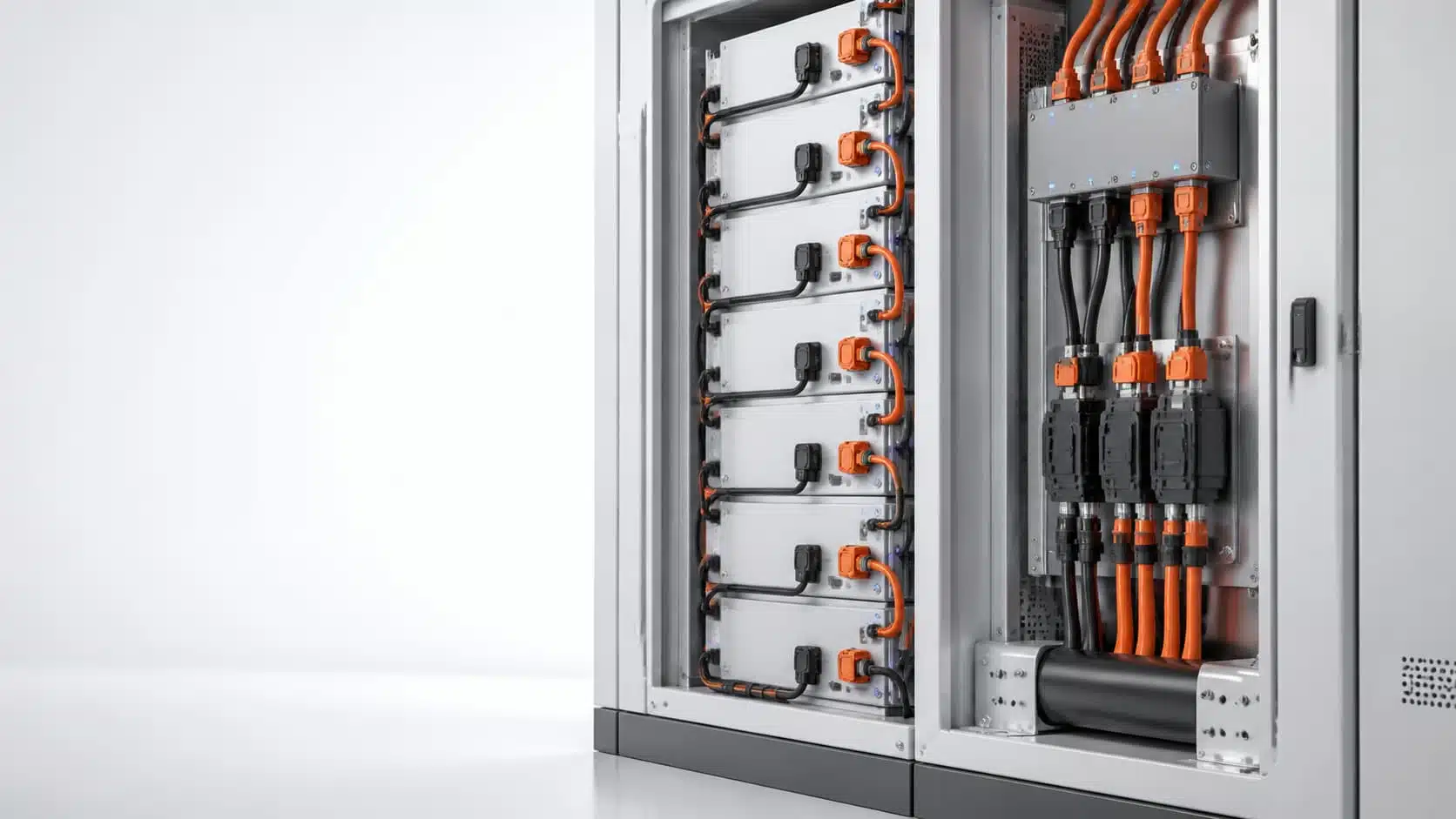
A battery storage connection solution has to fit one specific DC system: the voltage architecture, the conductor plan and the installation environment. It is not a stack of parts chosen from separate catalogs. When every element is checked against the same design, the risk of a mismatched joint is dealt with before the parts ship.
| Connection level | What has to be right | What we supply |
|---|---|---|
| Module and pack wiring | Compact, tool-friendly joints that stay sealed inside tight enclosures | CN06 (70-120 A) on 10/16/25 mm2 cable, straight or right-angle |
| Pack to rack PDU | Even current sharing and secure routing between parallel packs | CN08 (150-250 A) on 35/50/70 mm2 cable |
| Cabinet to inverter | The highest sustained current inside the enclosure without hot joints | CN10 (200-300 A) on 50/70/95 mm2 cable, pre-terminated assemblies |
| Container junction and distribution | Outdoor exposure, UV, long cable runs and field replacement | CN12 and CN14 (250-500 A) on 70-185 mm2 cable, with busbar-ready terminations |
Each CN model is available in straight and right-angle versions with a panel-mount socket. The plug offers four termination options, threaded hole, screw, nut or through-hole, with a fast self-locking latch for a clear mechanical and electrical lock and a 360-degree rotatable outlet that simplifies cable routing in a crowded cabinet.
The package also includes the parts around the connectors that keep a BESS safe to service. Manual service disconnects are part of the DC path on many of our projects, and they are quoted together with the connector set rather than as an afterthought. If your battery rooms follow a specific safety sequence, tell us and we include the corresponding hardware in the package.
The engineering review behind a battery storage connection solution is the same for a 5 kWh home battery and a 5 MWh container; only the current step and the conductor size change.
Most connection faults in storage systems do not begin in the cell chemistry. They begin at a joint where the resistance is higher than the design intended, and the failure chain is predictable: resistance heats the joint, heat accelerates oxidation of the contact surface, and the connection degrades until the string drops offline or the enclosure trips on overtemperature. Because DC current never crosses zero, an arc that starts is harder to stop than the same fault on an AC circuit.
In our experience, field failures trace back to a handful of causes, and each one is preventable at the specification stage:
| Failure mode | What actually goes wrong | How a matched package prevents it |
|---|---|---|
| Poor or inconsistent crimp | High-resistance joint that heats under sustained load | Factory termination on calibrated equipment, inspected before dispatch |
| Thermal cycling | Daily charge-discharge cycles stress the joint and can loosen contacts over years | Contact and housing design rated for continuous duty, 500 mating cycles, -40°C to +125°C |
| Cable gauge mismatch | The cable, not the connector, becomes the hot point | Conductor range matched to each current step: 10 to 185 mm2 across CN06 to CN14 |
| Polarity or assembly error | A reversed connection can damage electronics or kill a string | Keyed housings, orange/black/red options and clear polarity marking |
| Corrosion at outdoor joints | Rising contact resistance in container-level connections | IP67 sealed connection when mated and UV-resistant materials on request |
That pattern is why we engineer battery storage connection solutions as matched packages rather than catalog picks. The variables are settled in engineering, not left to the installation crew.
Even in a factory-built battery storage connection solution, some joints on a storage site are still terminated in the field, and we are clear about which ones. Pack connections on modular racks are usually better factory-terminated, while short interconnects between cabinets are sometimes made on site. When field termination is unavoidable, the package includes the correct dies, torque values and polarity checks for that specific connector, so the crew works to the same standard as the factory.
Battery storage connection solutions split into three groups by operating environment and by the current each joint has to carry continuously.

Residential battery storage connection solutions need to fit into tight spaces behind garage walls and in basement cabinets, and they are usually installed once by a crew that wants the job to stay done. The CN06 covers 70 to 120 A at 1500 V DC on 10/16/25 mm² cable (with 1000 V DC ratings available for lower-voltage architectures), using a fast self-locking latch, clear polarity keying and an IP67 sealed connection when mated. The 18 mm panel footprint is small enough for a wall-mounted battery cabinet, and the straight or right-angle plug versions match either a pre-terminated harness or a direct cabinet entry.

Commercial battery storage connection solutions run longer duty cycles than home systems, so the joint has to carry sustained load rather than occasional peaks. The CN08 and CN10 cover 150 A to 300 A at 1500 V DC on 35/50/70/95 mm² conductors, and they are the connectors we most often supply as pre-terminated assemblies for rack PDU links. Current rating, cable size and temperature derating are reviewed together before the order, because each one changes the effective limit of the joint. Contact resistance is specified at or below 0.2 mΩ on CN08 and 0.5 mΩ on CN10, which keeps the temperature rise low across the working range.

Utility-scale battery storage connection solutions have to survive container life: high ambient temperatures, long cable runs, UV exposure and field replacement by crews working to a schedule. We build these from CN12 to CN14, covering 250 A to 500 A on 70 to 185 mm² cable, with the cable length, exit angle and termination specified for the container layout. CN12 reaches 350 A and CN14 reaches 500 A, both with silver-plated T2Y copper contacts and touch-proof, keyway-polarized housings, which matters when a mistake would arc under full string voltage.
Most battery storage connection solutions we supply follow one of four standard profiles. That keeps the engineering repeatable and delivery predictable, and each profile can still be adjusted to a specific rack or container drawing.
| Configuration | Typical components | Where it is used |
|---|---|---|
| Home ESS pack harness | CN06 connectors, polarity keyed, pre-cut 10/16 mm2 leads | Residential modules and pack wiring, 5-20 kWh systems |
| Rack PDU link kit | CN08 connectors, straight and right-angle, polarity marked | Pack-to-PDU links in C&I racks |
| Cabinet-to-inverter power set | CN10 connectors, pre-terminated on 50/70/95 mm2 cable | DC cabinet to PCS inverter connections |
| Container junction package | CN12 and CN14 with custom cable lengths, UV jackets, threaded-hole or screw terminations | Container-level distribution and outdoor utility projects |
When a system does not fit one of these profiles, that is where custom engineering starts. We terminate custom cable lengths, select the right plug termination for the busbar or stud pattern, and match color and polarity marking to your wiring standard. If you have an existing layout, send the drawing; we quote battery storage connection solutions against the actual connection list rather than a generic bill of materials.
Storage projects usually move in stages: a prototype rack, a pilot cabinet, then series production. The same configuration can be quoted at every stage, and the engineering file carries over, so the pilot units and the production run are built from the same connector and cable choices. That continuity matters more in BESS than in most industries, because a component change between stages is hard to trace once the cells are in the racks.
Every battery storage connection solution we ship starts the same way, with a short set of project parameters. You do not have to work out the connector selection yourself; we translate the system numbers into a package.
| Step | What happens |
|---|---|
| 1. Share project parameters | DC system voltage, current per joint, cable type and size, environment and quantity |
| 2. Engineering match | We confirm the connector model (CN06 to CN14), plug termination, cable plan and sealing level |
| 3. Sample approval | Samples and drawings confirm fit and assembly before volume production |
| 4. Production under quality control | Factory termination and inspection, with the same process across the batch |
| 5. Delivery and support | Parts arrive ready to install, with documentation and engineering follow-up |
If you are at the drawing stage, the most useful inputs are the DC system voltage, the current at each connection point, the planned cable size, the environment and the order quantity. With those five points we can return a battery storage connection solution matched to your numbers, plus a project-specific quotation.
The quality behind a battery storage connection solution shows in the process, not in the datasheet alone. PVLinkTech has manufactured connectors since 2015 in a 6,800 m2 factory in Shenzhen, operating under ISO9001, IATF16949 and ISO13485 quality systems. Assembly and inspection stay in-house, which is why sample-first ordering works: the sample you approve comes from the same production line and inspection steps as the final batch. The full process is documented on our Quality Control page.
The materials that carry a battery storage connection solution are specified the same way across the CN series: PA66 housings with a UL94 V-0 flammability rating and T2Y pure copper contacts with silver plating. Contact resistance is specified at or below 0.2 mΩ on CN06 and CN08, and at or below 0.5 mΩ on CN10, CN12 and CN14. Insulation resistance stays above 500 MΩ, plugging force is within 75 N, and the connectors are rated for 500 mating cycles across -40°C to +125°C. The CN series carries UL 1977 and UL 4128 certification, with CE and RoHS documentation issued through UL Solutions and listed on our Certificates page. For installations in the U.S., the connection plan should also be reviewed against NFPA 855 practice and local authority requirements before supply.
Two delivered projects show the range of battery storage connection solutions we have built:
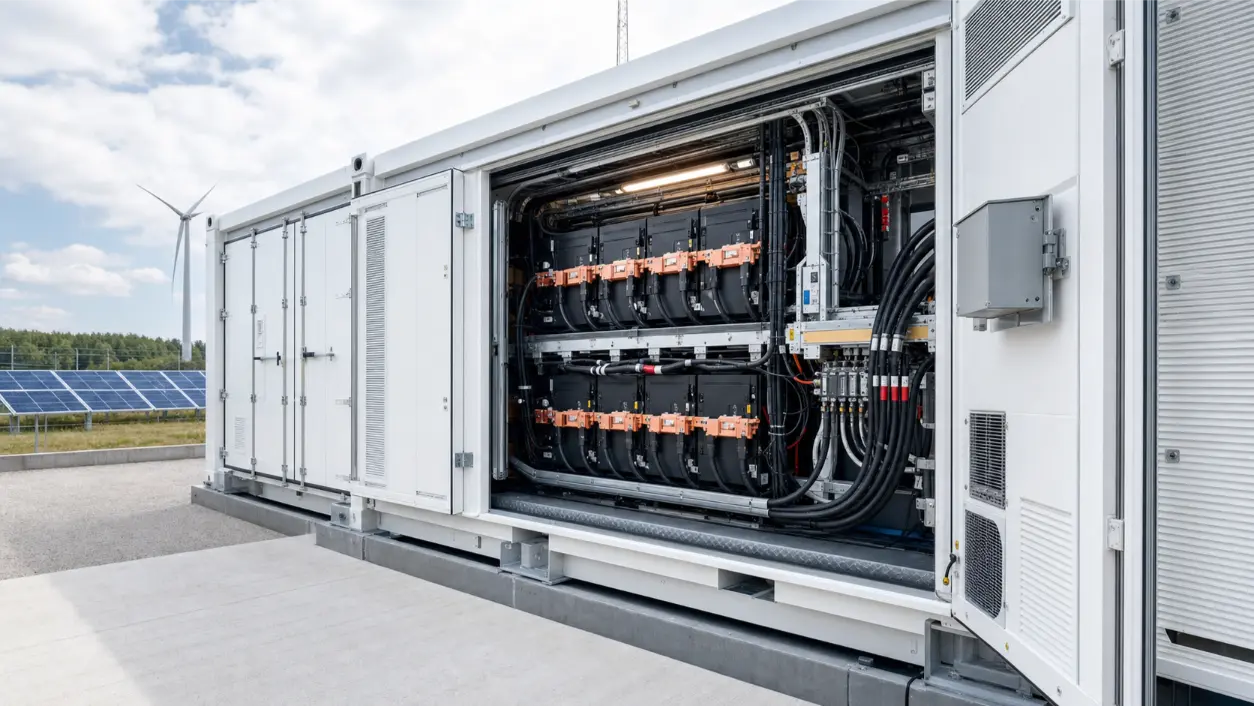
5 MW / 10 MWh Containerized System
Rack and cabinet connections engineered for utility-scale containerized storage systems, delivered as factory-terminated assemblies so on-site wiring strictly stayed on schedule.

350 A Junction, 5 MW / 10 MWh
Container-level distribution junctions rated at the 350 A current step, featuring IP2X touch-proof housings and mechanical keyway polarization for maximum field safety.
If your project sits in this range, the fastest path is a connection list or drawing plus the five parameters from the section above. We handle the precision matching from there.
Find quick engineering answers regarding our battery storage connection systems, certifications, custom tooling, and sample requests.
Yes. A complete battery storage connection solution covers the DC path from module wiring to the container junction: CN-series connectors matched to each current step, factory-terminated cable assemblies, and the engineering review of voltage, cable size and environment. Send your system drawing or connection list and we quote the full package.
Yes. The CN series carries UL 1977 and UL 4128 certification, with CE and RoHS documentation available for project files. Tell us the scope your project requires and we confirm which documents apply.
The CN series behind our battery storage connection solutions runs from CN06 to CN14, covering 70 A to 500 A at 1500 V DC, with 1000 V DC ratings available on CN06 for lower-voltage systems. Operating range is -40°C to +125°C, and the conductor range goes from 10 mm² to 185 mm².
CN-series connectors are rated IP67 when mated, with UL94 V-0 PA66 housings. UV-resistant materials and custom cable jackets are available for outdoor container and junction applications.
Yes. Custom battery storage connection solutions are built to the layout drawing, with the cable lengths, right-angle exits and threaded-hole, screw, nut or through-hole terminations you specify, including polarity and color requirements. Send the rack or container drawing and the connection list for a project-specific quotation.
We work sample-first. Give us the parameters or drawing and we confirm a sample timeline for that specific series and cable assembly, because it depends on the connector model and the amount of custom work in the order. Most projects start with samples before volume production.
Need battery storage connection solutions matched to your project? Send the DC system voltage, current per joint, cable size, environment and quantity. Our engineers do the matching and come back with a complete package and a project-specific quote.

LET’S BUILD YOUR CONNECTION SOLUTION
Share your application, specifications, and estimated quantity. Our team will recommend a suitable connector solution and provide a quotation.
Low MOQ · OEM & ODM · Product Selection Support · Fast Quote Response