


Samples in stock · Response within 12 hours. Request a Quote →
Custom cable assemblies built to your drawing — connector, cable, termination and marking, shipped as one part number, quoted within 12 hours.
A length with no datum, a cable listed in AWG on a part designed in mm², a jacket choice left open. Three drawings like that turn into three rebuilds, because none of the questions were settled on paper. Building the termination in the plant takes the guesswork out of the job: the length, the crimp and the seal get decided once and repeated for every part in the batch.
| Question | Short answer |
|---|---|
| What is a custom cable assembly? | The connector, the cable and the termination between them, built to one drawing and shipped as one part number. |
| What starts a quotation? | A drawing or a connection list with connector, cable size, length, end treatment and quantity. |
| Smallest trial order | One piece for a sample built from a catalog connector, so the interface can be checked on your bench. |
| Which connectors can be terminated? | MC4 / PV4 solar connectors on 4-6 mm² cable, CN energy storage connectors on 10-185 mm², M682 to M685 IP68 connectors and the M686 sealed junction box on 0.5-2.5 mm². |
| Private label | OEM marking, part numbers and field-kit packaging are quoted with the assembly. |
| Testing and paperwork | Test scope is agreed with the drawing; batch test reports ship with the goods on request. |
A custom cable assembly is the connector plus the cable plus the termination between them, built to one drawing and shipped as one part number, so the joint that decides whether the circuit works is made in a controlled place. A multi-leg cable harness carries the same logic into every leg, and where the legs split is a design decision rather than something to work out on site.
Three decisions shape a custom cable assembly order, and all three start on your side of the table. How long the cable runs and how thick it is sets the fit and the voltage drop. The jacket decides whether the joint survives the environment around it. Then there is the termination, which sets how much pull the joint takes before something moves. A drawing normally answers the three of them. If all you have is a connection list, the custom cable assembly gets worked out with you before a price is quoted, because the connector and the cable both come from our own plant and not from your stores, which keeps the crimp, the seal and the test record on one part number.
Most orders arrive in one of three shapes, and the same route covers a custom wire harness with branches. The shape tells us what to ask you for, how long a sample takes, and which connector family fits.
| Order shape | What you send | What comes back | Typical use |
|---|---|---|---|
| Single-ended leads | Connector model, cable size, length, which end stays free | Leads cut, stripped and terminated on one end, continuity checked | Panel and luminaire leads, control wiring |
| Double-ended leads | Both mating parts, keying and polarity, length between reference points | A matched pair, keyed and tested as one set | Solar string jumpers, module links |
| Branched harness | Connection list, junction point, number of legs, circuit marking | One sealed feed point with several labelled legs | Street lighting, cabinets, outdoor distribution |
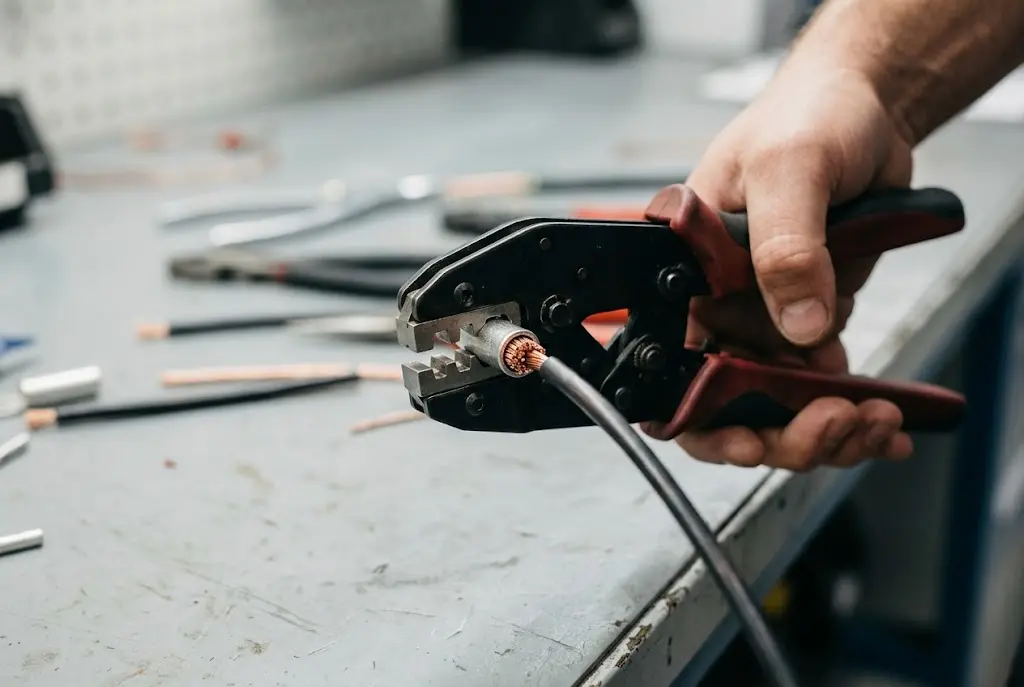
Cut twenty leads by hand and the crimp height drifts from the first one to the last. In the plant the same twenty come off one die setting, so the last lead matches the first. Strip depth is fixed so the strands are not nicked at the cut. One end can stay open for a terminal block, or strip back for a lug, and pre-terminated leads reach the panel ready for the terminal they use. Every lead is checked for continuity before packing, which is how a crossed pair gets caught on the bench and not at commissioning. Unless the drawing asks for solder or a weld, the end connection is a crimped joint.
A maintenance crew unplugs the same sensor lead, luminaire lead or pump lead every season, and the separate rubber boot is the part that goes missing. An overmolded cable assembly is a lead with the seal molded where the cable enters the housing, and that takes the boot out of the maintenance routine. It also closes the gap where cable meets housing, which is where an IP rating leaks first, and whether the closure holds comes down to the jacket material and the cable outer diameter. Both belong on the drawing before the tool is cut. Where the tool is new, the overmolded cable assembly waits for the sample approval before production starts.


A street lighting run, a control cabinet or an outdoor distribution point sometimes needs one incoming cable split into several outgoing legs, and that is a different build from a lead. The conductor count changes, the circuit marking changes, and the number of ways changes with them. A branched custom cable assembly is a harness with several legs off one sealed point, and every one of those legs has to stay sealed. The M686 family takes a single feed into several sealed outlets, with the wider variants on the IP68 waterproof junction box page. A harness of this shape is quoted from the connection list, because per-leg length, the marking on each leg and the way the split is sealed are three things no photograph settles.
Every missing line on a drawing costs a round trip, and the expensive omissions are not the price lines: a wrong outer diameter or an unstated datum changes what we build. A sketch with the dimensions marked is enough to start, and a CAD file is welcome but not needed. Those inputs are what a custom cable assembly quotation is built from.
| Input | Why it changes the build | Example |
|---|---|---|
| Connector series or mating part | Fixes the interface, the keying and the panel cutout | M684-T, M686, CN10, MC4 |
| Cable size | Sets the current path and the terminal that fits | 2.5 mm² or 14 AWG (state one unit) |
| Jacket material and outer diameter | Decides which gland seals and whether the cable survives the environment | 3-core rubber, 8.5 mm OD |
| Length and datum | Pin-to-pin and end-to-end are not the same measurement | 600 mm end-to-end, connectors included |
| End treatment | Terminal, tinning or open end, per end | Ring terminal on one end, open on the other |
| Keying and polarity | Wrong keying cannot be fixed on site | Keyed to the mating part, pin 1 marked |
| Marking and labels | Drives the printing step and the packing layout | Heat-shrink label per leg |
| Quantity and packing | Sets the production run and the carton count | 200 sets, 20 per bag |
| Environment and standard | Selects materials and the acceptance criteria | Outdoor coastal, IPC/WHMA-A-620 class 2 |
Pin-to-pin and end-to-end differ by the length of the connector body. On a sealed plug that gap is wide enough to miss a panel cutout or leave a lead short at the terminal block. One of the two numbers is the one we need. Mark it on the drawing, or send a photo with the dimension drawn on it.
Cable size is where the next mistake hides, because a 0.75 mm² conductor and an 18 AWG conductor look interchangeable on a parts list and behave differently in a gland. Conductor size in mm² for the electrical check. Jacket outer diameter in mm for the seal. Two lines, so nobody has to guess which number is which.
A rated plug on a cable whose outer diameter sits outside the gland range can pass a bench test and still leak in service, since the gland grips the jacket and never touches the housing. The jacket specification on a custom cable assembly earns the same care as the connector model.
Cable length is part of the circuit, and the longer the run, the more of your voltage the copper keeps. Every extra meter adds resistance, and on a DC string that resistance shows up as voltage drop and heat. How far an MC4 extension cable can run works through that arithmetic for solar strings, and the same sum applies to any long DC lead in a harness.
The drawing revision is the last detail to catch, and it is the one most often left until the pallet is packed. A sample approved at rev A and a shipment built to rev C produce an argument that is hard to settle, so on a custom cable assembly order the drawing that comes back with the first article is the one production follows. A change after that point restarts the sample. Each of these five costs an email to fix before the quote. After the pallet, one of them costs a return shipment and a schedule slip.
Before a custom cable assembly is priced, your drawing gets read against what we can build, and the ambiguous points come back to you in writing with the equivalent part from our own range, so the quotation sits on a fixed interface instead of an assumption. Production then runs under the same quality control steps as our connectors, and finished assemblies are packed by model and quantity.
| Step | What happens | What you receive |
|---|---|---|
| Drawing review | Ambiguous points, tooling needs and equivalents identified | The questions we need answered, in writing |
| Sample or first article | Built on the production line, with the same checks the batch will see | The part, the drawing revision and the measured dimensions |
| Production | Cut, strip, crimp, mold and assemble in one run | Parts labelled by model and batch number |
| Test and packing | Agreed test scope applied, carton marked with model and quantity | Packing list and certificate copies; batch reports on request |
A standard named in the RFQ tells us which acceptance criteria and which paperwork the order runs to, and naming it early is cheaper than finding the mismatch at incoming inspection. On a custom cable assembly order, the workmanship class changes the inspection time and the documents that travel with the goods. Where your drawing names one, that standard is what the first article gets checked against, and any class or sample plan is agreed in writing before the sample is built. Class 2 and Class 3 builds to IPC/WHMA-A-620 are available with the report, and the class is written on the quotation because it sets the inspection step.
| Standard | Issued by | What it covers |
|---|---|---|
| IPC/WHMA-A-620 | IPC and the Wire Harness Manufacturer’s Association | Workmanship and acceptance requirements for cable and wire harness assemblies |
| IEC 60352-2 | IEC | Solderless crimped connections: requirements, tests and tooling practice |
| IEC 60529 | IEC | The IP code for ingress protection of enclosures and connections |
| UL 2238 | UL Solutions | Cable assemblies and fittings for industrial control and signal distribution |
Yes, and most custom cable assembly orders begin that way. A sample of a custom cable assembly, built from a catalog connector with your cable, length and marking, starts at one piece, and it runs on the same line, checked against the same drawing as the batch behind it. If the order needs a new mould or a new overmold, tooling is quoted before any work starts and the sample date is set against your drawing.
PVLinkTech supplies the connector, the cable and the marking. Customer-supplied connectors and cable do not go into production, so every assembly leaves with one material set and one test record behind it. What we need from you is the mating interface. Name the mating part or send the drawing, and the quotation will state the connector model, the cable type and the length the custom cable assembly is built to.
Three to five business days covers a custom cable assembly: a connector from the catalog, your cable, your length, your marking. A new mould or a new overmold tool is a different case. The tool sits on the critical path instead of the assembly, so its date is set with the sample. Ask for the date in writing on the revision you approve.
A stock catalog model can be ordered one piece at a time, whether you are evaluating a part or replacing a failed one. Harness quantities are quoted per drawing. Production minimums follow the connector and the amount of assembly work in the order, which is why the number for a custom cable assembly appears on the quotation and not in a general rule.
Marking, private label and field-kit packaging are part of a custom cable assembly order, not exceptions to it. Send the artwork, the part number format and the packing layout with the request. Labels and bag quantities get confirmed with the sample, so the carton matches what your receiving team expects to see.
Test scope is written against the drawing before production starts. Depending on the assembly, that covers continuity across the full length or point to point, a length and marking check, and the pull or crimp-height checks your specification calls for. We write down which measurements run on every piece and which are sampled. Batch test reports ship with the goods on request, for a single lead or for a full wire harness assembly.
Send the drawing, the connection list, or a photo with the dimensions marked. The reply carries the equivalent part from our own range, the questions we still need answered, and a sample date for the custom cable assembly we would build. If you are still comparing connectors, how to order covers minimums, payment terms and shipping, and a new mould instead of a new lead is the custom waterproof connector manufacturer route. On a first order, the useful comparison between one cable assembly manufacturer and another is what arrives in the carton.
Request a quotationLET’S BUILD YOUR CONNECTION SOLUTION
Share your application, specifications, and estimated quantity. Our team will recommend a suitable connector solution and provide a quotation.
Low MOQ · OEM & ODM · Product Selection Support · Fast Quote Response