

Need waterproof connectors?Request a Quote →
A containerized BESS does not usually fail in the inverter. It fails where hundreds of amperes cross small mechanical joints inside a sealed cabinet. This German BESS integrator and OEM needed bess cabinet wiring that would carry 350A per circuit from battery rack to rack and into the PCS. The joints had to stay cool under sustained load, prevent reversed polarity, and keep field crimping out of the critical path. We supplied CN series push-in connectors from the energy storage line and factory-terminated cable assemblies cut to the customer’s cabinet drawing.
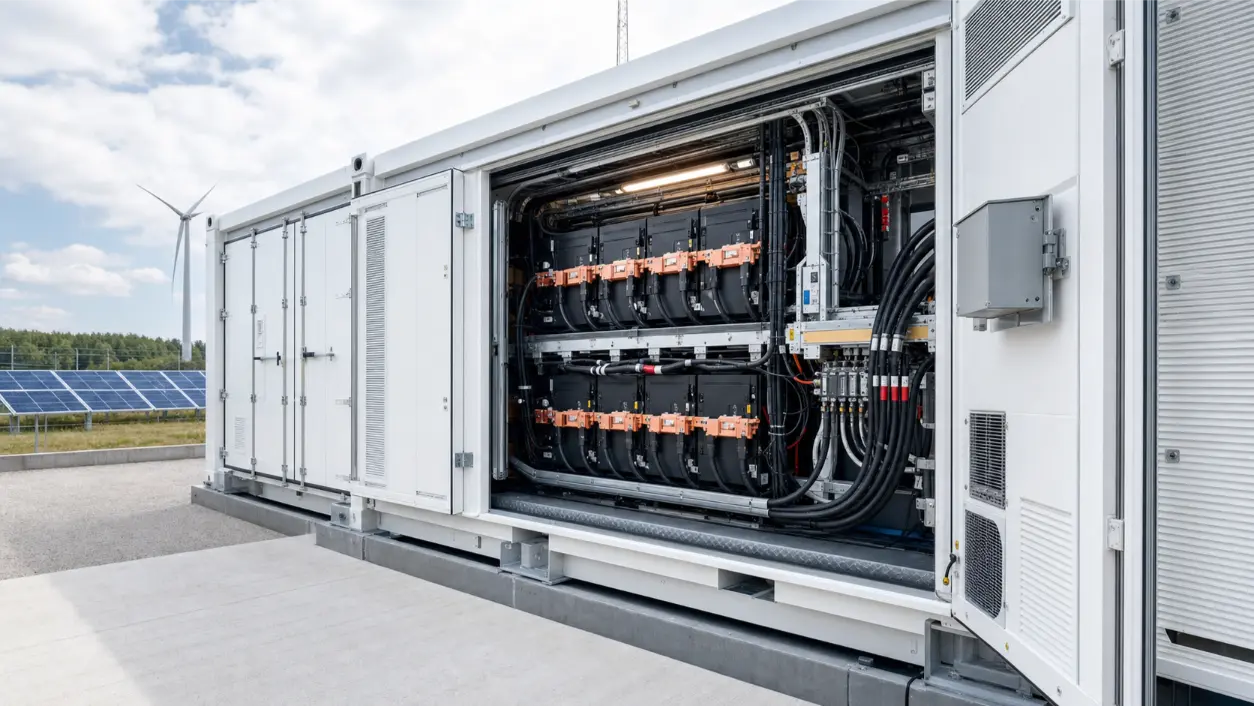
| Application | BESS cabinet wiring in a C&I containerized system |
| System capacity | 5MW / 10MWh |
| Location | Germany |
| Connector solution | CN series push-in storage connectors, CN06-CN14 (70A-500A) |
| Main circuit model | CN12, rated 350A with 120mm² cable |
| System voltage | 1500V DC |
| Terminations | Threaded hole, screw type, nut type, or through-hole |
| Protection | IP67, V-0 flame retardant (UL94), PA66 housing |
| Cable solution | Custom, factory-terminated assemblies, cut to length |
Client: BESS integrator & OEM, Germany (name withheld by agreement)

BESS cabinet wiring at this scale is a thermal and mechanical system, not a collection of individual connections. Three constraints drove the design.
A 350A circuit needs cable at 120mm² (4/0 AWG). The current is not intermittent. A BESS charges and discharges for hours at a time, so the cabinet sees sustained thermal load, and a sealed container has nowhere to push that heat. Every termination and every mated joint adds resistance, and resistance converts load current into heat. Temperature rise is the early indicator. A joint that runs warm at 60% load runs hotter at full discharge, and repeated thermal cycling slowly works on the mechanical interface. The wiring has to stay inside its temperature-rise budget for years, not weeks. That is why the connection is not only about ampacity at 25°C; it is about stability under long, hot cycles, and why contact resistance and plating quality carry so much weight in the specification.
A 5MW / 10MWh cabinet carries more high-current joints than most installers expect. Every one is a place where a loose crimp, an undertorqued terminal, or a reversed connection can become a warranty claim. Field crimping quality varies with the operator and the tooling. This customer wanted that variable removed from the wiring process altogether, and polarity errors were the specific risk they called out first. A reversed 1500V DC joint is not a small fault. It is an arc event waiting for the next maintenance cycle, and in a container full of identical heavy black cables it is exactly the kind of mistake a tired crew can make on a Friday shift.
At 120mm² the cable itself becomes a mechanical part. In a compact container, power cables share space with airflow paths, control wiring, and access panels. A cable routed with too tight a bend puts stress on its termination. A cable left loose blocks cooling and makes later work harder. And BESS maintenance is not rare: racks get replaced, cells get serviced, and every disconnect has to survive repeated cycles without degrading. The layout has to be clean the first time, because nobody wants to open that cabinet again just to fix a cable run.
We paired CN series push-in storage connectors with factory-terminated flexible cable assemblies. In bess cabinet wiring the specification step matters as much as the connector itself, so both were checked against the project voltage, current, cable schedule, and cabinet drawing before a meter of cable was cut. The customer’s integrator team received a wiring kit, not a box of parts to assemble on site.
Rated current is the natural starting point for bess cabinet wiring. The CN series covers 70A to 500A in five sizes at up to 1500V DC, so selection follows the circuit. A 350A rack-level run lands on the CN12 with 120mm² cable. A 300A feeder uses the CN10 with 95mm². A 150A branch can use the CN08 with 35mm². One connector family, one tooling set, one spares list for the whole cabinet.
| Model | Rated current | Applicable cable |
|---|---|---|
| CN06 | 70A / 100A / 120A | 10 / 16 / 25mm² |
| CN08 | 150A / 200A / 250A | 35 / 50 / 70mm² |
| CN10 | 200A / 250A / 300A | 50 / 70 / 95mm² |
| CN12 | 250A / 300A / 350A | 70 / 95 / 120mm² |
| CN14 | 400A / 450A / 500A | 150 / 185mm² |
| Rated voltage | Up to 1500V DC |
| Contact resistance | ≤0.5mΩ at 100mA (CN10-CN14; CN06/CN08 ≤0.2mΩ) |
| Insulation resistance | >500MΩ |
| Dielectric strength | Up to 4000V AC (CN06: 3000V / 4000V AC) |
| Plugging force | ≤75N |
| Mating cycles | ≥500 |
| Operating temperature | -40°C to +125°C |
| Waterproof / flame retardant | IP67 / V-0 (UL94) |
| Housing material | PA66 |
| Contact material | T2Y pure copper, silver plated |
| Colors | Positive orange/red, negative black |
View the full Energy Storage Connector Series →
This was not an off-the-shelf connector sale. Good bess cabinet wiring rarely is. The customer needed a wiring system built around their cabinet design, and every variable below was configured before production.
The customer shared the cabinet drawing and cable schedule. Our applications engineer came back with a connector and termination proposal in the first week. Samples went out three days after the drawing was approved. The integrator verified the tooling and torque specs, then the production batch followed on the agreed schedule with labels and assembly drawings to match.
The same four steps apply to your project:
The wiring kit shipped with one-key locking joints, factory-terminated runs, and cut-to-length assemblies, all documented against the cabinet drawing. The integrator’s crew assembled the joints on site without field crimping, and the polarity control removed the reversal risk from their checklist.
On temperature, the design point is simple. In a sealed cabinet the wiring margin shows up as temperature rise under load. Silver-plated finger-spring contacts keep resistance low, the push-in latch keeps the joint tight, and factory terminations remove the worst variable, so the margin stays stable cycle after cycle. For more detail on how connection resistance and ambient temperature interact inside storage enclosures, see our note on connector temperature rise in BESS cabinets.
We publish project-specific figures such as installation time, measured temperature rise, and delivery lead time only when project records back them up. Ask for the project summary pack under NDA.
| Mating cycles | 500+ |
| Contact resistance | ≤0.5mΩ at 100mA |
| Operating range | -40°C to +125°C |
| Waterproof / flame retardant | IP67 / V-0 (UL94) |
| System voltage | 1500V DC |
| Contact finish | Silver-plated T2Y copper |
The CN series energy storage connectors used in this project are certified to UL 1977 and UL 4128, carry CE marking, and are RoHS compliant. Certification documents are provided per delivered part number. UL 1977 covers component connectors for use in data, signal, control, and power applications. UL 4128 covers mating halves of intercell and intertier connectors for battery systems, and it is the standard a North American-bound storage cabinet typically has to meet. CE marking follows the applicable European directives; see the European Commission CE marking guidance and UL guidance on batteries and energy storage. PVLinkTech operates to IATF16949, ISO9001, ISO13485, and ISO14001 quality systems.
Engineering note: current rating, temperature rise, and IP protection depend on final cable size, ambient conditions, and the complete system design. Contact resistance values shown are per the product specification sheet at 100mA test current. Confirm the approved configuration with an applications engineer.

Scope: this case study covers power connectors and custom cable assemblies, not the supply of a complete battery energy storage system.
Everything you need to know about our high-current BESS connector solutions, certifications, and custom assemblies.
Yes, subject to a review of the system voltage, continuous and peak current, cable schedule, and enclosure conditions. The CN series covers 70A to 500A at up to 1500V DC.
The CN series runs from the CN06 (70A to 120A) up to the CN14 (400A to 500A). The main circuits in this project used the CN12 at 350A with 120mm² (4/0 AWG) cable.
At or below 0.5mΩ measured at 100mA on the CN10 through CN14 models; the CN06 and CN08 models are rated at or below 0.2mΩ.
Up to 1500V DC across the entire CN series.
IP67 rated ingress protection, V-0 flame retardant (UL94), operating from -40°C to +125°C, with 500+ mating cycles and a plugging force of no more than 75N on the push-in latch.
Yes. Assemblies are factory-terminated and precision-cut to length per your cable schedule, complete with industrial labels, batch traceability marking, and engineering assembly drawings on request.
The CN series is certified to UL 1977 and UL 4128, CE marked, and RoHS compliant, with full compliance dossiers per delivered part number.
Factory Quality Systems: IATF16949, ISO9001, ISO13485, ISO14001.
Rapid prototype samples dispatched within 3 days; custom tooling and custom-engineered connectors in 20 days.
Send your electrical requirements, cable schedule, and cabinet drawing. Our engineering team will review your BESS cabinet wiring scheme and provide an optimized connector and harness assembly proposal.

LET’S BUILD YOUR CONNECTION SOLUTION
Share your application, specifications, and estimated quantity. Our team will recommend a suitable connector solution and provide a quotation.
Low MOQ · OEM & ODM · Product Selection Support · Fast Quote Response