

Need waterproof connectors?Request a Quote →
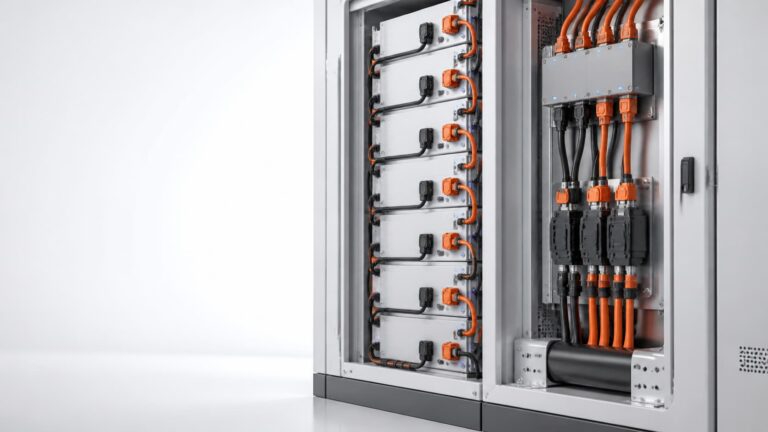
A working greenhouse runs humid. Water evaporates off the crop and the floor every day, and when the sun drops, the structure sheds condensation on everything inside, including electrical runs and connection points. That is the working environment for a 1.5MW / 3.2MWh microgrid in Westland, Netherlands, where a commercial horticultural enterprise balances rooftop solar generation and on-site LED crop lighting loads. The greenhouse microgrid wiring runs between storage, conversion, and lighting distribution. We supplied CN series push-in connectors from the energy storage line, with the CN10 on the main 300A DC paths, and factory-terminated cable assemblies built to the site’s electrical layout.
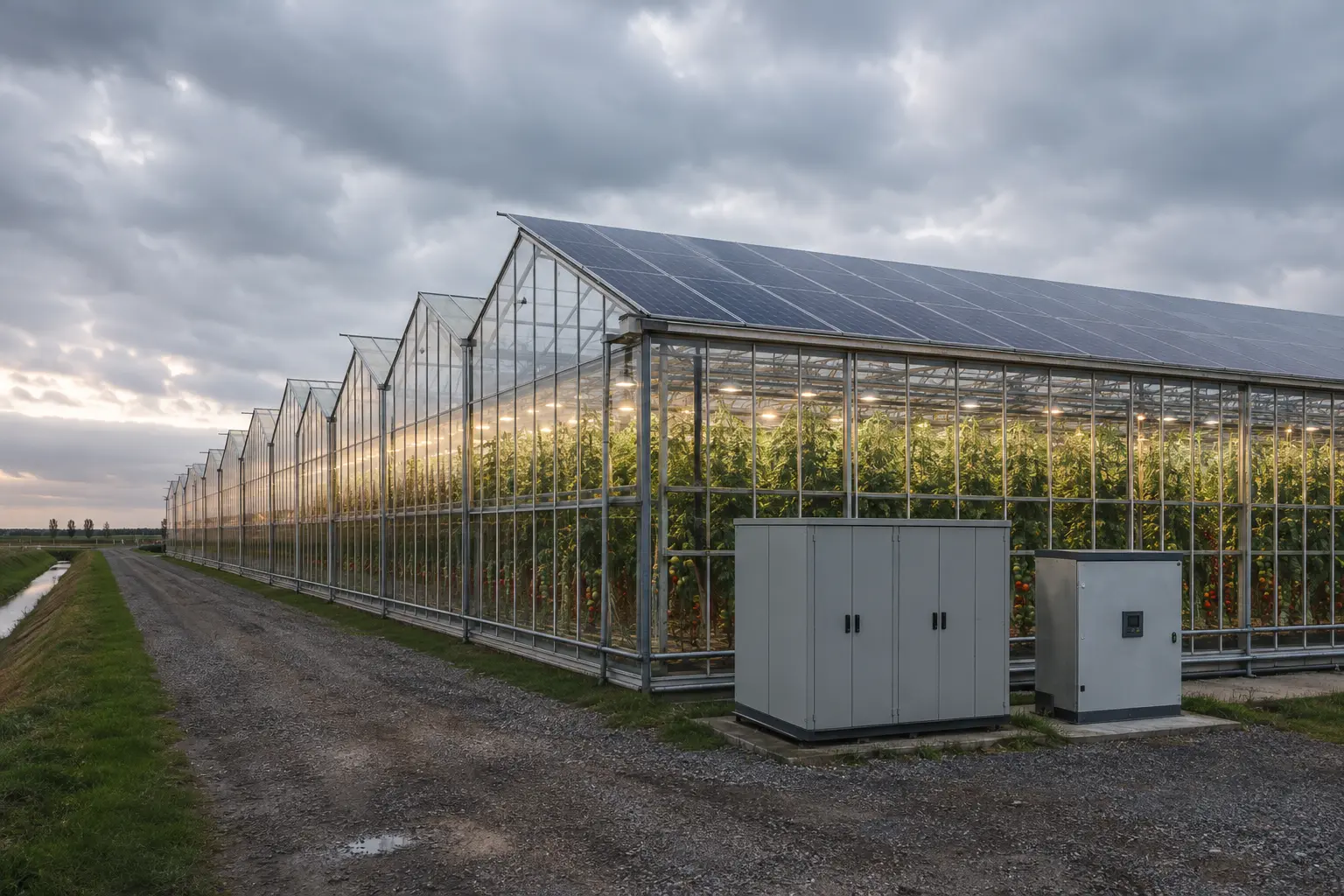
| Application | Agri-PV greenhouse microgrid wiring: rooftop solar, battery storage, LED crop lighting |
| System capacity | 1.5MW / 3.2MWh |
| Location | Westland, Netherlands |
| Connector solution | CN series push-in storage connectors, CN06-CN14 (70A-500A) |
| Main circuit model | CN10, rated 300A with 95mm² cable |
| System voltage | 1500V DC |
| Terminations | Threaded hole, screw type, nut type, or through-hole |
| Protection | IP67, V-0 flame retardant (UL94), PA66 housing |
| Cable solution | Custom, factory-terminated assemblies, cut and labeled per site layout |
Greenhouse microgrid wiring at this scale is an environmental and thermal system, not a collection of individual connections. Three constraints drove the design.
Horticultural greenhouses sit at the far end of what most DC connectors are designed for. Irrigation and plant transpiration keep relative humidity high for most of the day, and the temperature swing between night and morning produces condensation on every cool surface. Standard connector housings can trap that moisture at the seal line. Over a growing season, corrosion at the contact area shows up as rising contact resistance and temperature, not as a sudden open circuit. For a 300A circuit, that trend matters.
LED crop lighting draws steady, high-density current through the long dark hours of a Dutch winter, and the microgrid battery has to carry the same paths in both directions. Inside a greenhouse, ambient temperature already runs high near the roof line and lighting racks. A connector at 300A has a fixed temperature-rise budget, and any margin lost to a poor joint, an undersized contact, or an incompatible cable spec shortens the useful life of the whole run. The connection has to stay inside its temperature-rise budget through hours of continuous load, not just at the nameplate test point.
Horticulture runs on crop cycles, not maintenance windows. Between crops, crews change lighting layouts, add lighting zones, and reconfigure DC distribution, often under time pressure. Every disconnect and reconnect is a chance for a polarity mix-up or a half-seated joint, and every minute of downtime inside a lighting change is lost production. In a greenhouse full of heavy cables that look alike after a season of handling, the wiring has to make the correct connection obvious and a reversed one hard to achieve.
For greenhouse microgrid wiring, we paired CN series push-in storage connectors with factory-terminated cable assemblies. The specification step matters as much as the connector itself, so both were checked against the project voltage, continuous and peak current, cable schedule, and the moisture conditions of the greenhouse before a meter of cable was cut. The EPC received a wiring kit, not a box of parts to assemble on site.
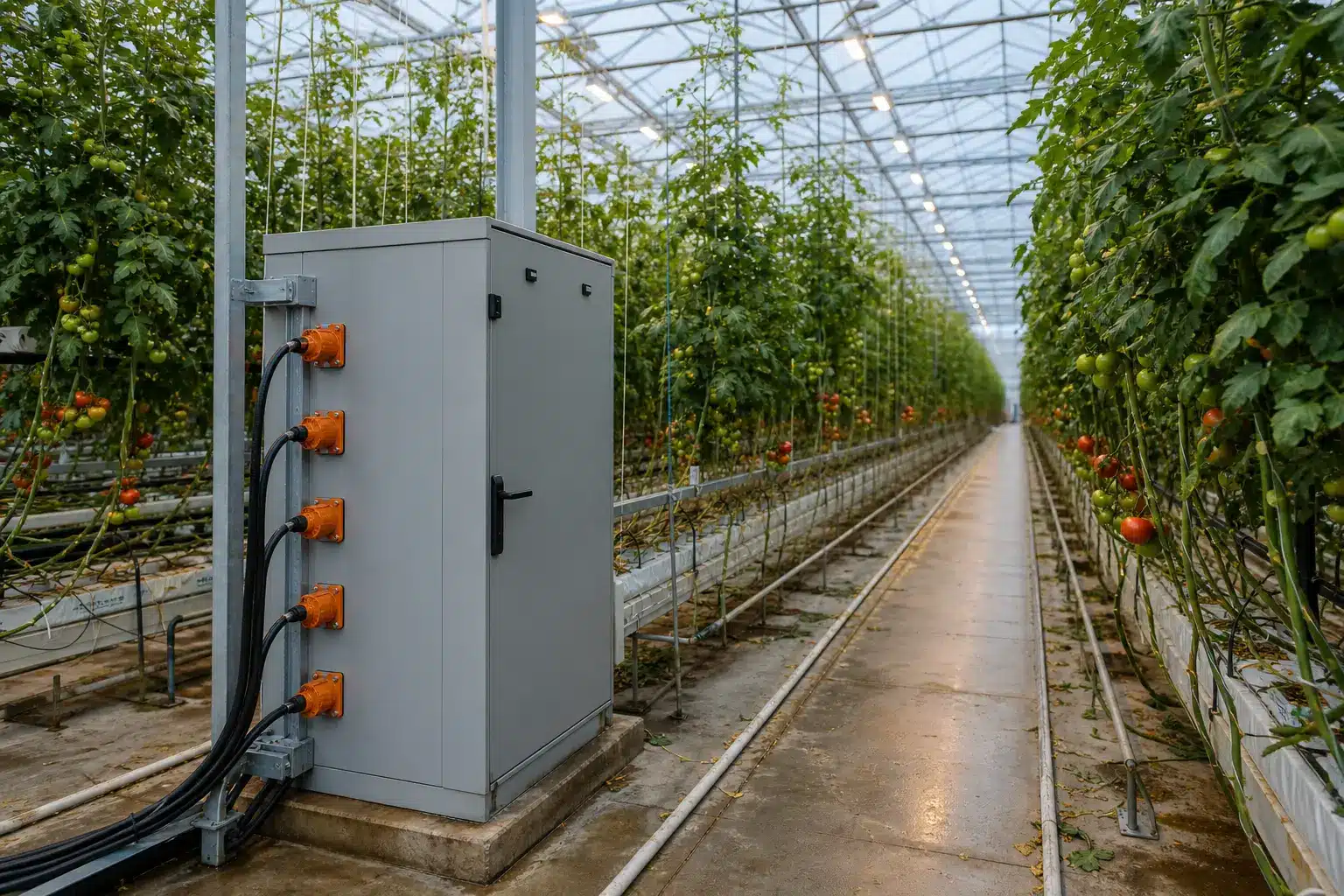
Rated current is the natural starting point for greenhouse microgrid wiring. The CN series covers 70A to 500A in five sizes at up to 1500V DC, so selection follows the circuit. The 300A battery and lighting distribution paths land on the CN10 with 95mm² cable. Smaller lighting zones can drop to the CN08 with 35mm². One connector family, one tooling set, one spares list for the whole installation.
| Model | Rated current | Applicable cable |
|---|---|---|
| CN06 | 70A / 100A / 120A | 10 / 16 / 25mm² |
| CN08 | 150A / 200A / 250A | 35 / 50 / 70mm² |
| CN10 | 200A / 250A / 300A | 50 / 70 / 95mm² |
| CN12 | 250A / 300A / 350A | 70 / 95 / 120mm² |
| CN14 | 400A / 450A / 500A | 150 / 185mm² |
| Rated voltage | Up to 1500V DC |
| Contact resistance | ≤0.5mΩ at 100mA (CN10-CN14; CN06/CN08 ≤0.2mΩ) |
| Insulation resistance | >500MΩ |
| Dielectric strength | Up to 4000V AC |
| Plugging force | ≤75N |
| Mating cycles | ≥500 |
| Operating temperature | -40°C to +125°C |
| Waterproof / flame retardant | IP67 / V-0 (UL94) |
| Housing material | PA66 |
| Contact material | T2Y pure copper, silver plated |
| Colors | Positive orange/red, negative black |
View the full Energy Storage Connector Series →
This was not an off-the-shelf connector sale. Greenhouse microgrid wiring rarely is. The customer needed a wiring system built around their site layout, and every variable below was configured before production.
The EPC shared the electrical single-line diagram, cable schedule, and greenhouse layout. Our applications engineer matched connector sizes and terminations to the battery, inverter, and lighting distribution interfaces, and factory-assembled the cable runs to length with labels and assembly drawings to match. Samples went out three days after the layout was approved, and the production batch followed on the agreed schedule.
The same four steps apply to your project:
The DC distribution runs shipped with one-key locking joints, factory-terminated connections, and keyed polarity pairs, all documented against the site layout. The crew on site assembled the joints without field crimping, and the polarity control removed the reversal risk from their seasonal changeover checklist.
We publish project-specific figures such as installation time, measured temperature rise, and maintenance intervals only when project records back them up. Ask for the project summary pack under NDA.
| Mating cycles | 500+ on the push-in latch, sized for seasonal lighting reconfiguration |
| Contact resistance | ≤0.5mΩ at 100mA |
| Operating range | -40°C to +125°C |
| Waterproof / flame retardant | IP67 / V-0 (UL94) |
| System voltage | 1500V DC |
| Contact finish | Silver-plated T2Y copper |
Real customer quote goes here, to be added when the horticultural enterprise or EPC approves one.
The CN series energy storage connectors used in this project are certified to UL 1977 and UL 4128, carry CE marking, and are RoHS compliant. Certification documents are provided per delivered part number. UL 1977 covers component connectors for use in power applications. UL 4128 covers mating halves of intercell and intertier connectors for battery systems. CE marking follows the applicable European directives; see the European Commission CE marking guidance. PVLinkTech operates to IATF16949, ISO9001, ISO13485, and ISO14001 quality systems.
About IEC 62619 on this project: IEC 62619 is the safety standard for the industrial lithium battery system used in this microgrid, not for the interconnecting connectors. The battery storage system in the project is qualified to IEC 62619:2022. Our supply scope covers the CN series DC connectors and cable assemblies between battery, conversion, and lighting distribution. See IP Code for what the IP67 rating does and does not cover.
Engineering note: current rating, temperature rise, and IP protection depend on final cable size, ambient conditions, and the complete system design. Contact resistance values shown are per the product specification sheet at 100mA test current. Confirm the approved configuration with an applications engineer.
Scope: this case study covers power connectors and custom cable assemblies, not the supply of a complete battery energy storage system.
Engineering guidance, wiring rules, and certification details for high-current greenhouse microgrid installations.
Send your electrical requirements, cable schedule, and site layout. We will review the DC wiring configuration and come back with a connector and cable assembly proposal sized for the environment it has to survive.

LET’S BUILD YOUR CONNECTION SOLUTION
Share your application, specifications, and estimated quantity. Our team will recommend a suitable connector solution and provide a quotation.
Low MOQ · OEM & ODM · Product Selection Support · Fast Quote Response