

Need waterproof connectors?Request a Quote →
Surge protection solutions exist because a lightning event does not have to hit the equipment to damage it. A strike on a nearby pole or an overhead line couples into the supply cable, and the resulting overvoltage arrives at the LED driver or inverter input as a short 8/20 microsecond spike. PVLinkTech matches surge protection solutions to outdoor lighting and solar projects by exposure class, installs them at the right point in the power chain, and delivers the SPD together with the waterproof connectors, junction boxes and pre-terminated leads that the wiring point needs. A surge protector clamps the overvoltage and shunts the energy to ground; the rest of this page is about the complete package that has to sit around it on an outdoor installation.
Two different types of surge reach outdoor equipment. Induced lightning surges come from nearby strikes coupling into long cable runs, which is why outdoor runs in street lighting and in photovoltaic installations see them so often. Switching transients come from the grid: capacitor banks, transformer taps, motor starts and fault clearing on the distribution line. Both arrive as brief overvoltage spikes, and both are measured in SPD datasheets with the 8/20 microsecond waveform. Because the two sources are always present on outdoor circuits, surge protection solutions are judged by where they sit in the supply path and how much surge energy they can absorb.
The damage depends on what is connected. LED drivers are switching power supplies built around MOSFETs and control ICs; a surge above the input rating can fail them immediately, while repeated smaller transients shorten their life without visible symptoms. Inverters, chargers and battery management boards in solar and storage systems carry the same class of sensitive semiconductor components on their control and supply inputs. That is why surge immunity is now a stated requirement in outdoor lighting specifications rather than a factory option. ANSI C136.2 for luminaires defines two exposure levels relevant to LED street and area lights: Enhanced at 10 kV / 5 kA and Extreme at 20 kV / 10 kA. A project specification that quotes either class expects the luminaire or its branch circuit to carry an SPD that meets that level.
The operating-voltage side is different but related: the protection device itself has to tolerate the continuous system voltage without conducting, then clamp the spike when it arrives. On 277VAC supplies, that continuous rating (Uc) is 320 V for the SPD range described on this page, which is why the same unit cannot simply be copied from one supply architecture to another.
| What arrives | Where it couples in | What it damages without protection |
|---|---|---|
| — | — | — |
| Induced lightning surge | Long AC supply runs and solar cable routes | LED driver input stages, inverter and charger electronics |
| Switching transient | Grid operations on the distribution line | Driver components weakened over repeated events |
| Direct or very close strike | Pole, mast or array structure to earth | Everything downstream of the entry point |
Surge protection solutions have to sit at the boundary where the disturbance enters the equipment, not somewhere convenient in the switchroom. For outdoor lighting and solar-fed sites that means three positions in the power chain, and each position has its own wiring layout.
| Protection point | What it guards | Typical device position |
|---|---|---|
| — | — | — |
| Luminaire level | The LED driver inside each fixture | In-line SPD between the supply and the driver input, inside the luminaire or at the pole hand hole |
| Branch and distribution box | A group of luminaires fed from one box | Panel-mounted SPD inside the distribution box that feeds the branch |
| Inverter, charger and control level | Inverter electronics, charging controllers, site control boards | SPD at the supply entry of the equipment enclosure |
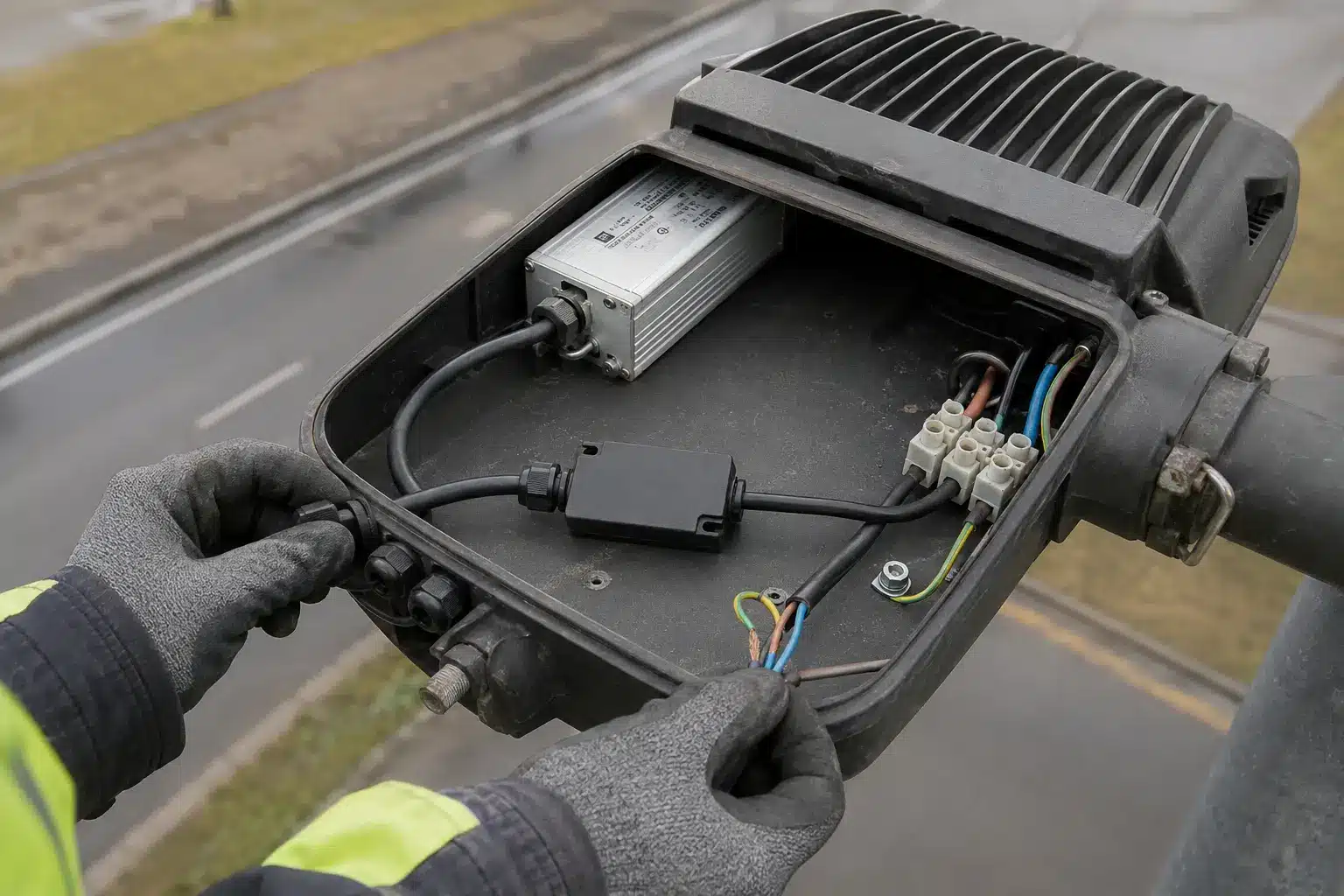
For a street lighting network, that means surge protection solutions are needed at every pole that carries electronics, not only at the feeder head. Luminaire-level protection is the final layer before the driver, and for many street lights it is the only layer. Standards divide SPDs into three classes by installation point: Type 1 at the service entrance, Type 2 at distribution boards and Type 3 at the equipment. This range sits at Type 3, mounted as close to the driver as the housing allows. GSPD1 arrives with the leads already terminated, SJOW 3x18AWG on the 10kV version and UL3239 20AWG on the 20kV version, so installation does not require opening the housing.
Branch and distribution boxes come into play when one box feeds several luminaires or when an outdoor lighting panel protects a site perimeter. The same 10kV or 20kV rating that protects a single driver can protect a whole branch when mounted in a panel body. Inverter, charger and control enclosures on solar and storage sites are the third position: their AC supply entry, and the AC lighting circuits that run around the plant, carry the same induced-surge risk as any outdoor run. These three positions rarely call for the same package, which is why surge protection solutions are quoted per protection point rather than per site. DC array-side circuits have their own rating logic, which is covered in the FAQ below.
The SPD range is built around mounting layout rather than one fixed form factor, so surge protection solutions can match the space and wiring style of a fixture, a box or a linear board. Every series is available in a 10kV and a 20kV rating, and all are IP67 rated with thermal protection and a failure indicator light. Full electrical parameters and certifications for the range are held on the LED surge protective device page; the table here shows the fit by installation point.
| Series | Wiring and position | Where it fits |
|---|---|---|
| — | — | — |
| GSPD1 | In-line with cable leads | Between driver and luminaire, retrofit without opening the housing |
| GSPD3 | Panel mounting | Distribution boxes feeding a group of luminaires |
| GSPD4 | In-line | Luminaire wiring compartments |
| GSPD5 | In-line and parallel, compact | Tight spaces where a shorter body helps |
| M997 | In-line | Standard street and area light wiring |
| M998 | Linear lighting scheme | LED linear boards in architectural and signage lighting |
| M999 | In-line | Street and area light duty with the same 10kV and 20kV levels |
Surge protection solutions are matched on exposure before price enters the decision; the 10kV and 20kV levels exist so the rating can fit the site. The 10kV version carries Uoc 10kV with 5kA nominal and 10kA maximum discharge current; the 20kV version doubles the discharge handling to Uoc 20kV, 10kA and 20kA. Parking lots, tunnels and sheltered urban sites normally sit at the Enhanced exposure level and take the 10kV unit. Open roadways, bridges, stadiums, airports and regions with frequent thunderstorms take the 20kV unit, matching the Extreme level in ANSI C136.2. Both ratings run on 277VAC / 320V class systems, so moving up a level does not change the supply requirements or the wiring.
An SPD only protects the circuit it is correctly wired into, and on an outdoor installation every wiring point has to be sealed. That is why the surge protection solutions we quote include the connection hardware around the SPD, not the SPD alone. The in-line series terminates into the luminaire cable path, the box series mounts beside the branch wiring, and every cable entry needs an IP-rated seal if the enclosure is exposed to weather. The standard surge protection solutions we build follow the four profiles below; each can be adjusted to a specific fixture, box or site drawing without restarting the engineering.
| Package | What is in it | Typical site |
|---|---|---|
| — | — | — |
| LED street and area light package | GSPD1, GSPD4, M997 or M999 at the required 10kV/20kV level, pre-terminated leads, IP68 screw or screwless connectors for the cable path | Roadway, parking, campus and perimeter lighting |
| Distribution box package | GSPD3 panel-mount SPD, waterproof junction box, cable glands matched to the incoming and outgoing cables | Branch boxes feeding groups of luminaires |
| Solar site lighting package | Luminaire-level SPD for AC-fed site lights, IP68 junction box, waterproof connectors for the light circuits | PV plant and storage site perimeter and equipment lighting |
| Linear and architectural package | M998 for linear boards, compact connectors, sealed leads | Signage, facade and linear architectural lighting |
The screwless waterproof connector and screw waterproof connector ranges are both part of these packages, because each project has its own preference for tool-free push-in termination or threaded assembly; the IP68 junction box line covers the branch points where several light circuits meet. For retrofit work, in-line surge protection solutions are the fastest fit, because they install between the mains and the driver without opening the fixture housing. When a solar or storage project needs the DC-side connection hardware as well, the connectors for module, string and rack wiring are quoted from the solar PV connector solutions and battery storage connection solutions programs, so the complete site has one engineering file and one delivery schedule.
Every surge protection solution we ship starts with a short parameter set, and the matching is our job rather than yours. The five points that define a package are the supply voltage and phase arrangement, the installation point, the exposure level or project specification, the cable and enclosure details, and the quantity.
| Step | What happens |
|---|---|
| — | — |
| 1. Share project parameters | Supply voltage (120-277VAC), installation point, exposure class if specified, quantity |
| 2. Engineering match | We confirm the series, the 10kV or 20kV level, and the connection package around the SPD |
| 3. Sample approval | Samples and wiring diagrams confirm fit before volume production |
| 4. Production under quality control | Assembly and functional testing on every batch, including the thermal protection circuit |
| 5. Delivery and support | Parts arrive ready to install, with wiring documentation and engineering follow-up |
Send us the luminaire or driver specification, the supply arrangement and the installation location, and we return a matched set of surge protection solutions with the supply, installation point and exposure class written into the quotation. If the site spec quotes an ANSI C136.2 exposure class or a customer standard, include it and we size against that document rather than against a generic rule.
The quality behind these surge protection solutions is decided in the factory, because the varistor and the thermal protection circuit determine whether a unit still protects after the third surge event. PVLinkTech has run this 6,800 m2 Shenzhen factory since 2015 under ISO9001, IATF16949 and ISO13485 quality systems. The varistors and thermal elements are bought from established component brands rather than unbranded stock, and every production batch is function-tested before dispatch. The sample you approve comes off the same line as the volume order. The QC steps behind that process are described on our Quality Control page, and the TUV, CE, ETL, CQC, UKCA and RoHS certificates for the SPD range are listed on our Certificates page.
The wiring side of these surge protection solutions is already running in the field on outdoor lighting projects, because the waterproof connectors that carry power into the fixture are the same family we deliver in volume for LED street lighting. Two delivered cases show that experience:
Street Light Waterproof Connector Delivery: 2025 Container-Scale IP68 Order: container-scale IP68 waterproof connector supply for municipal street lighting, delivered as a complete batch for field installation.
Smart Pole Connector Program: Los Angeles Municipal Lighting: connector supply for a municipal smart pole lighting program, where poles combine lighting with control and communication equipment that also needs surge protection at the enclosure entry.
For a new project, the SPD rating, the connector series and the cable plan are reviewed together before we quote, so the package matches the site rather than the nearest catalog page.
Need surge protection solutions matched to your LED lighting or solar site? To recommend the right surge rating and connection package, our engineering team reviews five key project parameters before preparing a matched quotation.
Supply voltage configuration, network phase, and line layout.
Luminaire body, branch junction box, or equipment enclosure.
Exposure class or project specifications, including 10kV or 20kV requirements.
Conductor sizes, driver parameters, and insulation requirements.
Required quantity, batch size, and expected delivery schedule.
With these details, our engineers can confirm the recommended series, 10kV / 20kV SPD level, waterproof connection package and provide an engineering recommendation and quotation response within 1 business day .
Explore technical specifications, installation guides, and compliance standards for commercial LED & solar surge protective devices.

LET’S BUILD YOUR CONNECTION SOLUTION
Share your application, specifications, and estimated quantity. Our team will recommend a suitable connector solution and provide a quotation.
Low MOQ · OEM & ODM · Product Selection Support · Fast Quote Response