


An MSD connector is a hand-operated isolator that gives a technician one physical point to cut a high-voltage battery circuit. Selecting one is not a matter of matching a current rating. Five numbers inside a storage rack constrain each other, and the order you settle them decides which part you end up with. The reply a supplier sends back is the other half of the job, and it is easy to accept one that answers none of these questions.
An MSD connector separates the battery side of a DC bus by hand, so a cabinet can be opened without live conductors behind the panel. It does not interrupt load current, it does not clear a fault, and it does not stand in for the contactors that switch the system every day.
Three requests should stop before they reach the MSD connector. If the device has to open while current is flowing, the answer is a contactor or a load-break switch, because an isolator is pulled only after the system has been commanded down. If it has to clear a short circuit, that belongs to a fuse or a breaker. Where the only need is a lockable isolation point on a low-voltage auxiliary circuit, an ordinary switch-disconnector does the work at a fraction of the cost. The code side of the question, meaning where such a point has to exist at all, is covered in our notes on battery service disconnect requirements, and the field labeling rules in Article 706 of NFPA 70 are what most site procedures are written against.
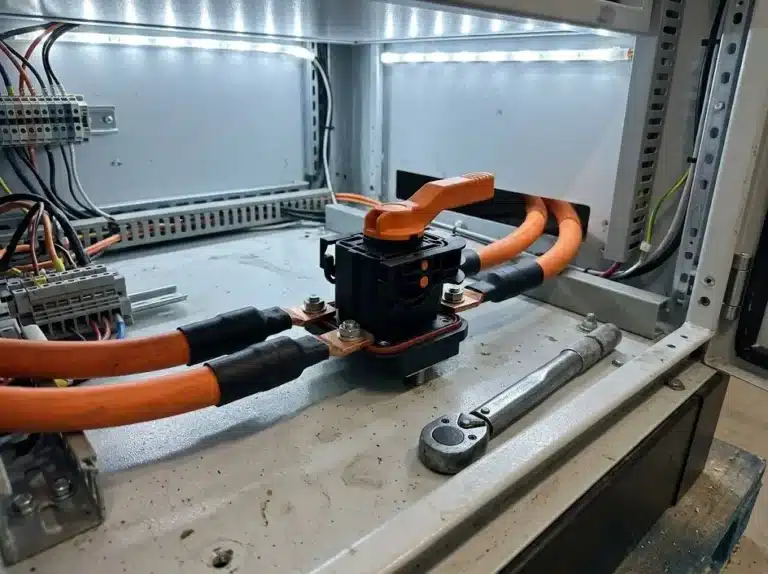
Parts built for this duty carry a two-stage latch, and the latch keeps the handle from outrunning the contacts inside it. The main contacts separate as the handle begins to move, and the handle cannot come free until they have. On the version we build, that first stage can carry an optional HVIL loop, so the battery management system sees the circuit open before the DC path does. Whether the isolator should also hold a fuse cavity is a separate decision, worked through in fused vs non-fused MSD. Every rating quoted below belongs to the non-fused version.
That sequence is what separates a service isolator from a switch that merely has a lock hole in the cover.
Send the figures below in this order and a supplier can price an MSD connector in one round. Send them in the order they appear on a nameplate and the fifth answer will contradict the second.
Read from the top and each line narrows the next. Read out of order and two people can each make a correct decision that does not fit together, which is how a rack ends up with an MSD connector sized for one pack and a bus built for another.

Each figure narrows the next one, so the order is part of the specification
| Figure you change | What it forces | Who has to decide it | What it costs to get wrong |
|---|---|---|---|
| String count | Voltage headroom against 1,500 V DC | Pack designer | Rework after the type test |
| Peak current with duration | Contact and terminal sizing | Buyer, using the drive profile | An MSD connector asked to carry more than it was sized for |
| Cabinet ambient | The current the part can actually carry | System integrator | Derating found at commissioning |
| Cable size | Lug stack height on the M8 stud | Installer | A lug that will not seat |
| Panel thickness | Screw length and gasket compression | Enclosure supplier | A seal that passes on the bench and leaks in the field |
Voltage sits on the first line because it removes whole families of parts before any other figure matters, and because it is the one line a buyer cannot check on the sample bench. The same order runs through the BESS connector selection guide for the connectors on either side of the isolator.
Voltage is the figure that never makes an MSD connector look wrong at the bench. A 1,500 V DC rating reads generous next to a pack labeled 1,000 V nominal, and most people stop the arithmetic there.
The comparison that matters runs the string voltage against the MSD connector rating, at the highest point the string will ever reach. That is the cell count times the top of the charge curve, corrected for the coldest morning the site is specified for, because an unloaded string at low temperature can sit above its warm-weather figure.
Run it on 360 cells at 3.65 V and the string lands at 1,314 V. A five percent cold correction puts it near 1,380 V, which leaves a 1,500 V part some room. Move to 410 cells and the same multiplication gives 1,497 V before any correction at all. That pack is outside the rating, and nothing in the hardware will tell you so once the cabinet is closed. An MSD connector does not report an overvoltage to anyone.

360 cells fit comfortably; 410 cells fit only while the pack is warm and at nominal voltage
It surfaces later, in a type test, in a design review of the DC bus, or after an insulation event nobody can explain.
Ask for the cell count before you ask for the current. A unit with the right current and the wrong voltage class cannot be used at all, whatever else the MSD connector gets right.
Continuous current is the figure buyers send in an MSD connector inquiry, and peak is the one that decides whether the part is ever asked to carry more than its contacts were sized for.
On a storage rack the peaks come from pre-charge inrush, from contactor bounce, and from whatever the PCS does during a mode change. None of those appear in a load schedule built from nameplate values, so the peak column often stays empty until somebody asks a direct question about it.
| Figure | Where it comes from | How to send it |
|---|---|---|
| Continuous current | The load schedule your integrator wrote | As a number with the ambient it assumes |
| Peak current | Pre-charge inrush and mode changes | As a number with its duration in milliseconds |
| Prospective fault current | The protection study | As a number with the device that clears it |
| Duty over a day | The charge and discharge profile | As the count of cycles at each level |
A peak quoted without a duration is not an MSD connector specification. Two hundred amperes for ten milliseconds and two hundred amperes for two seconds ask different things of a contact, and a supplier cannot choose between them without being told which case applies. Put both in the energy storage connector RFQ rather than in a later email.
Write the second number down even when it is an estimate. An estimate with a duration can be checked. A blank cannot.
The published figure for the MSD connector is 350 A, with no stated ambient and no derating curve behind it. Until a basis arrives in writing, treat that as a figure to plan around rather than a figure to design to.
Cabinets in a container on a summer pad run well above the temperature of a test bench. An MSD connector rated at an unstated ambient has to be read as an optimistic one, because nothing in the document limits where the rating applies.
Two things are worth asking for together. One is the ambient the MSD connector rating assumes. The other is a curve, or a set of points above that ambient. With both you can size the current against the cabinet you actually have. With only the single figure, you are choosing on one point and hoping the enclosure stays cool.
Where the answer comes back as a single number again, add margin to the current and note the reason in the design file. A margin with a stated reason survives a review without an argument.
The mechanical figures are where a part that matches the drawing still fails to fit the cabinet.
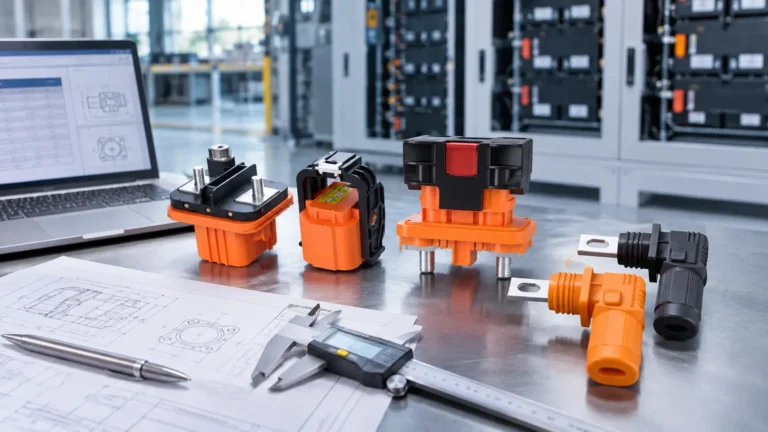
A lug stack a few millimeters too tall stops the cover from seating. A panel that is not flat lets a gasket that passed its own test leak in service. Neither shows up in a torque value, so send the stack height and the panel material with the MSD connector inquiry. It takes two lines and saves a sample round.
Four questions come up in every selection, and none can be answered from a component document alone.
Each is a system question wearing a component’s clothes. A supplier can usually answer the first, sometimes the second, and rarely the last two, because both of those depend on a cabinet they have not seen. The short-circuit question is the one that costs most when it is left open, and the MSD fuse rating figures are where that discussion usually starts.
That is not a reason to distrust the document. It is a reason to keep the open items on the same page as the MSD connector specification, so silence does not get read as compatibility.
A good reply is short, and each line carries its basis. A weak one repeats your MSD connector inquiry back with numbers attached to it.
| Line in the reply | Why it decides the selection | What it means when it is missing |
|---|---|---|
| Current rating with its ambient | A rating is only valid at a stated temperature | Two figures measured differently are being compared |
| Certificate and the model it covers | Documents are issued per model and per market | The file may not cover the part being bought |
| IP67 with its test condition | The two digits alone say nothing about depth or time | A rating that does not match the enclosure |
| Drawing with the panel cut and stack height | Mechanical fit decides installation | Rework at the panel |
| Peak current with a duration | Sets the short-time duty | An assumption nobody wrote down |
Run down that column before you look at the price, since two suppliers quoting the same 350 A have not necessarily quoted the same MSD connector. The difference usually sits in the second and third lines.
Price comes last because it is the easiest line to compare and the least informative one.
Send the string count, the highest cell voltage you expect, the continuous and peak current with its duration, and the cable cross-section. With those figures we can confirm whether the 1,500 V DC ceiling and the 350 A rating leave the headroom your rack needs, and the manual service disconnect (MSD) page answers what a drawing would otherwise have to show.
Mostly, and the difference is where it sits. A service disconnect is the function a code asks for. An MSD connector is one physical form of it, usually a lever-operated or plug-in part mounted in the battery circuit. Where a standard calls for a field-serviceable disconnect, this part can serve as that point if its ratings cover the circuit and its documentation covers your market. Catalogues also list it as a service plug or a battery isolation switch.
No. The contacts separate, but the part is not rated to interrupt load current. The sequence has to run the other way: command the system down, confirm the contactors have opened, then pull the handle. Treating the part as a load-break device puts an arc where the isolation point should be, and no rating in the document covers that.
It depends on what has to happen before the contacts open. If the BMS or PCS must trip the main contactors as the handle starts to move, an HVIL loop on the first stage gives that signal. Where the procedure already de-energizes the rack and a technician verifies absence of voltage, the loop adds wiring without adding a guarantee.
One isolation point can serve a rack when the whole string sits behind it and the service procedure de-energizes every module that way. Cabinets built from separately serviceable packs often need a point per pack, because the purpose is to work on one pack while the others stay live. Draw the isolation boundary first, then count the parts it requires.
IP67 covers dust and a defined immersion for a stated time. It does not cover condensation, chemical exposure, or a panel that flexes under load. On an outdoor cabinet the rating is a starting point, and the enclosure class, the breathers and the cable entries decide the rest. Ask for the test condition behind the two digits before you rely on them.
Cell count, the highest cell voltage you expect to see, continuous current, the peak and its duration, and the cable cross-section. Those five settle the voltage class and the terminal for an MSD connector. Add the panel thickness and the certificate your market requires if you want the answer to come back with a drawing rather than a follow-up question.

LET’S BUILD YOUR CONNECTION SOLUTION
Share your application, specifications, and estimated quantity. Our team will recommend a suitable connector solution and provide a quotation.
Low MOQ · OEM & ODM · Product Selection Support · Fast Quote Response