

Samples in stock · Response within 12 hours. Request a Quote →
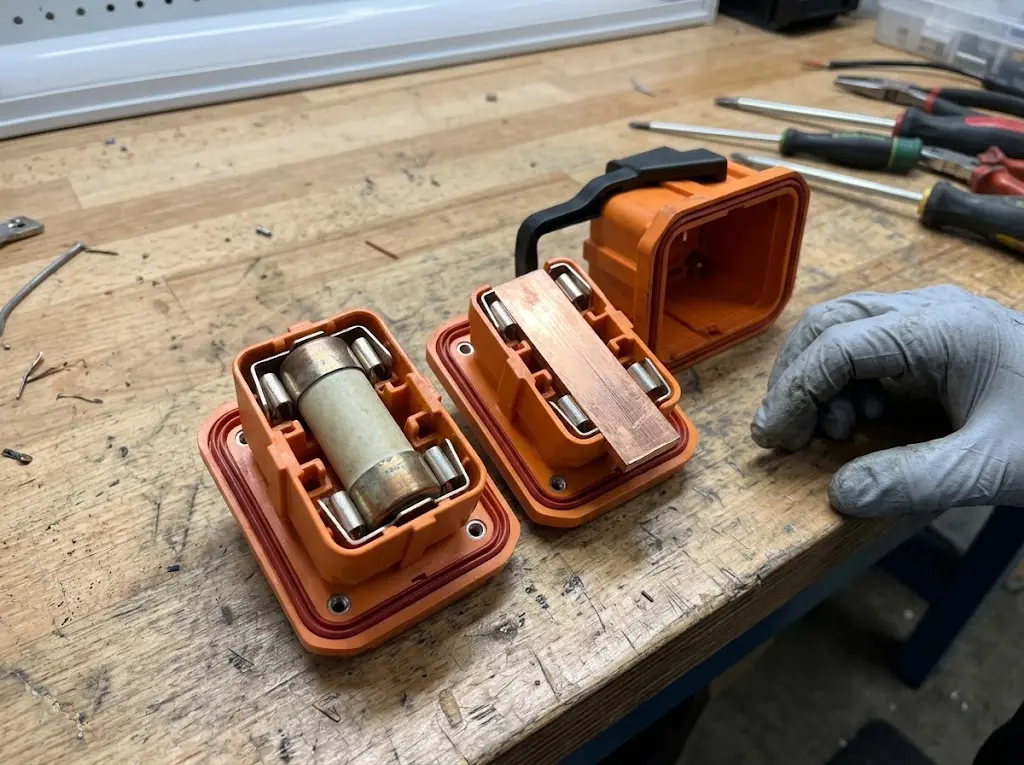
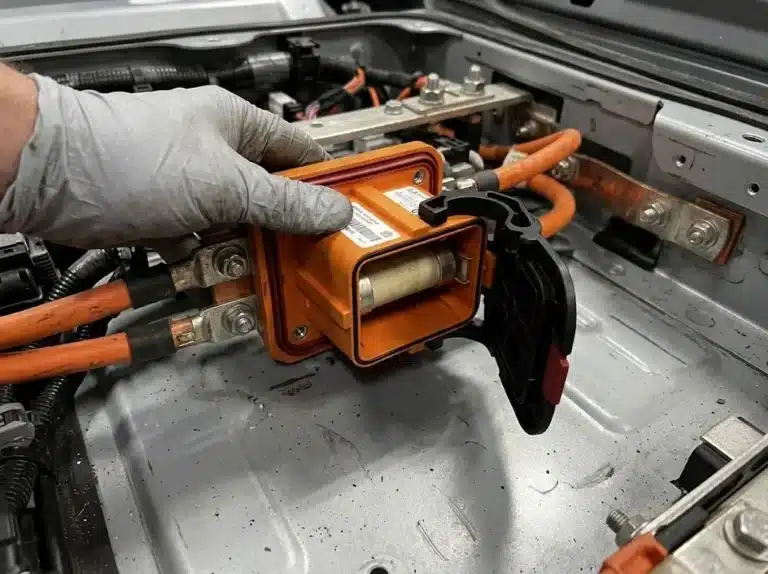
Fused vs non-fused MSD is a question about where the fuse sits, not about whether the pack gets short-circuit protection. In a fused manual service disconnect the fuse element rides inside the service plug, so one pull removes isolation and protection together. A non-fused MSD puts a solid copper link in that slot. The fuse sits at another point in the pack, and suppliers list that version as a shunt MSD. Take the fused type when the pack has a single service point and one fault path to clear. The non-fused type fits when the pack runs at 1,500 V DC, or needs more continuous current than a sealed fuse compartment can pass.
The choice follows from the fault study rather than from a catalogue page, because the two designs answer different site questions. One is where a short circuit gets cleared. The other is who has to reach that point with a tool in hand.
On a 1,500 V DC rack, the clear answer is usually a fuse near the cluster output. It sits bolted to busbar and sized by the fault study. Nobody opens that for routine service. The MSD on that rack gives a technician a lockable break they can see and reach. Two devices, two jobs.

Where the pack is small and the service point is the only place a fuse will fit, those two jobs collapse into one housing. Most fused families are built for that case, which is why they are automotive parts with a 400 V to 800 V working voltage rather than energy storage connectors.
Field-serviced battery circuits above 240 V DC nominal are allowed a bolted or plug-in disconnect without load-break capability, which is what Clause 706.15(E)(2) of NEC 706.15(A) says and what 706.15(A) already assumes when it requires a disconnect for each system. A device that is not expected to interrupt current does not need a fuse inside it. UL 4128 goes the same way for connectors, which are not to be connected or disconnected under load.
Catalogues use four words for two parts, and the fused vs non-fused MSD pair decides what you can ask for.
| Term in the catalogue | What it actually means |
|---|---|
| Fused MSD | Also written fused manual service disconnect. Service plug with a fuse element and spring clips inside the removable handle. Fuse brand and current rating are part of the ordering code. |
| Non-fused MSD | Same housing, same lever, with a solid copper link where the fuse would sit. Overcurrent protection is elsewhere in the pack. |
| Shunt MSD | The name several catalogues use for the non-fused version. Here shunt means the solid link that bypasses the fuse position, not a current-measuring shunt and not a shunt-trip release. |
| MSD, service disconnect, service plug | One device under several names. The function is a manual, lockable break in a high-voltage DC path. |
A table that reads “with fuse / with shunt” lists the fused vs non-fused MSD pair on one line. Amphenol PCD builds both from the same shell, and the fuse rating is a code in the model number rather than a separate family. State the type before the current when you ask for a quotation, because the same 350 A on the label means a different thing on each version.
A fuse element and its spring clips are heat sources, and in a fused MSD they share a sealed cavity with the contacts. Nothing moves air through it. The current rating is set by a temperature-rise test on the assembled part, so the fuse ends up inside the thermal limit of the part in your hand.
A second effect hits the voltage rating: a fuse needs a defined arc path and clearance to clear a DC fault, and the housing must provide both. In the fused vs non-fused MSD comparison, the fused version usually carries the lower DC rating. The gap appears in the manufacturer’s own table, not a competitor’s brochure.
The temperature-rise test described the assembled part with that fuse inside it, at one ambient, on one cable, and a rating carried across from the non-fused version therefore describes a component nobody tested in that state.
Public datasheets for fused service plugs cluster in a narrow band. With a fuse fitted they sit between 450 V DC and 690 V DC, and continuous current falls by roughly 45 percent once a 350 A fuse goes into a shell that carries 360 A without one.
| Fused MSD | Non-fused MSD | |
|---|---|---|
| Published DC rating | 450 V DC to 690 V DC | 1,000 V DC and above |
| Continuous current, same shell | 195 A with a 350 A fuse | 360 A with no fuse |
| Where the fuse sits | Inside the service plug | Elsewhere in the pack |
Voltage headroom lives in the non-fused column, which is why our MSD-350 sits at 1,500 V DC with 350 A and no fuse cavity to heat. Fused versions above 690 V DC do exist, so the ceiling is model-specific; ask for the rating of the exact version.

Most packs answer the fused vs non-fused MSD question before anyone opens a catalogue, because the architecture has already put the fuse somewhere.
| Pack situation | Type that fits | Why | What to confirm |
|---|---|---|---|
| Utility BESS rack at 1,500 V DC, fuse at the cluster output | Non-fused | The MSD only isolates; the fuse is sized by the fault study and stays bolted to busbar | DC voltage and continuous current of the MSD |
| EV pack at 400 V class, one service point | Fused | One part does both jobs in a space that has none to spare | Fuse rating, fuse brand and DC voltage of the fused version |
| 800 V pack, 400 A to 500 A continuous | Non-fused | A sealed fuse cavity costs too much continuous current at that level | Cable cross-section and lug termination |
| Retrofit where the original part was fused | Match the original | The protection topology was part of the evaluated design | Whether the pack drawing still assumes a fuse inside the plug |
| Container with one MSD per cluster | Non-fused | Each cluster keeps its protection upstream, and the MSDs stay identical | Coordination between the cluster fuses |
| Pack that needs an HVIL circuit | Either, if the model supports it | HVIL is a model option, not a feature of one type | Interlock arrangement on the datasheet |
Move the protection somewhere else halfway through a project and the whole row has to be re-evaluated from the fault study down.
None of that matters until someone stands at the open enclosure with a replacement fuse in hand.
| Task | Fused MSD | Non-fused MSD |
|---|---|---|
| Isolate the string | Pull the handle, lock it open | Same |
| Replace the fuse | Remove the element from the plug, then fit the listed replacement | Open the fuse holder in the cabinet |
| Restore the circuit | Reseat the handle | Reseat the handle |
| Spare parts to stock | Handle plus a fuse list | Handle only |
| Prove the circuit dead | Test at the terminals, both sides | Same |
A fused MSD shortens the isolation step, because the person who pulls the handle has already removed the protection element from the fault path. The non-fused answer to the fused vs non-fused MSD question keeps fuse work out of the service part. Replacing a fuse leaves the handle and the panel seal alone. Only one of these arrangements fits the maintenance plan your site already runs.
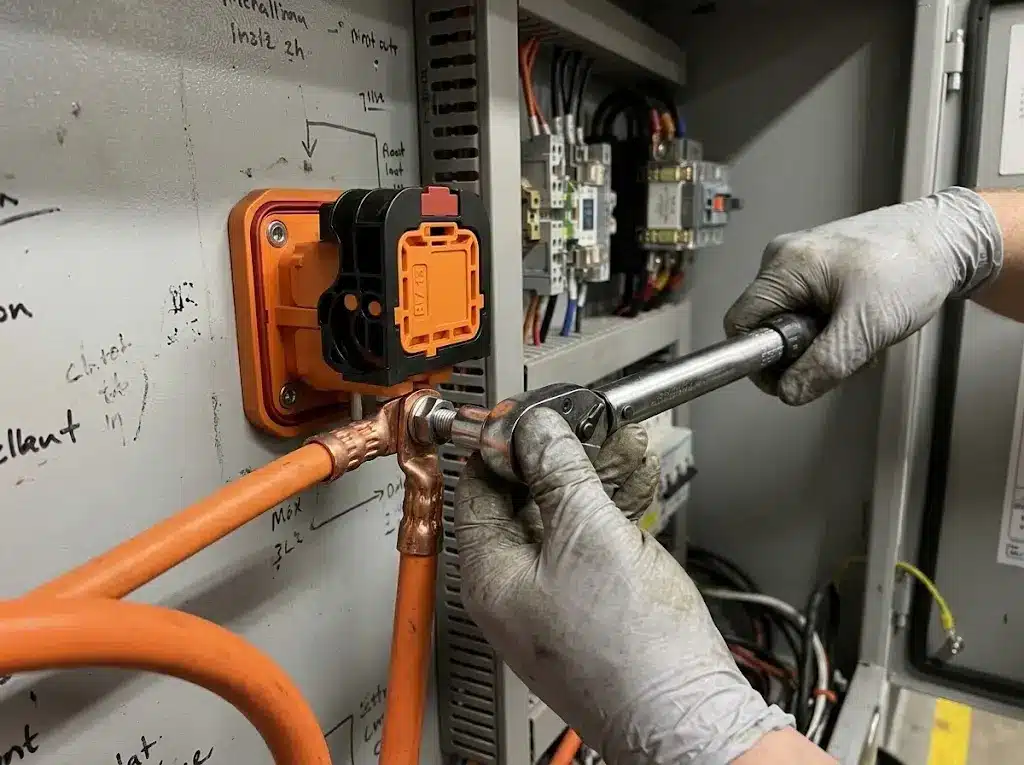
Three conditions point at the non-fused side of the fused vs non-fused MSD question, and they usually arrive together.
Above roughly 1,000 V DC, both fuse and housing need the full string voltage rating. The published fused families mostly stop short of that. Continuous current in the 300 A to 500 A range points the same way, because the sealed cavity costs 40 percent or more of the housing’s capability. A cabinet that already holds a fuse block settles it, since the only new part is the isolation point.
Our MSD-350 answers those three conditions. The isolator is rated 350 A at 1,500 V DC. It seals to IP67 with the gasket flat on a level panel. Its two-stage handle separates the contacts before the handle can be withdrawn. Contact resistance is 0.20 mΩ or less, dielectric strength is 6,000 V AC, and the handle is rated for up to 300 mating cycles. An HVIL circuit is optional, and the cable lands on an M8 stud torqued to 12 N·m.
Where current is the constraint rather than voltage, the arithmetic that drives the housing choice is the same one that governs any DC bus. BESS connector temperature rise works through current, contact resistance and cable size, and it applies to a disconnect exactly as it applies to a connector pair.
Automotive packs are the clearest case for the fused half of the fused vs non-fused MSD split. A 400 V pack usually has one service point and little space to spare. Putting the fuse in the plug then leaves one part to fit, one part to stock and one part in the service procedure.
If the original pack used a fused service plug, the replacement should keep that topology, and that is where prototype and retrofit work lands too. The fuse was sized against the prospective fault current, and the parts downstream were checked against it.
When a drawing calls for a fuse inside the service plug, we say so at the quotation stage rather than quote a housing that cannot carry it. That part is not in our range, and we build the non-fused version. Of the two answers a fused vs non-fused MSD enquiry can get, ours is always the second. A supplier should say that early, not leave it to the invoice.
Reading the fuse amperage as continuous current comes up most often. A 630 A fuse in a housing rated 240 A continuous is a normal pairing, not a misprint. A voltage rating carried across from the non-fused version causes the next error, which is how a 1,000 V part gets specified into a location that will see 1,500 V.
Some engineers expect the MSD to clear a fault. That assumption survives because the fused version shares a housing. A fuse list gets ignored next: a fused MSD takes the sizes and brands its cavity accepts, and a larger element from another maker may not seat. Last comes the belief that the non-fused version needs nothing else. It needs a fuse position, a fault study and a coordination check against the cable, the contactor and the disconnect itself.
A quotation for either type needs six inputs. The same six the 1,500 V BESS connector selection guide works through the rest of the DC bus.
| Field | Why it decides the part |
|---|---|
| System voltage and whether it is DC | Sets the voltage rating and rules out the fused version if the string runs above its ceiling |
| Continuous current and ambient | The two numbers that make a rating comparable |
| Available fault current | Confirms the fuse layer exists and where it sits |
| Cable cross-section and lug type | Decides the termination and the stud |
| Fused or non-fused, as drawn | The one field in a fused vs non-fused MSD enquiry that cannot be inferred from the current |
| Target market and documentation | Tells us which test reports and declarations apply |
Send us your pack voltage and fault current requirements. We’ll help identify a suitable part number instead of sending you back with questions about which version you need.
Send Your Pack Voltage and Fault CurrentA fused MSD carries a fuse element inside the removable service plug, so the part that isolates the string also carries the overcurrent element. A non-fused MSD has a solid copper link in that position and relies on a fuse elsewhere in the pack. The fused vs non-fused MSD difference is physical rather than a marking change, and the two are not interchangeable, because one contains a protection function that the other assumes is provided elsewhere.
In supplier catalogues, yes, and the fused vs non-fused MSD pair is what that catalogue line separates. The word shunt describes the solid link that takes the place of the fuse element, and Amphenol PCD lists “with fuse / with shunt” as the two options in one part-number table. It is not a current-measuring shunt and it is not a shunt-trip release, even though both of those also use the word.
Only after the fault study and the pack evaluation are redone, and usually not at all on a unit in service. Removing the internal fuse removes a protection layer the original design counted on, and the substitute may also carry a different voltage rating and a different termination. A fused vs non-fused MSD swap is a design change, not a spare-part decision.
Yes. Overcurrent protection does not disappear, it moves. On a 1,500 V DC rack it normally sits at the cluster output or inside a fused switch-disconnector, sized against the prospective fault current and coordinated with the cable, the contactor and the contacts inside the disconnect. The non-fused MSD then does the one job it is rated for: giving a technician a lockable, visible break.
Non-fused, in most cases, which is where most fused vs non-fused MSD decisions on a 1,500 V DC rack end. Published fused families top out well below 1,500 V DC, and the sealed fuse cavity also costs continuous current in a rack that may need 300 A or more. Non-fused parts reach 1,500 V DC and keep the full housing rating, while the fuse sits where the fault study and the maintenance plan put it.
No. A manual service disconnect is an isolation device, not a switch. The code accepts a plug-in or bolted disconnect on those field-serviced circuits precisely because it is not meant to interrupt current. Bring the current to zero with the contactors first, then pull the handle. Anyone who treats the handle as a switch is using the part outside what it was tested for.

LET’S BUILD YOUR CONNECTION SOLUTION
Share your application, specifications, and estimated quantity. Our team will recommend a suitable connector solution and provide a quotation.
Low MOQ · OEM & ODM · Product Selection Support · Fast Quote Response