

Need waterproof connectors?Request a Quote →

Choosing between screw-free vs screw-type waterproof connectors is not simply a matter of installation speed. Engineers must also consider conductor type, cable diameter, electrical ratings, environmental exposure, vibration, maintenance procedures, and assembly quality control.
A screw-free terminal can simplify conductor termination, while a screw-type terminal may fit an established torque-controlled assembly process. Neither option is automatically more waterproof or more reliable — the correct choice depends on the complete connector design and the conditions it will be installed in.
This guide compares the two termination methods and gives you a practical framework for product selection and supplier evaluation.
These terms describe how the conductor is secured inside the connector — not how the housing, cable gland, or mating interface is locked. That distinction matters, because it’s easy to assume “screw-free” describes the whole connector when it usually only describes the terminal.
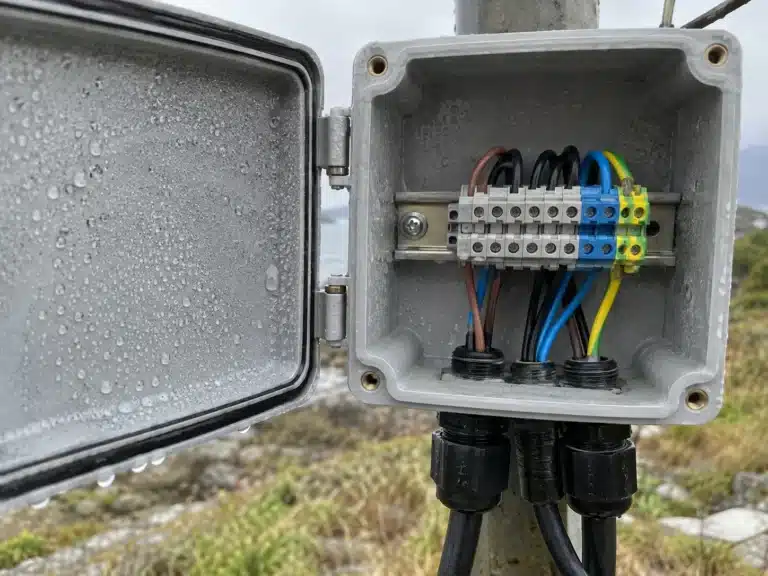
Screw-free waterproof connectors typically use a lever, spring clamp, push-in mechanism, or similar structure to retain the conductor. The installer opens or activates the terminal, inserts a properly stripped conductor, and closes or releases the mechanism — creating a repeatable connection without tightening a conductor-retaining screw.
“Screw-free” does not always mean the entire installation is tool-free. Depending on the connector, you may still need:
Before calling a product “tool-free,” confirm whether that claim applies to conductor termination only, or to the full installation sequence. In supplier catalogs, these are sometimes marketed as screwless waterproof connectors — the same termination category, just a different name for the same lever, spring-clamp, or push-in mechanism.
Screw-type waterproof connectors secure the conductor with a screw terminal, clamping plate, or similar mechanism. Installation normally requires a screwdriver, and many products specify a tightening torque.
A controlled screw-terminal process works well when a manufacturer already has documented tools, training, inspection procedures, and torque specs in place. Performance still depends on correct conductor preparation and installation, not on the terminal type alone. This category is also commonly labeled screw terminal waterproof connectors in datasheets and catalogs.
The conductor-retention mechanism and the environmental seal are two separate systems. A connector’s actual waterproof performance depends on:
A screw-free terminal does not automatically deliver a particular IP rating. A threaded housing or gland doesn’t automatically mean the connector is suitable for immersion. The rating belongs to the complete assembled connector, not the terminal style.mmersion. The rating belongs to the complete assembled connector, not the terminal style.
For a broader overview, see our guide to waterproof connector types and applications.

The table below describes typical differences, not guaranteed performance. Always confirm with the datasheet and installation instructions for the exact part number you’re evaluating.
| Selection factor | Screw-free termination | Screw-type termination |
|---|---|---|
| Conductor retention | Lever, spring clamp, or push-in mechanism | Screw or clamping plate |
| Pole count | 2–5 poles | 2–5 poles |
| Rated voltage | 450 V | Varies by model |
| Rated current | 16 A | Up to 41 A, depending on pole count |
| Conductor range | 0.5–2.5 mm² (approx. 20–14 AWG) | Up to 6 mm² (approx. 10 AWG) |
| IP rating | IP68* | IP68* |
| Termination tool | May not require a screwdriver | Normally requires a screwdriver + torque control |
| Other tools still needed | Stripper, ferrule tool, gland/housing tools | Stripper, ferrule tool, gland/housing tools |
| Assembly speed | Can reduce termination steps on high-volume lines | More positioning + tightening per terminal |
| Field servicing | Often faster reconnection, but model-dependent | Familiar to most technicians |
| Best fit | Standardized, high-volume termination; lower current, smaller conductors | Higher current, larger conductors; existing torque-controlled processes |
*IP68 immersion depth and test duration vary by model — confirm with the datasheet before specifying for continuous submersion.
These figures represent typical values across our screw-free and screw-type product families. Exact ratings vary by part number — always confirm against the datasheet for the model you’re specifying.
High-volume assembly. Removing the conductor-tightening step can shorten cycle time and reduce dependence on individual operator torque technique. When estimating labor savings, measure the full sequence — stripping, ferrule prep, insertion, terminal closure, gland/housing assembly, and inspection — not just the insertion step in isolation.
Restricted installation spaces. A compact lever or spring terminal can be easier to operate where there’s no clearance for a screwdriver — common in outdoor lighting, pumps, HVAC units, signage, and panel-mounted controls.
Mixed installer experience. A well-designed screw-free mechanism can help standardize the termination sequence across a team. It cannot, however, compensate for incorrect stripping length, incomplete insertion, incompatible wire, or a poorly tightened cable gland.
Frequent field access. Quick-connect terminals can simplify planned maintenance — but confirm whether the terminal can be safely reopened, how many reconnection cycles are rated, and whether the seal needs replacing after each opening.
Screw-free waterproof connectors typically use a lever, spring clamp, push-in mechanism, or similar structure to retain the conductor.
Existing torque-controlled processes. If a factory already runs calibrated tools, torque specs, and documented inspection steps, switching to screw-free termination may not offer a meaningful advantage unless it improves throughput, quality, or serviceability in a measurable way.
Higher current or larger conductor needs. Our screw-type models generally support larger conductors and higher current than our screw-free line — up to 6 mm² (≈10 AWG) and up to 41 A depending on pole count, versus 0.5–2.5 mm² (≈20–14 AWG) and 16 A for screw-free. If your application needs headroom above 16 A or conductors larger than 2.5 mm², screw-type is typically the better starting point — confirm exact ratings for the pole count and part number you need.
Familiar service procedures. Maintenance teams may prefer screw terminals when tooling and inspection routines already center on them. That familiarity only pays off when technicians follow the specified prep and torque procedure — under-tightening can produce a weak connection, and over-tightening can damage the conductor or terminal.
Screw-type waterproof connectors secure the conductor with a screw terminal, clamping plate, or similar mechanism.

Both IP67 and IP68 waterproof connectors are considered for wet or dusty environments, but the rating alone doesn’t define every operating condition. IP68 in particular has no single universal test — per the IEC 60529 ingress protection standard, the depth, duration, and mating condition must be stated by the manufacturer, and ratings can differ between mated, unmated, inline, and panel-mounted versions.
Both our screw-free and screw-type waterproof connector families carry an IP68 rating. Immersion depth and test duration vary by model — request the specific test conditions for the part number you’re evaluating before specifying it for continuous submersion.
Don’t treat IP68 as unlimited or permanent underwater protection — actual suitability depends on the declared test conditions matching your real exposure.
For a full breakdown of test conditions, depth/duration specs, and how to compare IP68 claims across suppliers, see our [IP67 vs. IP68 Waterproof Connectors guide].

Start with the cable, circuit, environment, and assembly process — not the termination style.
Choose screw-free when faster conductor termination or a more standardized assembly sequence offers a measurable advantage, and the model is verified for your conductor and environment.
Choose screw-type when it fits an established torque-controlled process, a specific conductor requirement, or a familiar maintenance routine.
Either way, confirm electrical ratings, cable sealing range, conductor compatibility, IP test conditions, and installation requirements for the exact part number before you approve it.
Have your cable and operating conditions defined? Send them to our team for a connector recommendation.
Ready to compare your options?
Not necessarily. Conductor termination may not need a screwdriver, but wire stripping, ferrule prep, gland tightening, or housing assembly may still require tools. Confirm the full installation procedure for the specific model.
Terminal style doesn’t independently determine IP rating. Waterproof performance depends on the whole assembled connector — housing, seals, gland, cable diameter, mating condition, and installation.
Not automatically. IP68 test conditions must be declared by the manufacturer, and many outdoor installations involve rain, spray, condensation, UV, or temperature cycling. Match the rating’s actual test conditions to your exposure.
Some designs accept stranded or fine-stranded conductors; others require ferrules or have different limits. Our screw-free terminals accept 0.5–2.5 mm² (≈20–14 AWG) conductors — always check the datasheet for the exact part number and construction requirements.
Our screw-free waterproof connectors are rated 450 V and 16 A across 2–5 poles. Our screw-type models support the same pole range with current ratings up to 41 A depending on pole count and conductors up to 6 mm² (≈10 AWG). Exact ratings depend on the specific part number.
Neither style is universally better — vibration performance depends on terminal design, conductor prep, strain relief, and housing. Request test data and validate in the finished application.
Voltage, current, pole count, conductor type/size, cable outer diameter, operating temperature, environmental exposure, mounting configuration, required certifications, expected quantity, and target market.

LET’S BUILD YOUR CONNECTION SOLUTION
Share your application, specifications, and estimated quantity. Our team will recommend a suitable connector solution and provide a quotation.
Low MOQ · OEM & ODM · Product Selection Support · Fast Quote Response