

Need waterproof connectors?Request a Quote →
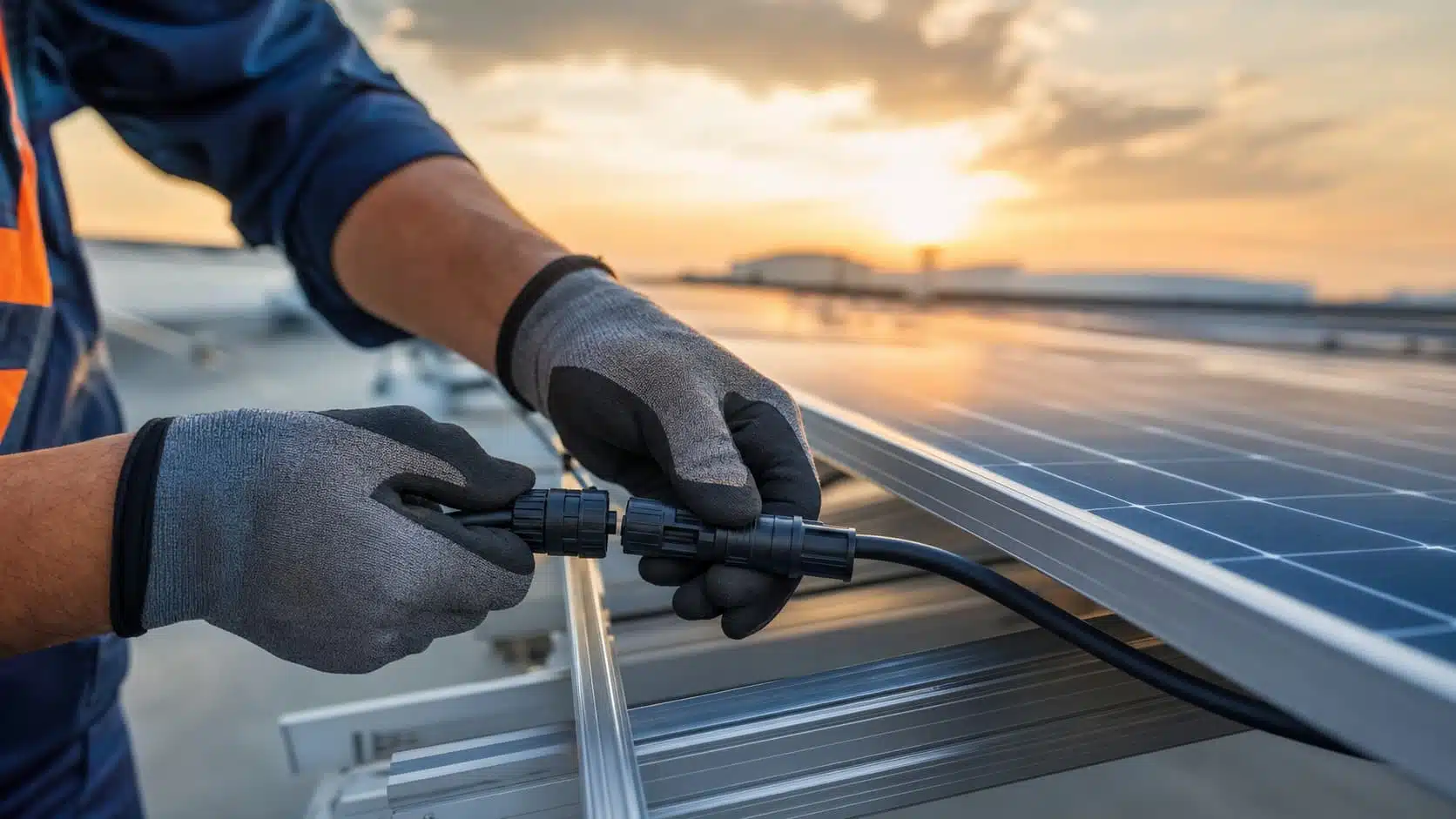
“MC4” refers to a widely used connector format for outdoor DC connections in solar PV systems — module leads, extension cables, combiner box terminations, and similar points in a system’s DC wiring. Connectors sold as MC4 are generally single-pin, weatherproof, locking connectors meant to be mated male-to-female.
Here’s where it gets a little messy, though: “MC4” has effectively become a category name in the solar industry, not a single manufacturer’s trademark that everyone respects strictly. Plenty of suppliers use the term to describe connectors that share a general form factor without being identical in tolerance, material, or certification. Two products both labeled “MC4” can come off different tooling entirely. So before specifying MC4 connectors for a project — or assuming an existing stock of “MC4” parts is interchangeable — it’s worth pulling up the specific manufacturer and part number and checking the MC4 / PV4 solar connectors documentation rather than trusting the name on the bag.
PV4 connectors occupy a similar functional space: outdoor DC connections within a PV system, generally used for the same kinds of joints — module leads, extension runs, and connections to other DC components.
As with MC4, there isn’t one universal PV4 standard that every manufacturer builds to. The term describes a category of connector rather than a single fixed specification, and design details, dimensions, and performance figures will differ by manufacturer and product line. If a specific PV4 connector’s ratings or materials matter to your project — and they should — that information needs to come from that manufacturer’s own datasheet, not from an assumption based on the name.

The table below lays out the main categories where MC4 and PV4 connectors can differ. You’ll notice most rows say “varies by model/manufacturer” — that’s not a cop-out, it reflects how this market actually works. Both terms cover products from multiple manufacturers, and the only way to know what you’re actually buying is to check the datasheet for that specific part.
| Category | MC4 Connector | PV4 Connector |
|---|---|---|
| Intended application | Outdoor DC connections in PV systems (module leads, extension cables, combiner box connections) | Outdoor DC connections in PV systems, broadly similar role |
| Connector geometry / interface | Varies by model/manufacturer — not guaranteed identical even across products both labeled “MC4” | Varies by model/manufacturer |
| Voltage and current ratings | Varies by model/manufacturer; confirm on datasheet | Varies by model/manufacturer; confirm on datasheet |
| Wire-size range | Varies by model/manufacturer | Varies by model/manufacturer |
| Sealing / IP rating | Varies by model/manufacturer | Varies by model/manufacturer |
| Locking mechanism | Varies by model/manufacturer; latch/tab designs are not guaranteed cross-compatible | Varies by model/manufacturer |
| Materials | Varies by model/manufacturer (housing, contact, seal materials differ by product line) | Varies by model/manufacturer |
| Certifications | Varies by model/manufacturer; verify against the specific product’s certification documents | Varies by model/manufacturer; verify against the specific product’s certification documents |
| Manufacturer documentation | Should be requested and reviewed before specification | Should be requested and reviewed before specification |
| Compatibility verification | Requires manufacturer confirmation and/or testing — not assumed from naming or appearance | Requires manufacturer confirmation and/or testing — not assumed from naming or appearance |
The pattern here is consistent: neither “MC4” nor “PV4” is a single standardized spec. Two connectors in the same naming category can still diverge in dimensions, materials, and real-world performance depending on who actually manufactured them.
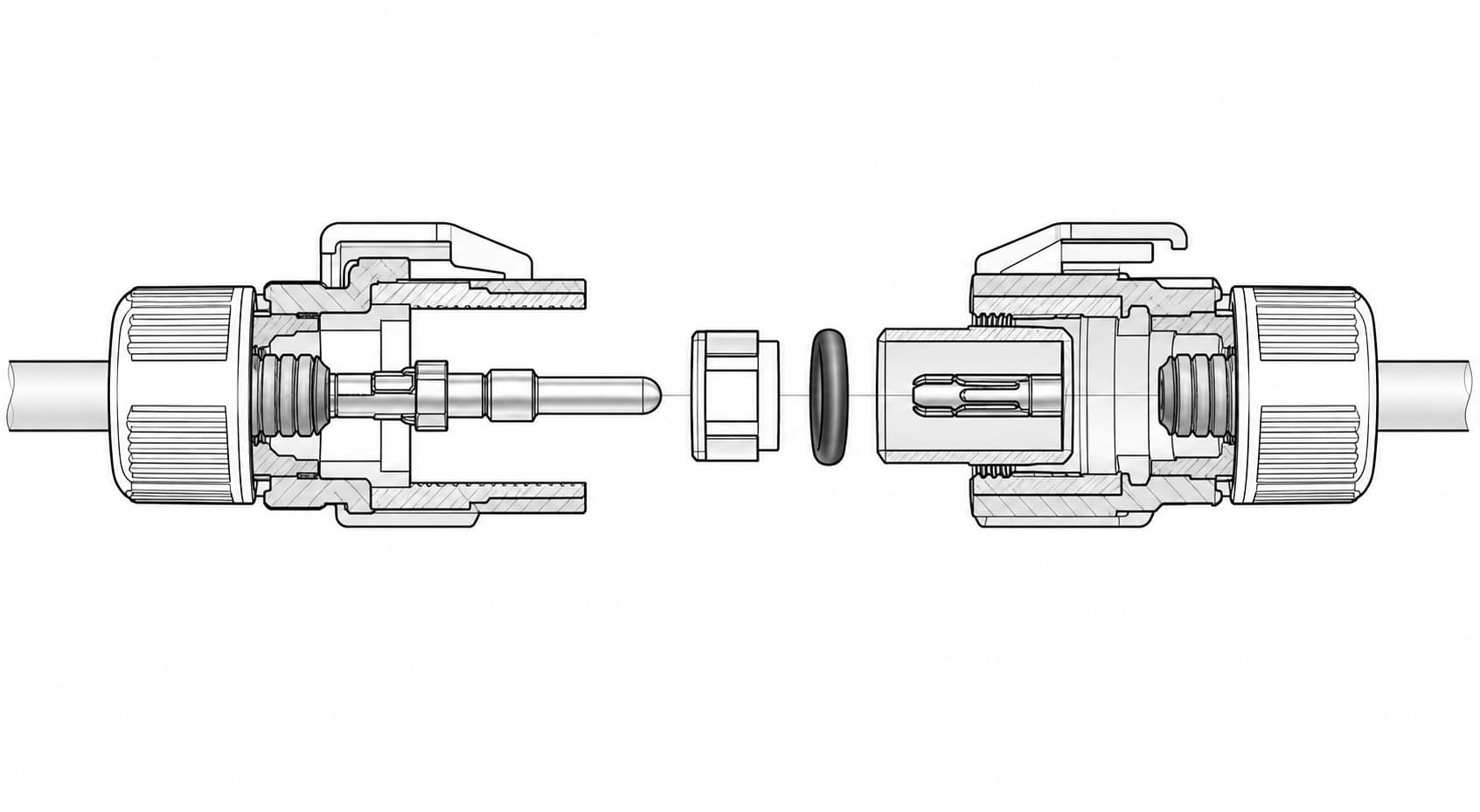
This is the question most readers came here for, and it deserves a careful answer rather than a convenient one.
Certain MC4 and PV4 connector models can, in practice, be pushed together and appear to lock. That tells you almost nothing on its own. It doesn’t confirm:
To put it plainly: this article does not claim, and installers shouldn’t assume, that MC4 and PV4 connectors are universally interchangeable. A connector that clicks together by hand can behave very differently once it’s carrying real current through a Phoenix summer or a coastal winter.
None of the following are hypothetical concerns invented for this article — they’re the standard failure modes cited across the industry whenever mismatched or unverified connectors are discussed, and they’re worth taking seriously precisely because they tend to surface long after installation, not during it.
Contact resistance is usually the first domino. If the contact geometry or plating isn’t matched, resistance at the junction increases, and that resistance generates heat under load — sometimes enough to be picked up by a thermal scan during O&M, sometimes not until there’s a visible failure. Water ingress follows a similar logic: seals are engineered around a specific mating geometry, and when that geometry doesn’t quite match, the IP rating printed on either connector’s datasheet stops meaning anything for the assembled joint. Locking is the third common failure point — a latch that seats “close enough” by feel can still leave the joint under-tensioned, which becomes a real problem once thermal cycling and vibration get involved over a few seasons.
Beyond the physical failure modes, there’s a paperwork layer that matters just as much on commercial projects: certification generally applies to a connector, or to a specific approved mating pair — not to an arbitrary combination someone assembled in the field. Warranty terms are often written the same way. And if an inspector or commissioning engineer can’t find documentation for a non-standard pairing, that’s a stalled sign-off, which on a tight schedule is its own kind of cost.

Connector selection should follow documented project requirements, not assumptions about what’s “probably fine.” A few things worth working through, roughly in order of how often they get skipped:
Current and voltage come first — confirm the connector’s rating meets or exceeds the system’s operating conditions, with whatever safety margin the project design calls for. Cable cross-section is next, and it’s an easy one to get wrong on a busy site: match the connector’s wire-size range to the actual gauge being terminated, since a mismatch here affects crimp quality even if every other spec is correct.
IP rating deserves attention specific to the site — rooftop, ground-mount, coastal, high-humidity installations don’t all call for the same sealing performance, and it’s worth checking against the environment rather than a generic assumption. UV and temperature resistance matter for the same reason; outdoor connectors live in sustained UV and wide temperature swings, so the manufacturer’s stated operating range should actually be checked against local conditions, not skimmed past.
Mating compatibility comes back again here — confirm in writing, where possible, that the specific connectors being paired are approved to mate. Certifications and project requirements should be checked against what the project, utility, or authority having jurisdiction actually requires, not what’s generically “standard.” Installation tools matter more than they get credit for: use the crimping tool, die, and torque spec the manufacturer recommends, because a generic tool can compromise even a correctly specified connector. And finally, supplier documentation and traceability — working with a supplier who can provide datasheets, certification documents, and batch traceability supports both quality control on-site and warranty claims down the line.
PVLinkTech’s selection guides go into more depth on matching connector specs to project requirements, if you want to work through this in more detail.
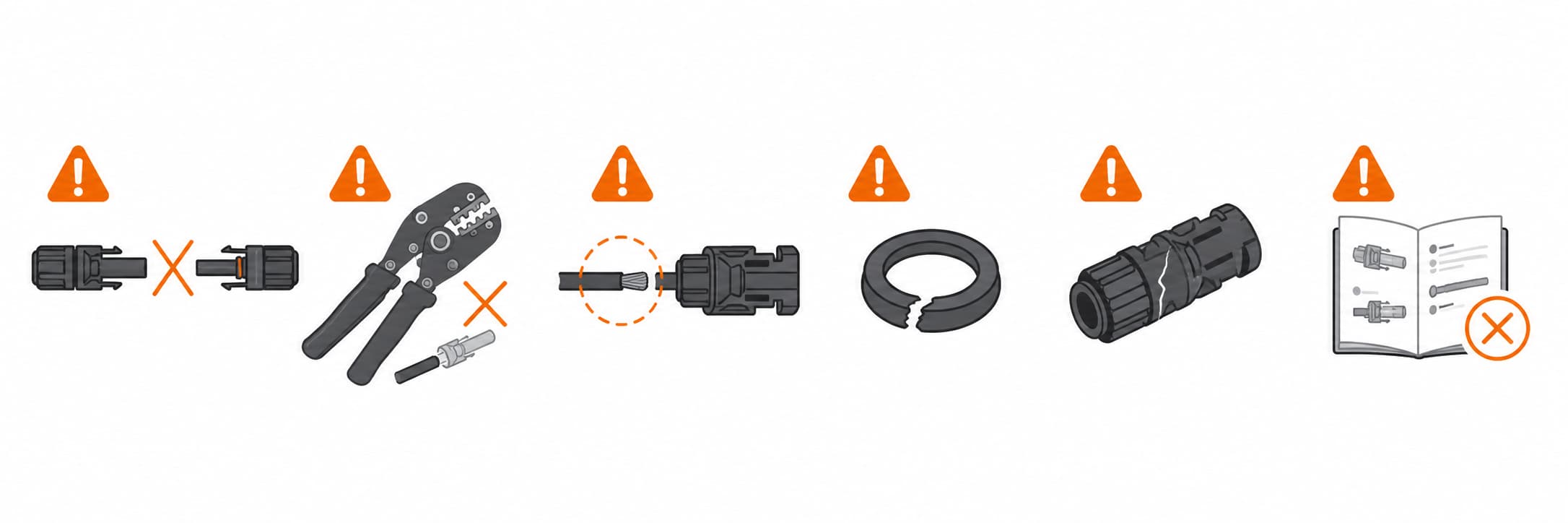
A few patterns show up repeatedly across field reports and installer discussions, independent of connector brand:
Whether you’re choosing between MC4 and PV4 connectors, or deciding if the two can be used together on a specific project, the answer comes down to documentation rather than assumption. Physical fit doesn’t prove compatibility — verifying specifications and certifications against the manufacturer’s official datasheets, checking project requirements, and following local electrical codes before mixing connector types or brands is the only approach that holds up under inspection, and under warranty scrutiny.
PVLinkTech offers a range of MC4 / PV4 solar connectors and can support project teams with product selection, technical drawings, and samples, as well as OEM/ODM connector development for specific project requirements. To discuss your project’s connector specifications, request a quote from our technical team.
Sources

LET’S BUILD YOUR CONNECTION SOLUTION
Share your application, specifications, and estimated quantity. Our team will recommend a suitable connector solution and provide a quotation.
Low MOQ · OEM & ODM · Product Selection Support · Fast Quote Response