

Need waterproof connectors?Request a Quote →
A high-altitude desert solar plant in Chile needed DC branch connectors that could withstand sandstorms, strong UV, and daily temperature swings of more than 100°C. We supplied a custom high-temperature variant of the EW-PV4 1500V solar connector (project name: PVLT-1500V Heavy Duty DC) with PPO housings and FKM sealing rings. The connectors have run for 2+ years without a single structural failure.
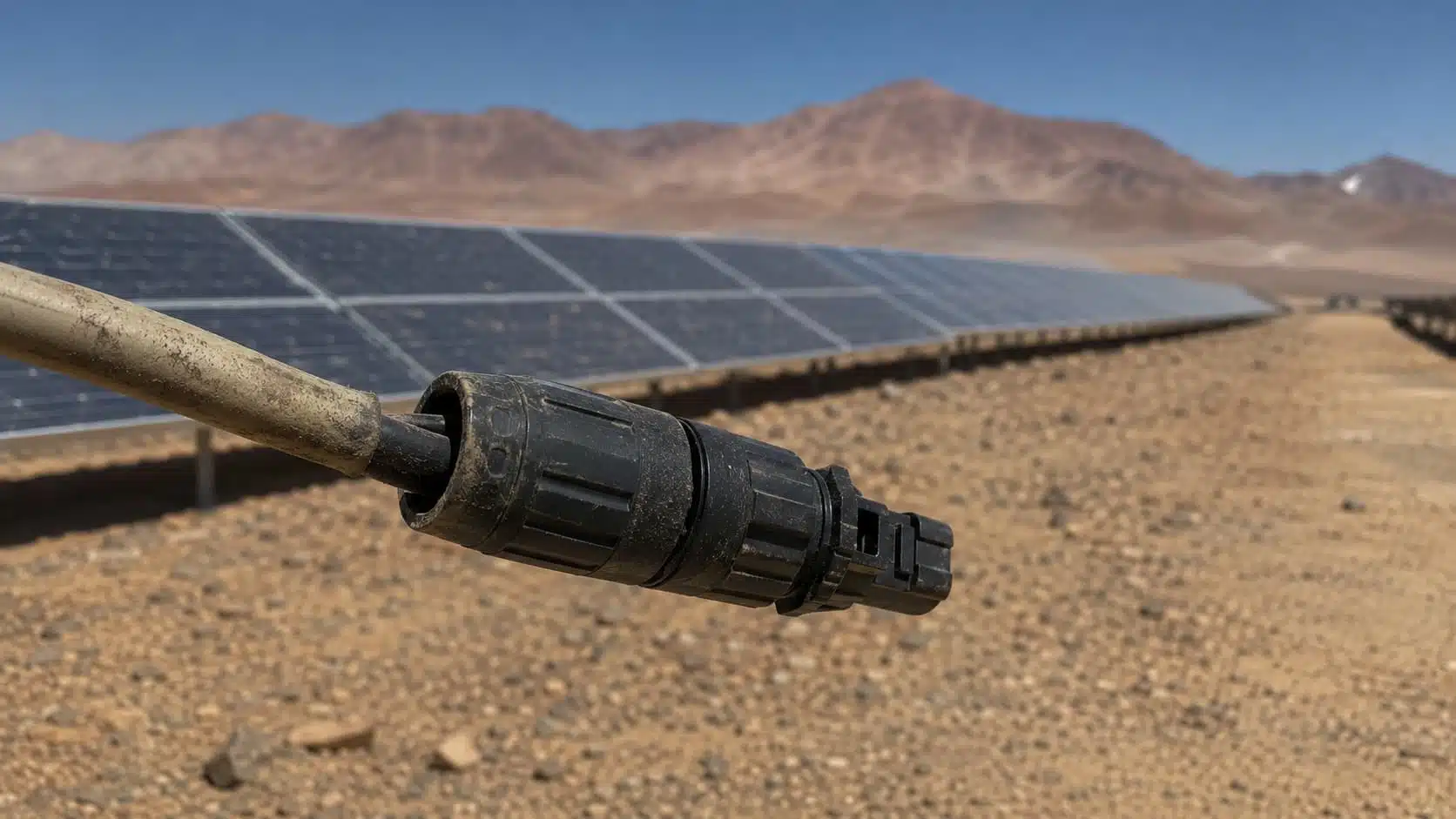
Client: Global renewable developer (name withheld by agreement)
| Application | DC branch connections, utility-scale PV plant |
| System capacity | 200 MW |
| Location | High-altitude desert, Chile |
| Connector solution | EW-PV4 desert solar connector (PVLT-1500V Heavy Duty DC), custom high-temperature variant |
| System voltage | 1,500 V DC |
| Rated current | 50 A per branch (series rated to 65 A) |
| Operating temperature | −40 °C to +110 °C (custom variant) |
| Protection | IP68 2 m / 120 h underwater test |
| Standards | UL 6703 · TÜV / IEC 62852 · GB/T 33765 |
Desert wind carries dust fine enough to work its way past a standard seal and into a connector housing. Every day, the same heat cycle that stresses the panels also pumps air in and out of the housing: warm expansion pushes it out, night cooling draws it back in, and the dust comes with it. Once inside, it grinds the contact surfaces and holds moisture against the joint. For a desert solar connector, the seal material matters as much as the IP rating.
This site sits at high elevation. Night temperatures drop below freezing, and daytime panel and housing temperatures climb far above the standard rating window. That cycle repeats every day, and each cycle stresses the seal and the housing differently: materials expand and contract at different rates, and a seal that never gets a rest day is a seal that eventually leaks. A desert solar connector rated for a temperate climate does not stay within its temperature–rise budget here.
A desert solar connector sits in full sun with no shade for its whole life. UV intensity is stronger at altitude, and dry air carries ozone. Over years of exposure, the wrong housing material turns brittle and cracks. The locking features are usually the first to fail. The process is slow: surface dulling first, then microcracks, then a housing that snaps instead of flexing. That failure shows up as an open string, not as a visible problem at first.
We built the desert solar connector package around the EW-PV4 series and changed the parts that the environment attacks: housing material and seal material. The electrical design stayed the same, which kept the approval process short.
| Rated voltage | 1,500V DC |
| Rated current | Up to 65A (project: 50A per branch) |
| Operating temperature | −40℃ to +110℃ (custom) · −40℃ to +85℃ (standard) |
| Waterproof rating | IP68 solar connector rating (2m / 120h) |
| Housing material | High–performance PPO |
| Seal material | FKM (fluororubber) |
| Contact material | High–conductivity copper alloy |
| Mating | Dual–spring clip, snap–on; tool or manual release |
| Insertion / extraction | 100+ cycles |
| Standards | UL 6703 · TÜV / IEC 62852 · GB/T 33765 |
View the full Photovoltaic Connector Series →
The standard EW-PV4 housing is PPO, and the standard seal is chosen for general outdoor use. For this site we kept the PPO housing and specified FKM for the sealing ring. For a desert solar connector, the site data decides the bill of materials, and both choices came from the site data, not from a brochure.
PPO housing. Polyphenylene oxide handles heat, UV, and ozone better than the plastics you find in general-purpose connectors. It also absorbs little moisture, which matters at a site where the night air condenses on cold metal and the morning sun dries it off before lunch. A housing that drinks moisture swells, and a swollen housing changes its locking geometry.
FKM sealing ring. Fluororubber keeps its elasticity at high temperatures where NBR and EPDM soften and take a permanent set. Permanent set is what turns a seal into a gap: the ring stops pressing against the housing, and the gap is exactly the size of the dust it lets in. That is how you build a dust proof solar connector: choose the seal for the dust, then keep everything else standard.
The changes were material substitutions, not a redesign. The electrical interface, the mating geometry, and the tooling stayed the same, which is why the sample went out 3 days after the layout was approved.
Every change in this desert solar connector order came from a specific site condition.
High-temperature rating. The housing and seal package were re-specified so this high-temperature solar connector holds −40°C to +110°C, beyond the standard PV4 range.
Seal spec. FKM sealing ring selected for fine dust and sand resistance, tested against the site’s dust conditions.
Identification and packing. Project part labels, batch marking, and desert-ready packaging to keep seals clean in transit and on site.

The custom temperature rating did not change the test standard. The batch still had to pass the same gates as the standard product, which is what the 2+ year service record is built on.
The developer shared the string layout and environmental data for the site. Our applications engineer came back with the PPO + FKM material proposal and a confirmed temperature window. Samples went out 3 days after the layout was approved. Field crews installed the desert solar connectors with standard crimp tooling, with no special equipment on site. The dual-spring clip locks by hand and releases with a tool or a thumb, which keeps installation time down across thousands of branches. Production batches are followed with project-specific labels and packing.
The same four steps apply to your project:
The desert solar connectors have held up for more than 2 years in service, through the site’s sandstorm season and its daily temperature swings. The plant’s maintenance schedule includes routine visual checks of DC connections, and the EW-PV4 joints have come back clean on every check: no housing cracks, no displaced seals, no locking failures. We publish project-specific figures (connection resistance drift, measured temperatures, failure counts) only when project records back them up. Ask for the project summary pack under NDA.
| Service time | 2+ years, full structural integrity |
| Operating range | −40℃ to +110℃ (custom variant) |
| Ingress protection | IP68 (2m / 120h) |
| System voltage | 1,500V DC |
| Housing / seal | PPO / FKM |
| Standards | UL 6703 · TÜV / IEC 62852 · GB/T 33765 |
Real customer quote goes here, to be added when the developer approves one.
PVLinkTech operates to IATF16949, ISO9001, ISO13485, and ISO14001. The EW-PV4 series complies with photovoltaic system standards including UL 6703, TÜV / IEC 62852, and GB/T 33765; certification documents are provided per delivered part number. See also UL (safety organization) and the European Commission CE marking guidance.
Engineering note: current rating, temperature rise, and IP protection depend on final cable size, ambient conditions, and the complete system design. Confirm the approved configuration with an applications engineer.
Scope: This case study covers DC connectors and connection components, not the supply of complete PV modules or racking.
Send your string layout, electrical requirements, and site conditions (temperature range, dust, altitude). We’ll come back with a desert solar connector and material proposal.
Explore the Photovoltaic Connector Series · WhatsApp: +86 132 8895 6228 · [email protected]
1500V Solar Connectors — 120MW Indonesia PV Plant
BESS Cabinet Wiring — 5MW/10MWh Storage, Germany

LET’S BUILD YOUR CONNECTION SOLUTION
Share your application, specifications, and estimated quantity. Our team will recommend a suitable connector solution and provide a quotation.
Low MOQ · OEM & ODM · Product Selection Support · Fast Quote Response