

Samples in stock · Response within 12 hours. Request a Quote →
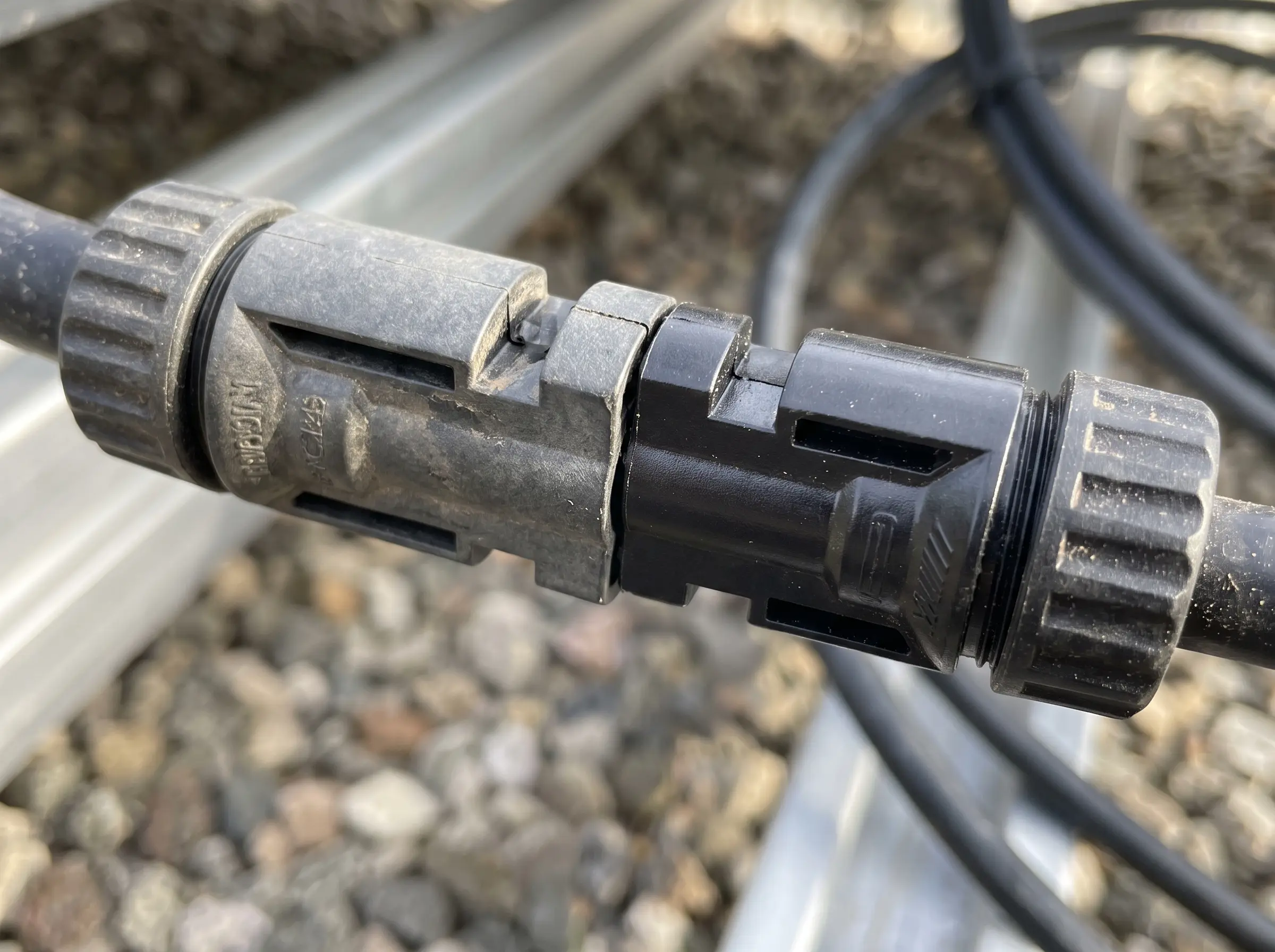
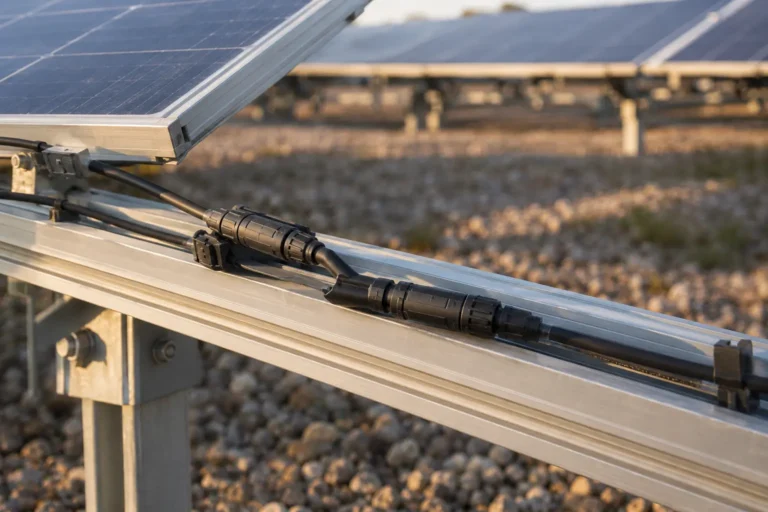
Can you mix MC4 connectors from different brands? The question hides three separate questions, and they have three separate answers. One asks whether the two housings will engage. One asks whether that exact pair was ever tested together. One asks whether the electrical code permits the result to be energized. Only the third decides whether the connection is legal, and it is the one most people never ask. This article separates the three, traces where the gap comes from, and gives a field sequence for pairs already in service. All sources were retrieved on October 21, 2026.
Key Takeaways
The click is a latch reporting that the locking mechanism traveled far enough to retain the housing. It says nothing about the metal inside.
Plenty has to go right before a pair carries current for 25 years. The pin enters the socket to a designed depth. The socket spring deflects by a designed amount and holds contact force inside tolerance. The plating on both surfaces stays compatible through thermal cycling. The gasket compresses to its design ratio. A copied housing can differ on all four.
It is also the only thing a crew can verify by hand, which is why it is over-trusted.
Can you mix MC4 connectors? Before reaching for an answer, separate the three questions hiding inside it, because each one needs different evidence.
| Question you are asking | What would prove it | What a click proves | What it leaves unproven |
|---|---|---|---|
| Will the halves engage? | Housing and latch dimensions | The latch engaged | Contact depth, spring force, seal |
| Was this pair tested together? | A certificate naming both halves | Nothing | Everything |
| Does the code permit it? | Identical type and brand, or a listing | Nothing | Compliance |
| Will it last 25 years? | Aging tests on this pair, cable and tool | Nothing | Long-term resistance |
The answers diverge in ways that matter commercially. A pair can engage perfectly, carry current for years, and still be a code violation that voids a warranty and moves liability to whoever installed it.
The MC4 connector came from Multi-Contact, now Stäubli, in 2004. MC4 is a Stäubli trademark, and everything else sold under the term copies the mating dimensions of that original.
A supplier writing “MC4-compatible” is making a statement about external geometry, not about the contact system, the alloy, the plating, or whether anyone tested the two halves as a pair. Those are different claims with different burdens of proof.
| Term | Who uses it | What it asserts | What it does not assert |
|---|---|---|---|
| MC4 | Stäubli | One product family | Anything about another brand |
| MC4-compatible | Third-party suppliers | The housings will mate | Contact, materials, seal, certification |
| MC4-style | Suppliers, catalogs | Similar appearance | Even the mating dimension |
| Listed for intermatability | A testing laboratory | A named combination was evaluated | That a listing exists for your pair |
“Compatible” is a shape claim made by a seller. “Listed for intermatability” is a finding made by a laboratory about two named products. Between them sits an actual paired test, and most cross-brand pairs on real sites never had one. Brand is only one axis: a 4 mm and a 4.10 mm family share the MC4 name but not the interface, which our MC4 vs PV4 comparison treats separately.
Three documents govern this, and each has a scope limit that matters more than its rule.
IEC 62852:2014+AMD1:2020 is the safety and test standard for connectors in PV DC circuits. It evaluates a system: housing, contact, cable, crimp tooling. The certificate attaches to that assembly, not to a housing shape that happens to mate with a competitor’s.
UL 6703 is the North American counterpart. A listing attaches to a defined product, tested with its own mating half.
IEC 62548-1:2023 states the rule directly: connectors shall be of the same type from the same manufacturer. The 2016 edition was withdrawn in December 2023, so a citation without an edition points at a superseded document.
Stäubli’s published position puts the consequence in one sentence: if a plug from manufacturer A is combined with a socket from manufacturer B, a new, non-certified connection is created, and the standard’s test sequences are not suitable for validating it. The position is self-interested and mechanically correct. No test house can certify a combination whose counterpart it was never given.
NEC Article 690.33(C), in the 2020 and 2023 editions, reads: where mating connectors are not of the identical type and brand, they shall be listed and identified for intermatability, as described in the manufacturer’s instructions. The code does not ban mixed pairs, and three routes are available.
| Route under 690.33(C) | What the code requires | What it costs |
|---|---|---|
| Identical type and brand | Both halves from one manufacturer and family | Spare-parts discipline |
| A listed jumper between halves | A listed jumper with correct ratings | Two more interfaces per joint |
| Listed for intermatability | A UL 6703 listing naming both halves | No such listing exists in general use |
| Field improvisation | Nothing | Outside every warranty involved |
The third route is open in the text and empty in the market. No manufacturer has an incentive to pay for a listing that turns its own connector into a commodity. And NEC 110.3(B) requires equipment installed in accordance with its listing and the manufacturer’s instructions, while the assembly instructions from the major connector makers tell the installer not to mate their product with another manufacturer’s.
Read those clauses together and the logic shuts: the code permits a listed cross-brand combination, the listing does not exist, and the instructions forbid it. An installer who mated two brands sits outside the instructions whether or not the pair performed. Lucas Miller makes this argument in Mayfield Renewables’ 2024 article on DC connector risk.
Where an Interface Difference Starts to Matter

| Interface difference | Mechanism it starts | What appears later | What to measure |
|---|---|---|---|
| Pin diameter, spring force | Contact area drops, resistance rises | Warm housing, discolored polymer | Resistance or temperature rise |
| Alloy and plating | Galvanic couple forms an oxide film | White or green corrosion | Visual plus resistance |
| Gasket compression | Seal never reaches design ratio | Water, dust, condensation | Seal condition at teardown |
| Crimp tool and die | Conductor under- or over-crimped | Loose ferrule, heat at the crimp | Pull test, cross-section |
Heat is the accelerant. Higher resistance raises joint temperature, temperature speeds oxidation and hardens the seal, and the next thermal cycle starts from a worse baseline.
Sandia National Laboratories published a study in Solar Energy (volume 301, 2025, article 113916) characterizing 6,276 connectors harvested from US residential rooftops by visual inspection, resistance measurement and X-ray imaging. Its critical-failure criterion was resistance above 50 milliohms, and its abstract calls connectors a primary contributor to PV system failures and a source of numerous fire incidents. The same program publishes infrared surveys showing 25 to 27 °C on healthy joints and up to 95 °C on degraded ones.
PVEL reported nearly 3.5 billion PV connections worldwide as of December 2021; SolarGrade found 40 percent of the urgent safety issues it identified were related to field-made or factory-made connectors.
Procurement teams should read this twice: the answer is not the party holding the crimp tool.
| Party | Position after a mixed pair fails | Basis |
|---|---|---|
| Connector manufacturer | Not liable | Used outside its intended use |
| Test laboratory | Not liable | Reports carry a disclaimer and describe samples |
| Module or inverter maker | Not liable | Warranty covers its own connector |
| EPC or installer | Usually liable | Executed the work and chose the parts |
| Asset owner | Absorbs the loss | Downtime, fire damage, insurance |
An individual test report is not a certificate. It describes the samples submitted, and the client chose what to test. A design type certificate comes from an accredited body, covers a series, and requires production surveillance. Confusing the two is how “compatibility testing” reaches a tender document.
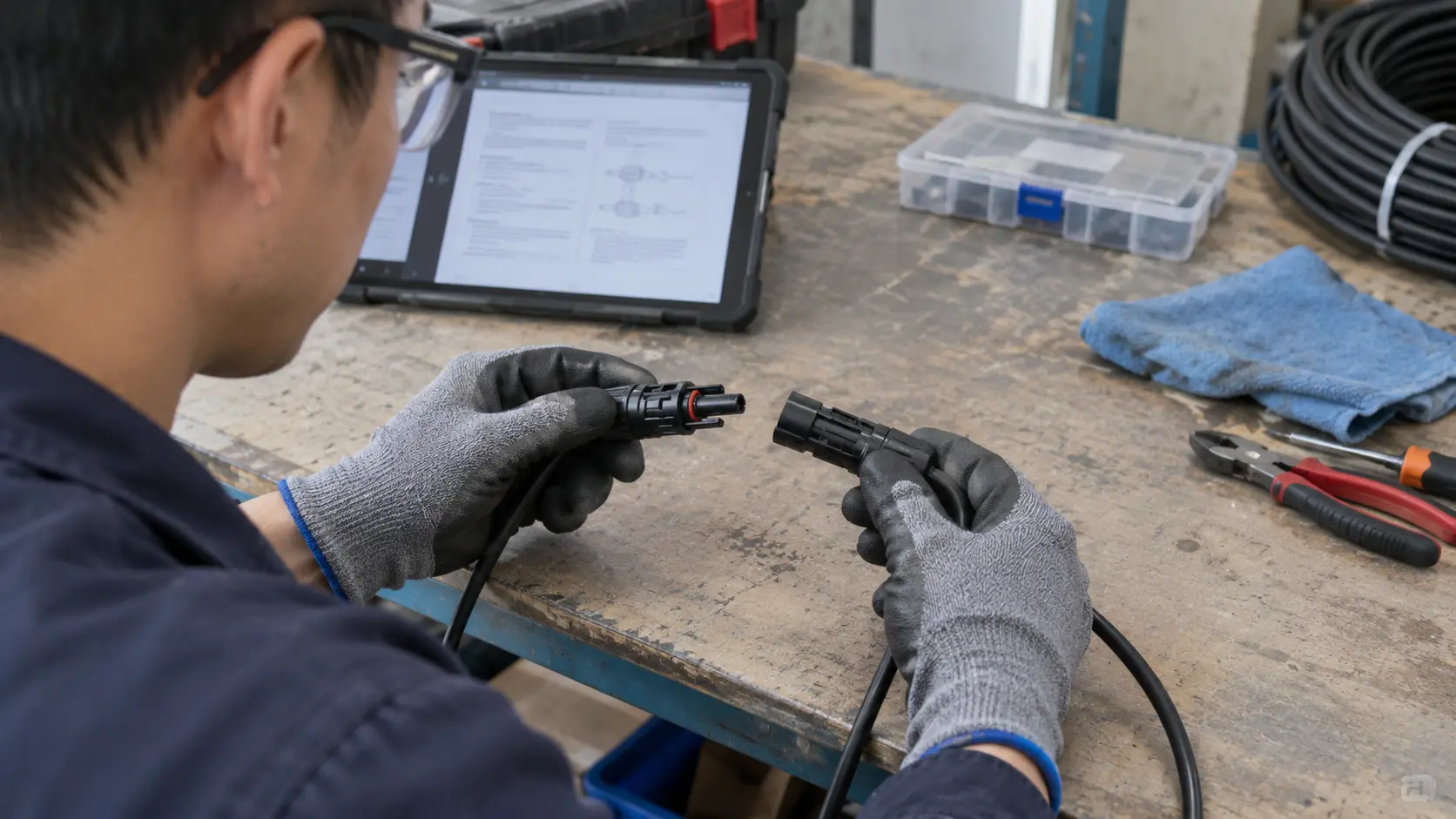
Wrong-die crimping survives brand discipline, which is why the crimping procedure belongs here.
Buy the same family and model as the half you keep, or replace both. Do not accept a “compatible” substitute because the original is out of stock.
Put part numbers, cable range, crimp tool and die, and certificate reference into the purchase order. Our RFQ checklist lists the fields worth comparing.
Sample by installation crew and by string, because mixed pairs cluster around whoever assembled them. Then read the assembly instructions in force at installation.
One project record, as an example rather than a rule. A 120 MW floating and ground-mount plant in Indonesia took a single Greenway MC4 family rated 30 A at 1000 V DC system voltage, CE and RoHS, with UL94 V-2 housing. Commissioning required matched families, controlled crimping, and a photograph of every connection point. The plant recorded no connector-related failures in 18 months, and assembly ran about 25 percent below baseline. The same question came back at commissioning. Can you mix MC4 connectors here? Standardize the family and it never arises.
Sources are named with title and date. All pages were retrieved on October 21, 2026.
No. Compatibility in the product description refers to the outside dimensions of the housing, not to the contact system inside it. Two connectors from different manufacturers can mate while differing in pin diameter, spring force, plating, and seal compression. A pair is compatible when it is documented and approved as a pair, and on that test most cross-brand pairs fail.
The click proves the latch engaged and nothing more. It does not report contact resistance, insertion depth, or seal compression, and it has no bearing on certification. In the United States a mixed pair is permitted only when the combination is listed for intermatability, and the assembly instructions from the major manufacturers prohibit it outright.
It requires that where mating connectors are not of the identical type and brand, they be listed and identified for intermatability as described in the manufacturer’s instructions. Two compliant routes remain in practice: use identical type and brand, or insert a listed jumper. The third route depends on a listing that does not exist for cross-brand pairs.
It can pass an inspector who does not read markings against certificates, which is not the same thing as being compliant. Whether a specific installation survives review depends on the AHJ, the contract, and the insurer. Once a claim exists, documentation decides the outcome rather than the pair’s operating history.
Yes. Keeping one half leaves an interface in the system that no certificate covers, and the retained half carries unknown thermal history from whatever condition caused the finding. Replace both with one matched pair, using the specified contact and crimp tool, and record the replacement against the string position.
Read the housing. Manufacturer logo, model code, polarity marking, and production marks are molded or printed on the body, and both halves carry them. Compare them against the maker’s drawings and certificates. If a marking matches no documented product, treat the connector as unidentified and replace it rather than guessing the brand.
Send us the counterpart part number. If you are specifying connectors or auditing a site, send the male and female part numbers, cable construction and jacket diameter, system voltage and current, and the application environment. Our engineering team will tell you whether the pairing is documented, and our connector sample testing process covers the checks a mixed pair would otherwise skip.

LET’S BUILD YOUR CONNECTION SOLUTION
Share your application, specifications, and estimated quantity. Our team will recommend a suitable connector solution and provide a quotation.
Low MOQ · OEM & ODM · Product Selection Support · Fast Quote Response