

Samples in stock · Response within 12 hours. Request a Quote →
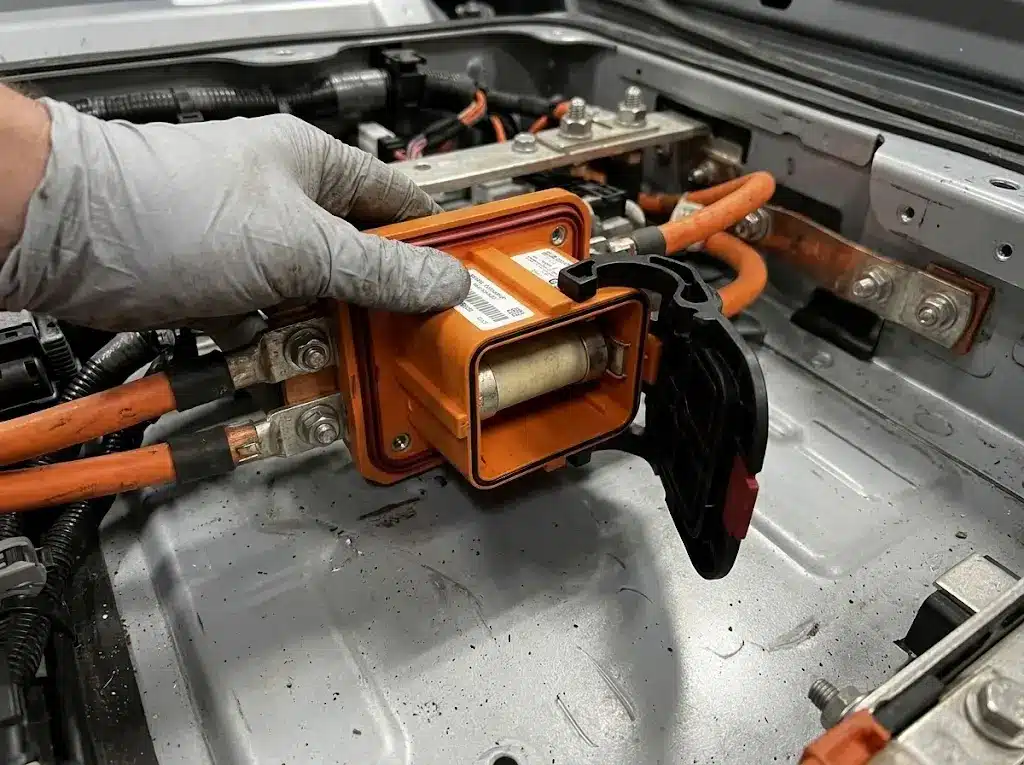
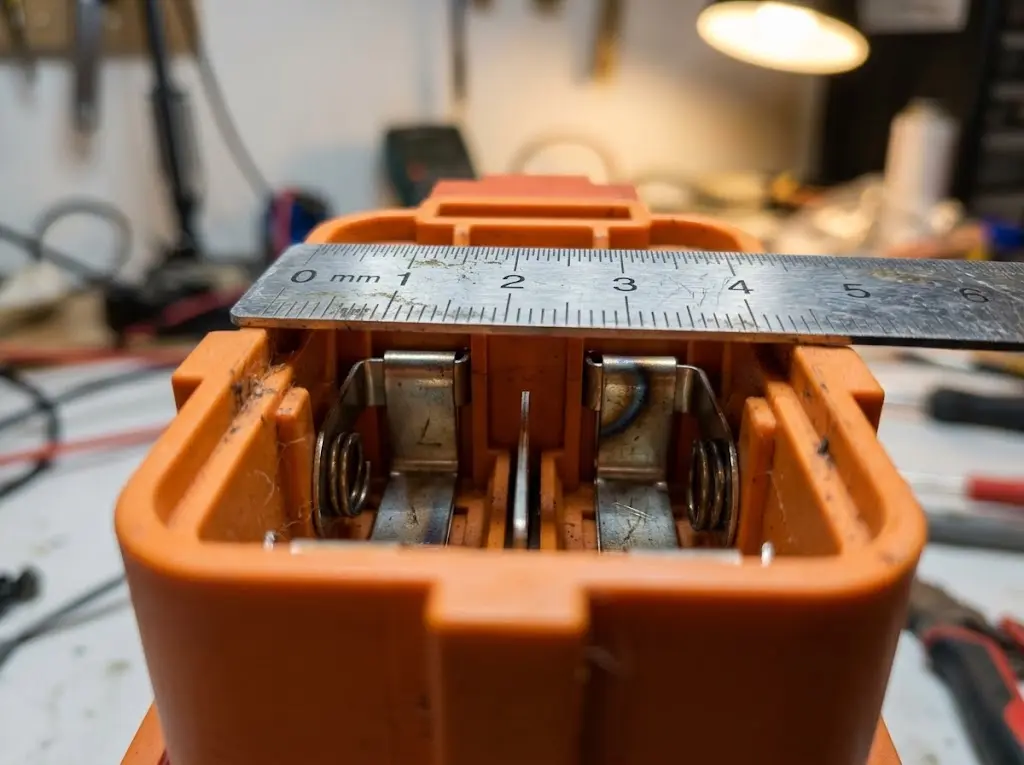
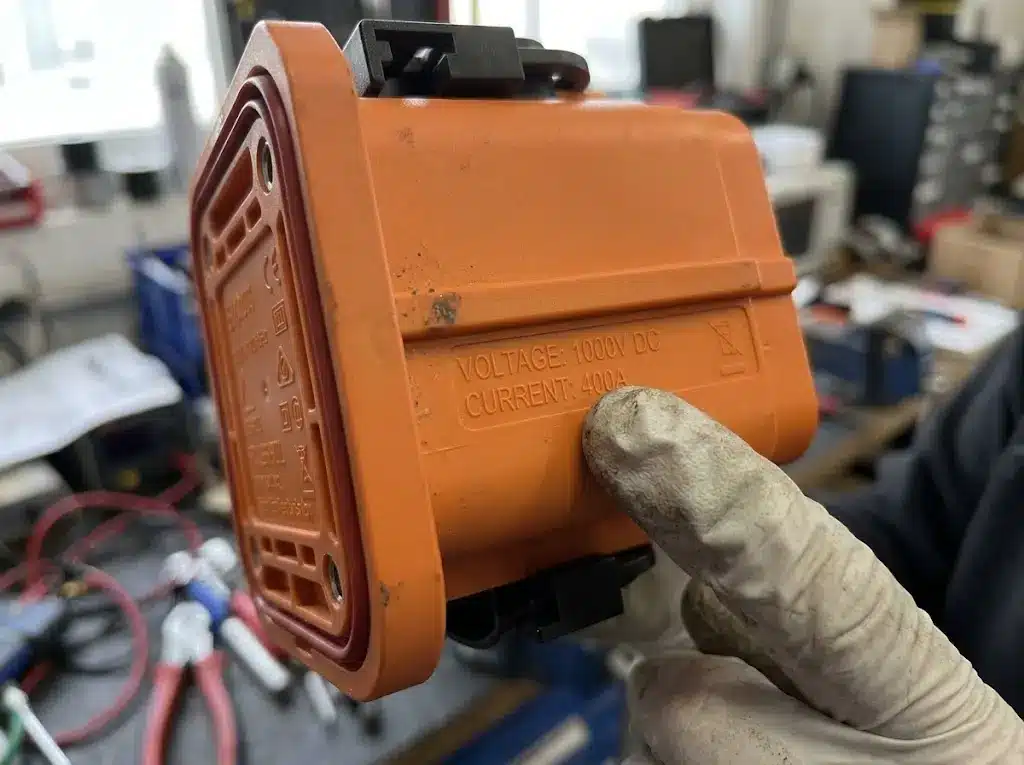
MSD fuse rating and the current rating printed on the same disconnect answer two different questions, and neither one is a mistake. The number on the fuse, 400 A in this case, is the current the fuse-link is built to carry without opening. The 240 A printed on the disconnect is the continuous current the assembled device passed its temperature-rise test at, with that fuse already fitted. A 400 A fuse in a 240 A disconnect is a normal design result, because the fuse has to sit above the device’s continuous limit so it stays closed in normal service. Swapping either number breaks a pair that was tested together.
| Item | Figure |
|---|---|
| Disconnect rating in the example | 240 A continuous |
| MSD fuse rating fitted in the same housing | 400 A |
| Minimum fuse size over a continuous load (NEC 210.20(A), 215.3) | 125% of the load |
| Same housing with no fuse fitted, published MSD data at 25 °C | 360 A |
| Same housing with a 350 A fuse, published MSD data at 25 °C | 195 A |
Two tests produce the two numbers, and they measure different failure modes. The fuse number comes from the fuse standard. A UL 248 Listed fuse of 600 A or less is tested at 100 percent of its marked current. Fuses of 601 A and above in Class L and T are tested at 110 percent. That is how the manufacturer can state the link carries its own rating without opening. Above that point the published time-current curve decides when it melts. IEC 60269 gG fuse-links are checked between two gates instead: no opening at 1.25 times rated current inside the conventional time, and an opening by 1.6 times rated current.
The disconnect number comes from a temperature-rise test on the hardware, and nothing in that test produces an MSD fuse rating. Current is driven through the mated contacts, the fuse clips, the terminals and a stated length of cable at a stated ambient, and the temperature is monitored until it settles. What comes out is a property of the whole current path. It belongs to that configuration only.
| Question | Which number answers it | What that number leaves out |
|---|---|---|
| How much current can flow for years without overheating? | Disconnect rating, 240 A here | Whether the fuse opens at that current |
| Where does the fuse begin its opening curve? | MSD fuse rating, 400 A here | How hot the assembly runs in the cabinet |
| How much fault current can the device interrupt? | Interrupting rating printed on the fuse | The continuous current it will carry |
Read as a pair, the two numbers are consistent. The hardware carries 240 A continuously, and the fuse does not begin to open until well above that. An engineer who checks only the smaller figure will go looking for a fault that is not there.
The load sets the floor for an MSD fuse rating, and the floor already sits above the device rating. NEC 210.20(A) and 215.3 size the overcurrent device at 125 percent of a continuous load. With 240 A flowing continuously, the circuit therefore needs a device of at least 300 A before any other factor applies. Standard ratings step from there, and 350 A or 400 A is where that arithmetic lands.
A DC link has to be precharged, and a contactor closes with a bounce, so a rack may see capacitor charging current well above its steady value for a fraction of a second. A fuse whose MSD fuse rating sat exactly on the continuous current would open on the first precharge of the shift.
Inside a sealed housing the heat from the fuse element has nowhere to go. Eaton’s application note on 100 percent fuse loading makes the point directly: whether a fuse can be used at its full marking depends on the environment and on the switch and terminations around it. An MSD is a sealed body in a warm cabinet, so the fuse runs well under its own number and the MSD fuse rating reflects that heat.
Fault current decides the class of the fuse rather than its size. The prospective short-circuit current of a 1500 V DC string at the terminals is a fault study figure. The fuse has to interrupt it at that voltage. A designer picks the smallest standard rating that satisfies the load, the inrush and the coordination. Interrupting rating and let-through energy then get checked against the parts downstream. The check only works with the whole chain in front of you, because the cable, the contactor and the disconnect each publish a damage curve. An MSD fuse rating has to sit above normal operation and below the lowest of those three curves.
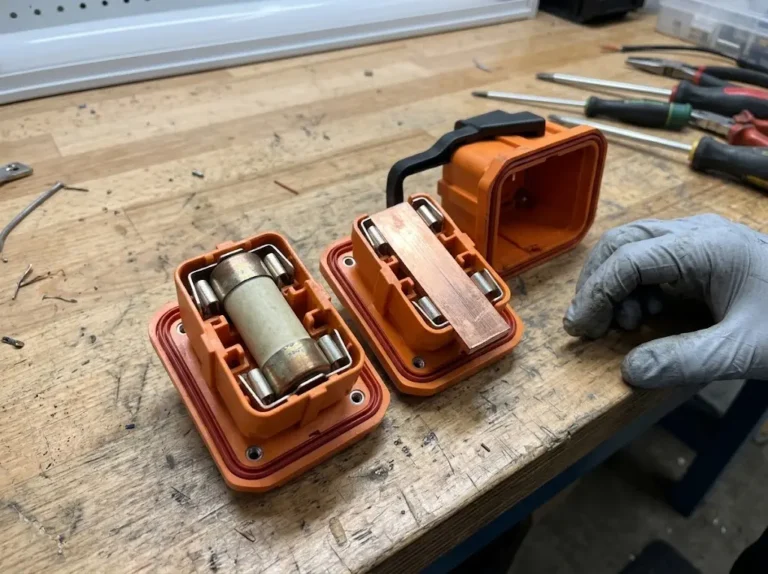
Manufacturers of fused manual service disconnect parts publish both numbers, and the gap between them is larger than most engineers expect. The figures below come from published datasheets for fused manual service disconnects, quoted as an industry reference and not as a PVLinkTech rating. The current values are for a 70 mm² cable at the stated ambient.
| Configuration | Fuse fitted | Continuous rating at 25 °C | Continuous rating at 85 °C |
|---|---|---|---|
| Disconnect only, no fuse | None | 360 A | 260 A |
| Disconnect with a 200 A fuse | 200 A | 150 A | 110 A |
| Disconnect with a 350 A fuse | 350 A | 195 A | 140 A |
The table shows the same housing losing more than half its capacity once a fuse goes in. The element and the clips are heat sources in the same sealed body as the contacts. It also shows an MSD fuse rating running well above the continuous rating it produces, roughly 1.8 to 1 in the 350 A row. A 240 A device carrying a 400 A fuse is the same pattern at a different point on the curve.on the curve.

Someone reaches for a swap because they need more headroom, or the only fuse in the stores is a different size, or the original looks oversized next to the cable. Changing it moves more than one figure at once, and the MSD fuse rating is not the only one of them.
| Change | What it moves | What you get |
|---|---|---|
| Larger fuse | Point where the curve starts, and the let-through I²t | A fault that burns longer inside the same contacts and clips |
| Smaller fuse | Margin over the continuous load | An opening at precharge, and an outage nobody can explain |
| Different class or curve | Overload behavior against short-circuit behavior | No overload protection, or no ride-through for inrush |
| AC-rated fuse at 1500 V DC | DC interrupting capability | An arc the fuse cannot force to zero |
A coordination study does not stop at the fuse curve. The other half is the withstand of the cable, the contactor and the disconnect contacts, and those figures were established with one specific fuse in the circuit: substitute another and the study describes a panel that no longer exists, even if the new part is a better fuse on its own.
The fuse value is also part of the evaluated configuration of the pack or cabinet. NEC 110.9 and 110.10 put the interrupting rating and the component withstand on the installation, not on the person who chose the fuse. Nobody at the site can re-establish that evaluation with a part number from a catalog page.
Direct current has no natural voltage zero, so the fuse arc is the only thing that pushes the current down to zero. Mersen’s technical note on fuse operation under DC conditions puts it plainly. Without a natural voltage zero, DC fault interruption is harder than AC. A large L/R time constant makes it harder again, because the current rises more slowly and the pre-arcing time lengthens. The same note adds the practical rule, that an AC-rated fuse can be used on DC only where the manufacturer publishes the DC capability of that fuse.
Read that against a 1500 V DC battery string and an MSD fuse rating stops being a maintenance detail. A fuse rated for the wrong voltage or the wrong time constant does not open a little late. It fails to interrupt, and the energy stays in the housing.
Most of the confusion about an MSD fuse rating comes from treating the disconnect as a breaker. The disconnect isolates the string. The fuse is the part that clears a fault. NEC 706.15(E)(2) says as much for battery circuits above 240 V DC nominal that are serviced in the field. The design has to be able to divide the string into segments of 240 V DC or less. Bolted and plug-in disconnects without load-break capability are explicitly allowed for that maintenance purpose, which is why a non-load-break device can be the right part here.
Our own MSD-350 follows the same split. It is a non-fused isolator rated 350 A at 1500 V DC, sealed to IP67 when the gasket sits flat on the panel, with a two-stage handle that opens the contacts before it releases. The fuse sits elsewhere in the pack, and its rating comes from the rack design rather than from the disconnect, which is why no MSD fuse rating appears on the isolator itself.
Four figures matter when you are standing in front of a fused disconnect with a replacement fuse in your hand, and the MSD fuse rating is only one of them.
| Figure on the label | What to check before you touch the fuse |
|---|---|
| DC voltage rating | That it is a DC rating at your string voltage, not an AC rating |
| Current rating with its conditions | Ambient temperature and cable size the rating was established at |
| Fuse class and current | Same class, same current, same physical size as the fitted part |
| DC fuse interrupting rating | Equal to or above the available fault current at that point |
An MSD current rating without its conditions cannot be compared with anything. Ask for the temperature-rise report, as you would ask for a derating curve before committing a connector to a cabinet. Heat is the other half of this question, and BESS connector temperature rise follows current, contact resistance and cable size through the cabinet.
When a design needs more current, the MSD fuse rating is the wrong thing to change. The disconnect, the fuse class, the cable, the contactor and the busbar all sit in the same coordination study, and raising one of them moves the limit to the next weakest part. Take the load profile, the ambient and the available fault current to the pack or cabinet manufacturer, and ask which fuse and which disconnect were evaluated together at that current.
That 240 A disconnect and the 400 A fuse are a matched pair, not a contradiction. The device holds 240 A, the fuse stays closed above it, and the pair was tested as one assembly at a stated ambient with a stated cable. Anyone who changes one half of that pair without the fault study and the evaluation behind it is no longer working on the same device.
If you are specifying a disconnect for a new pack or cabinet, send us the string voltage, continuous current and available fault current. We can help you identify MSD fuse options that meet your electrical requirements.
Discuss Your MSD RequirementsNo, not on a unit that is in service. The MSD fuse rating was established with that fuse fitted, at a stated ambient and cable size, and the fault study assumed the same part. A different manual service disconnect fuse changes the heat balance and the let-through energy at the same time. If the circuit needs more current, the disconnect, the fuse, the cable and the contactor move together, and the pack manufacturer signs off the new combination.
Usually not. Published data from fused manual service disconnect families shows the fuse number sitting well above the continuous rating the same housing produces, because the fuse and its clips add heat inside a sealed body. The two figures come from two different tests. A genuine error looks different: a fuse whose voltage class or MSD fuse rating does not match the marking, or a part that does not seat in the clips.
It opens when it should not, and a lower MSD fuse rating is not the safer choice. Precharge current, contactor bounce and a hot cabinet all push a marginal fuse over its curve, and the outage that follows looks like a failed disconnect. A fuse that opens at part load can also leave a damaged element in the body, and the next person to read the MSD fuse rating will be looking at a part that never cleared a fault.
Yes. The same disconnect in the same published family carries 360 A at 25 °C and 260 A at 85 °C with no fuse fitted, and the gap stays in proportion once a fuse is added. Cabinet temperature, cable size and airflow all move the number. An MSD fuse rating quoted without its conditions is not a specification you can design to.
Only if the fuse manufacturer publishes a DC rating for that specific fuse. At 1000 V DC and above, an AC rating tells you very little, because the fuse has to force the current to zero without a natural zero crossing. An AC-only fuse in a 1500 V DC string can fail to interrupt, and no MSD fuse rating on the housing will tell you that before the fault.
The person the site’s electrical safety program authorizes, working to the pack manufacturer’s procedure. That procedure normally requires the system to be de-energized, the disconnect locked open, the DC bus verified at zero volts and the replacement recorded with its part number. The fuse is a listed component of the assembly, so the record matters as much as the part, and the MSD fuse rating on the new fuse has to match the old one exactly.

LET’S BUILD YOUR CONNECTION SOLUTION
Share your application, specifications, and estimated quantity. Our team will recommend a suitable connector solution and provide a quotation.
Low MOQ · OEM & ODM · Product Selection Support · Fast Quote Response