

Need waterproof connectors?Request a Quote →
PVLinkTech Technical Blog · Guide for Panel Builders, Electrical Contractors & OEM Buyers · Reviewed by the PVLinkTech Engineering Team
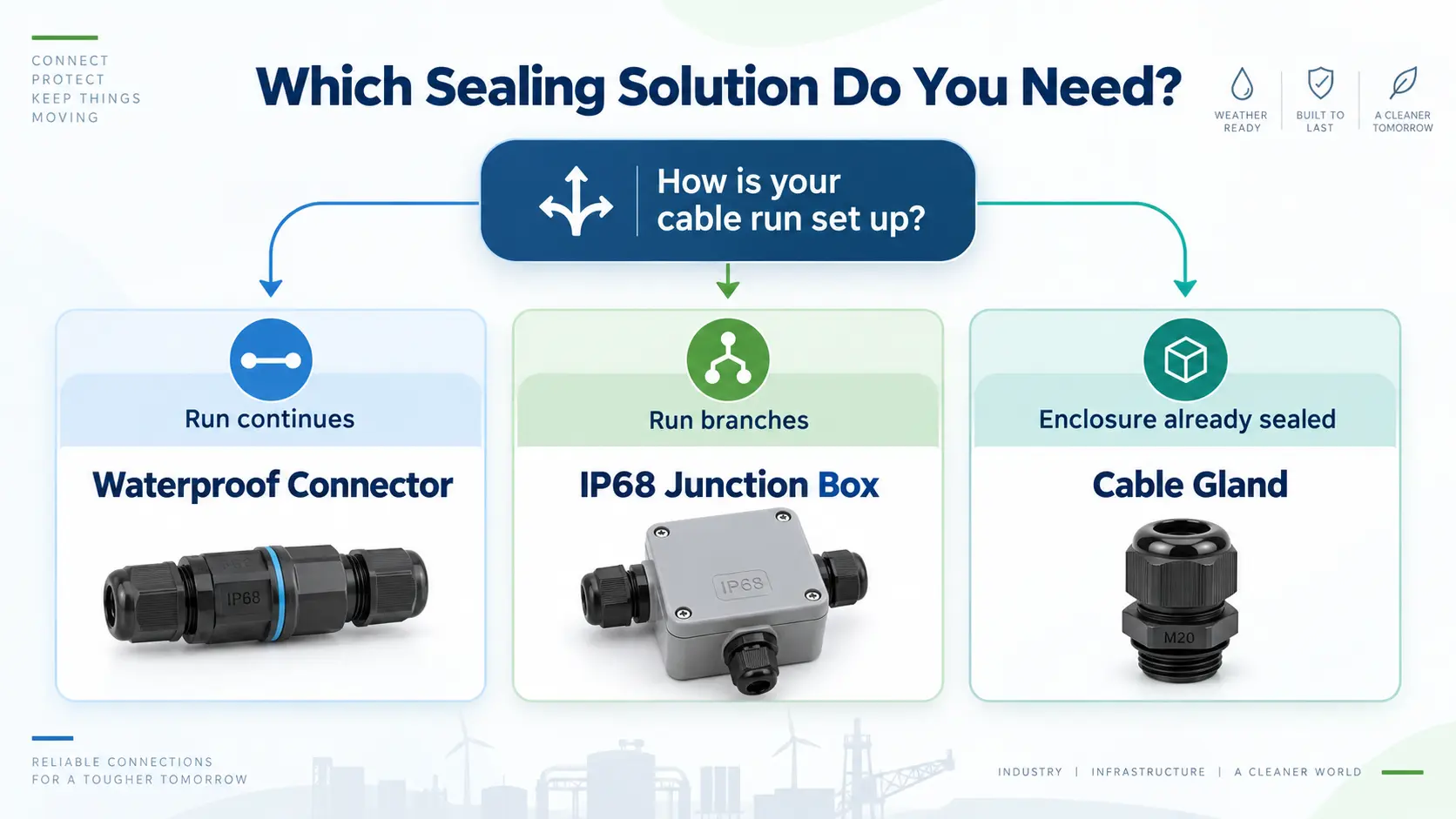
A run that leaves a building gets joined in one of three places. A connector continues it, an IP68 junction box splits it, or a gland seals the point where the cable enters equipment that already has its own enclosure. All three can carry an IP68 rating, so comparing datasheets rarely settles the question. What settles it is the shape of the run, who has to open the joint later, and how the cable arrives at the split point.
| Item | Detail |
|---|---|
| What IP68 means (IEC 60529) | Dust-tight, plus protection in continuous immersion at the depth and duration the manufacturer declares |
| M686 IP68 junction box range | 2-way (1 in / 1 out) to 6-way (1 in / 5 out), plus 8, 10 and 14-way bodies |
| Electrical rating to IEC | 24 A at 450 V AC, terminals 0.5-2.5 mm² (12-14 AWG) |
| Electrical rating to ETL | 10-15 A at 300 V AC |
| Gland sizes | 3-6, 4-8, 8-12 and 10-14 mm jacket ranges depending on model |
| Sealing and temperature | IP68 tested at 2 m for 120 hours, -40°C to +105°C |
| Certifications | ENEC, CE, ETL, UKCA, CB; RoHS |
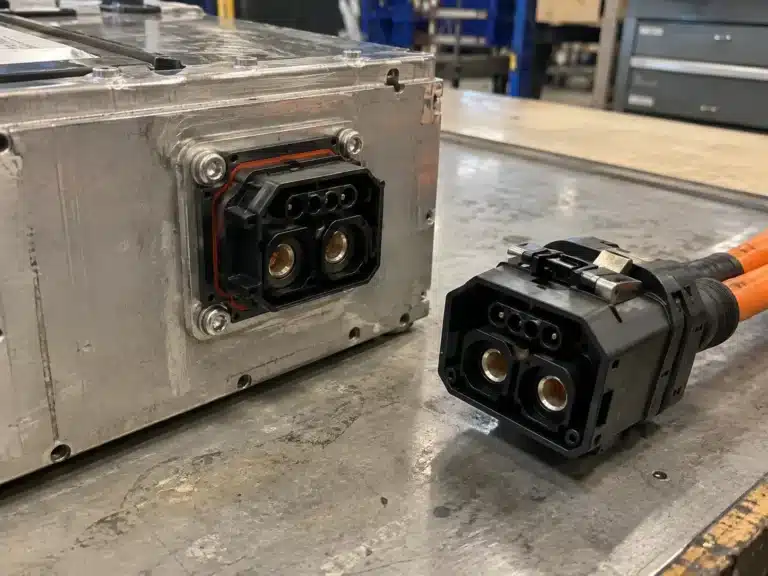
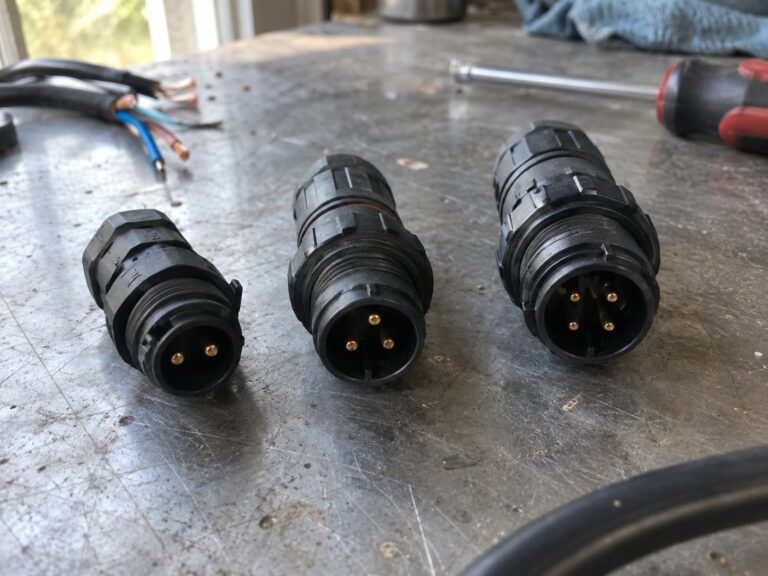
A connector becomes part of the run. Two cable ends meet, one sealed mating pair holds them, and nothing has to be mounted on the structure. An IP68 junction box works differently. One incoming cable reaches a set of terminals, and the current leaves along several directions from a single sealed housing. The third case is barely a joint at all. Where the equipment already ships with a sealed enclosure, the only thing that has to stay dry is the cable entry, and a gland or a panel-mount connector covers it.
Buyers start on the wrong one of the three often enough that it shows up in the quotes we write. Catalogs group these parts by rating rather than by function, so the search starts with an IP number and a price, and the drawing later turns out to need a split point, or the box turns out to have nowhere to sit.
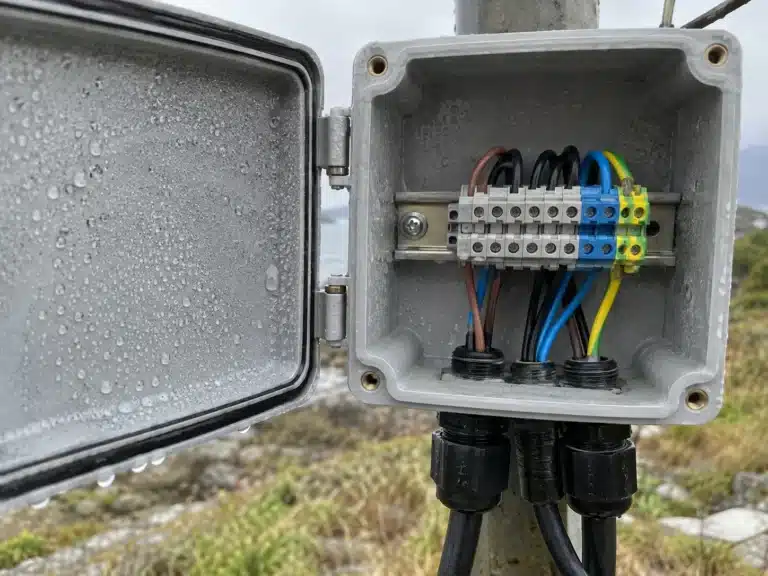
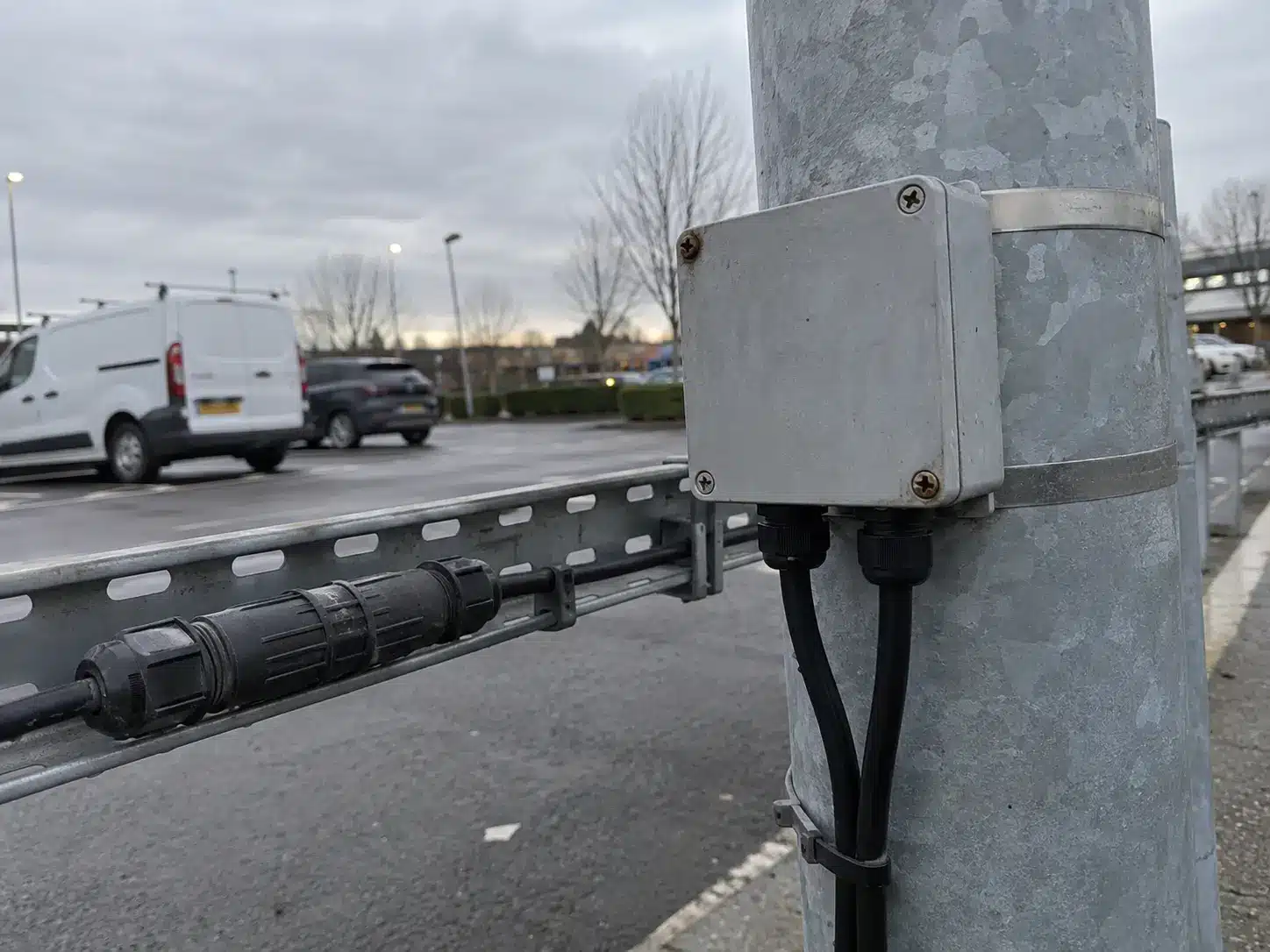
Branching is the clearest case. One feed leaves a distribution board, and four luminaires have to be supplied from it. Built from connectors, that branch needs four mating pairs along the same run, each with its own seal, latch and cable support. Built at a box, the branch happens once inside one housing, and the enclosure takes the mechanical load instead of the joint. Our M686 range covers that work from a 2-way straight joint up to a 14-way split, and the quote requests we see land mostly between 3-way and 6-way. The full model table, gland sizes, and dimensions sit on the IP68 waterproof junction box page.
Service access pushes the same way. Every re-termination at an inline connector eats a little more cable, and a pole handhole or a duct pit holds only so much slack. Terminals behind an IP68 junction box lid can be opened, checked and closed again without cutting anything.
Sometimes it is only the space. A 4-pole or 5-pole connector on a 10-14 mm jacket needs a bend radius that a pole handhole may not offer, while a compact IP68 junction box body takes the bend out of the joint and lets the stiff cable run straight into a gland.
Growth is the one that gets left out of the RFQ. A site that will add a fixture next season is cheaper to plan as an IP68 junction box with a spare way than as a run that has to be cut open again.
If the run does not branch, an IP68 junction box is costly and heavy with nothing to do. Two cable ends meet, the joint has to stay sealed, and a connector is the smaller, faster answer. Our screw waterproof connectors and screwless waterproof connectors cover that work at 17.5 A, 24 A, and 32 A, with the same 2 m/120 h immersion test behind them.
An IP68 junction box also needs somewhere to live, whether that is a bracket, a pole face, a wall or a tray, plus room to swing a lid and turn a gland nut with a spanner. A connector needs the cable and nothing else. Where a pole offers no face to mount on, that difference decides the design.
Repairs point the same way. When a cable is damaged mid-run, a connector splices in a new length without disturbing the boxes at either end.
A connector still cannot give you a place to split. Add a second fixture to a straight run, and the joint has to be rebuilt; a longer run of connectors does not solve it.
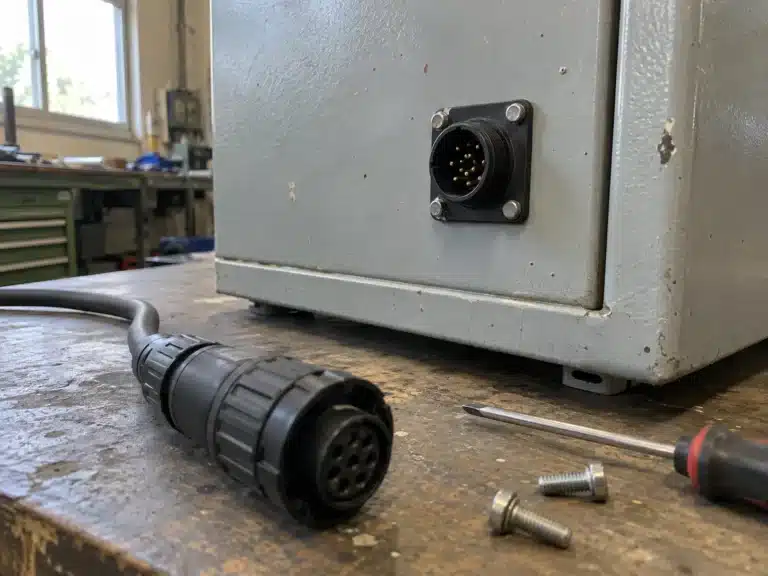
A good share of what gets quoted as outdoor connection work is really an entry point. A luminaire driver, an inverter, a small control panel, or a pump controller already has a sealed enclosure, and nothing needs joining. The cable has to pass through a wall and keep water out, and a gland sized to the jacket does that for a fraction of the hardware. Ordering an IP68 junction box here puts an enclosure next to an enclosure, which is the most common over-specification we see in RFQs.
A gland is also the answer when the interface gets replaced rather than opened. There is nothing inside an entry point to inspect, and if the seal is damaged, the gland is a small part to swap. Where the equipment side has to be unplugged during service, a panel-mount connector does the same sealing work with a mating pair, which adds one joint and saves cutting the cable.
Essential engineering factors to evaluate for IP68 junction boxes and cable connectors before finalizing your bill of materials.
Continuation is a connector, and a branch point is an IP68 junction box. Draw the run and count the directions; the part type usually falls out of the sketch before anyone opens a catalog.
Rule of Thumb: Straight continuation uses inline connectors; multi-direction branching requires an IP68 junction enclosure.
An IP68 junction box is rated as an assembly, so its outputs share one figure instead of each carrying a rating of its own. Sum the connected load and compare it with 24 A at 450 V AC under IEC, or the lower ETL figure of 10–15 A at 300 V AC, depending on the market the job ships to. A box that looks lightly loaded per fixture can sit close to its limit once four are added together.
Standard Threshold: 24 A / 450 V (IEC) vs. 10–15 A / 300 V (ETL). Calculate cumulative load across all outputs.
Terminals take 0.5–2.5 mm², and glands are sized by jacket outer diameter in 3–6, 4–8, 8–12 and 10–14 mm bands. A 2.5 mm² core in heavy insulation can fall outside the gland band even though the conductor sits well inside the terminal range. The per-model table is on the IP68 junction box page.
Watch Out: Conductor gauge fit (0.5–2.5 mm²) does not guarantee outer sheath fit in the gland.
A joint inspected every year is easier to live with in an IP68 junction box. A joint closed for the life of the installation is often better as a sealed connector with no lid to lose.
Maintenance Choice: Choose a junction box for annual inspection; choose a permanent sealed connector for fit-and-forget installations.
Ask what the claim is based on, meaning depth, duration, test condition, and whether the glands were fitted during the test. A supplier who answers all four is describing a test. A supplier who answers with the two digits alone is describing a label.
Verification — 4 Factors: Test depth, test duration, exact test parameters, and gland installation state.
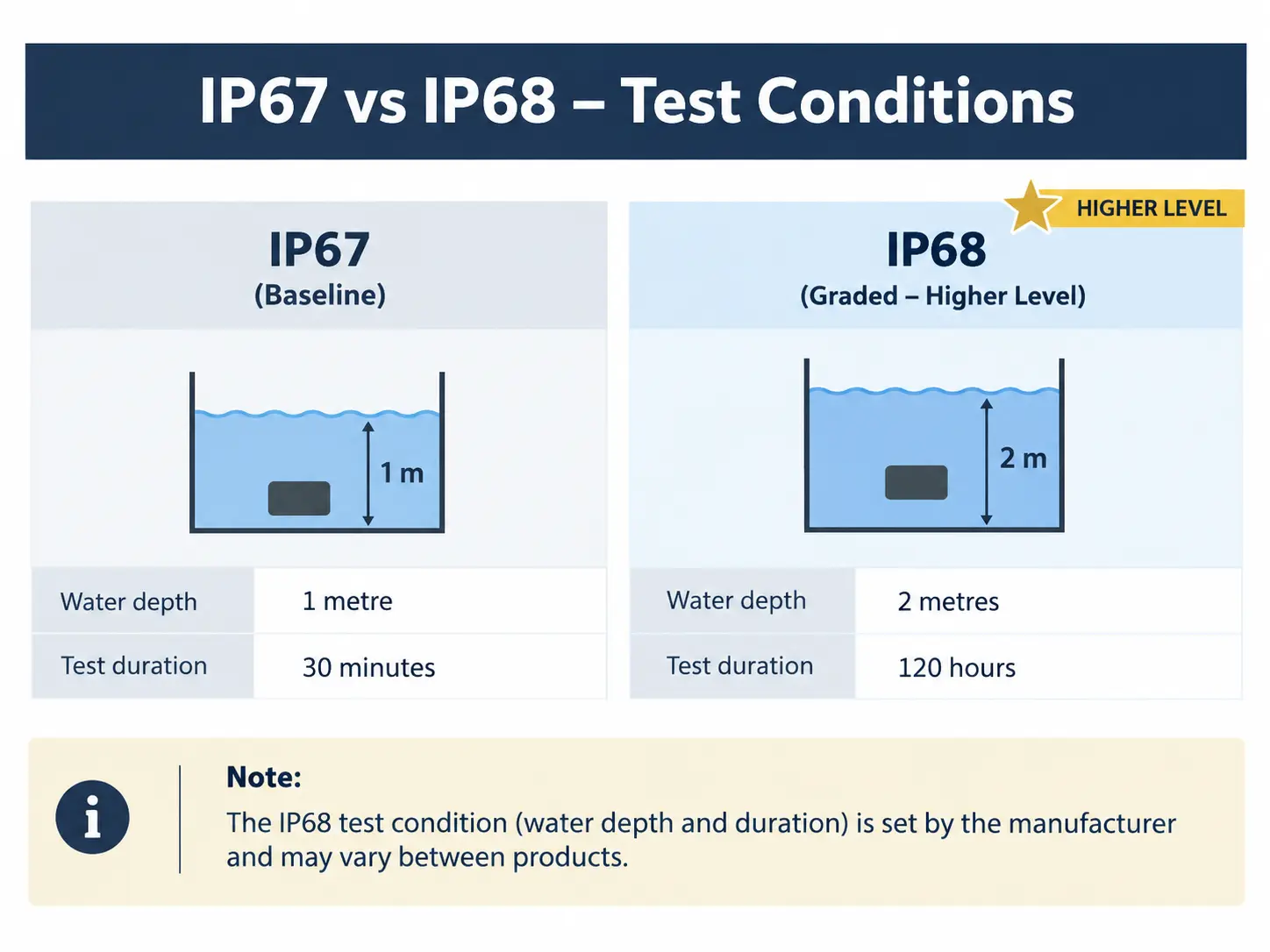
IEC 60529 fixes the IP67 test at 1 m for 30 minutes, so that figure means the same thing whoever prints it. IP68 is defined as continuous immersion under conditions the manufacturer specifies, which means two suppliers can both print IP68 while one tested at 2 m for 120 hours and the other at 1 m for 30 minutes. The comparison between the two ratings is set out in IP67 vs IP68 waterproof connectors.
For an IP68 junction box, four things belong in writing: depth, duration, whether the sample was tested as a complete assembly with the glands fitted, and the temperature range. A box heading for a duct pit or a flooded pump chamber needs a number the buyer can hold a supplier to. PVLinkTech tests the M686 series at 2 m for 120 hours with the glands fitted. The IP code entry lists what the two digits cover and what they leave out.
Certificates answer a different question from the rating figure. ENEC, CE, ETL, UKCA and CB say which markets approved the part. The current figure depends on the standard behind it: the same IP68 junction box is 24 A at 450 V AC under IEC and 10-15 A at 300 V AC under ETL, so a North American project should be quoted against the lower number. Compare the two figures before you compare prices. The gap is a market requirement rather than a quality difference.
Those figures belong on the purchase order line, because the enquiry is not the document the receiving inspection works from. An order that reads IP68 junction box, 2 m / 120 h, glands included, -40°C to +105°C gives the goods something to be checked against, and it removes the argument about what the supplier understood by IP68. The certification line belongs on the same order line: ENEC, CE, ETL, UKCA, and CB for the M686 series, with RoHS alongside.
Topology first, then current, then cable, then access, then the test condition behind the rating. A run that branches wants an IP68 junction box, a straight run wants a connector, and an enclosure that already has a lid wants a gland. Get those five answers onto one page, and the part number follows from them rather than from a price list. For a whole site that mixes boxes, connectors and glands, the outdoor waterproof connection solutions page shows how the three are matched together.
One safety note belongs with all of it. Isolate the supply and verify the circuit is dead at the terminals before opening any joint, and never mate, open, or unmate a connector or box under load. Nothing in this range is built for switching duty.
Practical answers to common questions about IP68 junction boxes, waterproof connectors, ratings, and installation.
They do different jobs, and the rating says how each one behaves in water rather than where a run should be joined. Use a connector to continue a run and a box to branch one. The box also gives you a mountable housing and serviceable terminals, which a connector does not.
Only if the IP68 junction box already has a spare way, which is why a 4-way often costs less over the life of a site than a 3-way bought twice. An inline connector joint cannot take a new branch; adding one means cutting the run and fitting a box.
When the run branches, when the joint has to be reopened without losing cable length, or when a stiff cable will not bend inside the space you have. A straight continuation with no future branch is usually faster and cheaper with a connector.
Ask for four figures in writing: test depth, test duration, whether the glands were fitted during the test, and the operating temperature range. IP67 is fixed by IEC 60529, but IP68 is set by the manufacturer, so an IP68 marking without depth and duration is a claim rather than a specification.
It does not. The rating belongs to the IP68 junction box as an assembly, so the connected loads add up against one figure. Plan against 24 A at 450 V AC under IEC, or the lower ETL value of 10–15 A at 300 V AC for North American projects, whichever applies to the market you ship to.
Only if the IP68 junction box already has a spare way, which is why a 4-way often costs less over the life of a site than a 3-way bought twice. An inline connector joint cannot take a new branch; adding one means cutting the run and fitting a box.
Send us the circuit list with the number of directions, the current per direction and the jacket outer diameter, and we will confirm the joint type, the model and the gland sizes that fit. If the box is already chosen and you only need pricing, the waterproof connector quote page takes the same details.

LET’S BUILD YOUR CONNECTION SOLUTION
Share your application, specifications, and estimated quantity. Our team will recommend a suitable connector solution and provide a quotation.
Low MOQ · OEM & ODM · Product Selection Support · Fast Quote Response