

Need waterproof connectors?Request a Quote →
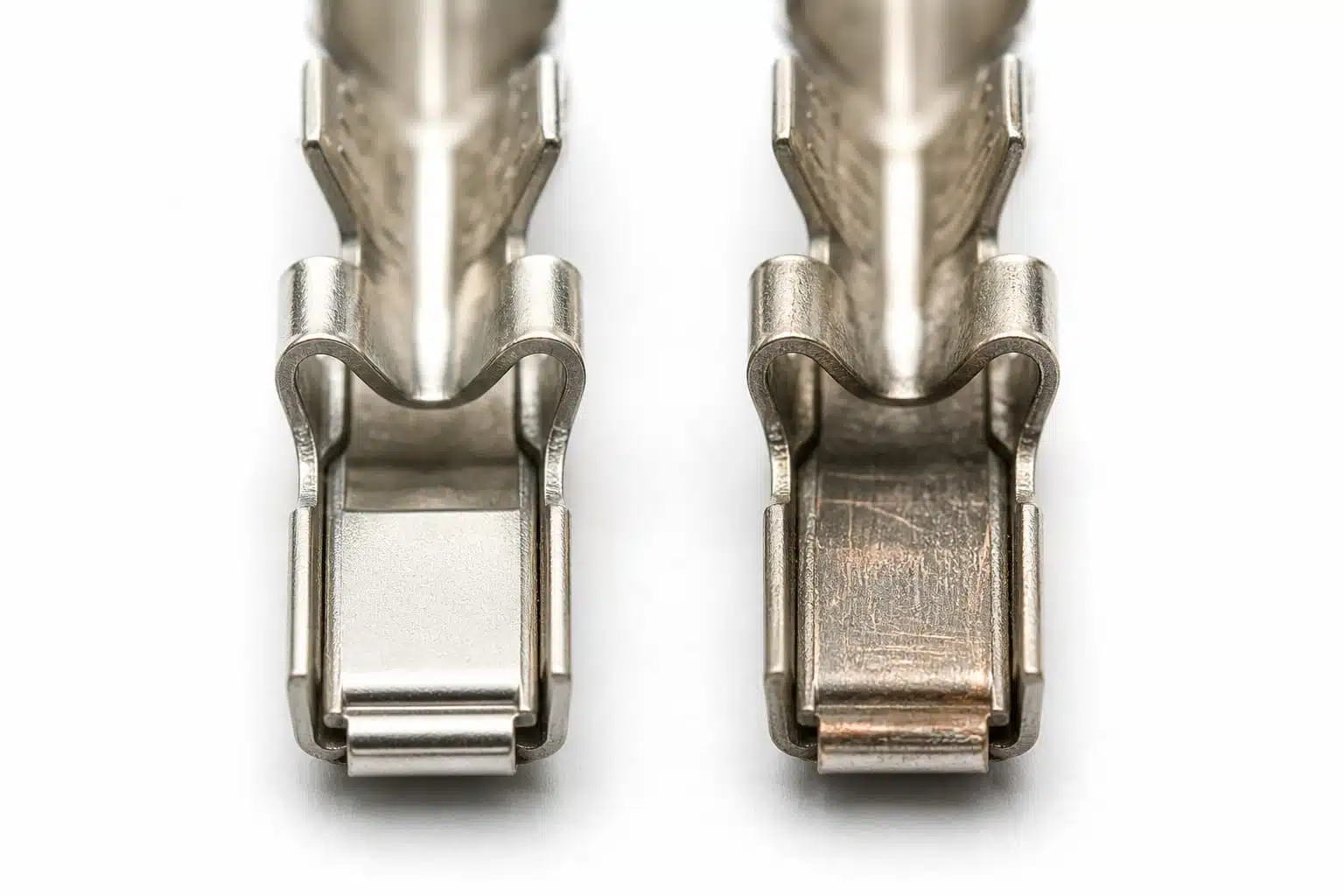
MC4 connector mating cycles, what repeated disconnection wears out, and safer alternatives for portable solar systems.
“I disconnect my panels every day. Am I wearing out the connector?” That question shows up in portable solar forums constantly (see this r/SolarDIY thread: this r/SolarDIY thread). MC4-style connectors were designed for rooftop strings: mated once at installation, then left alone for decades. A waterproof rating like IP67 or IP68 tells you the connector keeps water out while it sits mated. It does not tell you the connector was built to be plugged and unplugged twice a day.
The short answer is yes: repeated disconnection wears the connector, and that wear isn’t always visible from the outside. Understanding MC4 connector mating cycles helps you determine when continued reuse is safe and when the connector should be replaced. Mating life is finite, environment and handling matter, and if you disconnect often, a connector built for that duty is the better tool. One safety line before anything else: never mate or disconnect a PV connector while the circuit is live. Isolate the source and verify the circuit is de-energized before touching anything.
A mating cycle is one complete connection and one complete disconnection. Plug it in and pull it apart: that is one cycle. Every MC4 connector mating cycle rubs metal on metal inside the housing. Connector datasheets express endurance as a maximum number of mating cycles, tested under defined conditions.
That rating is a tested endurance limit, not a prediction that the connector fails on cycle 101. A connector rated for 100 cycles will usually still work past that number, but its properties are only guaranteed within the tested range. Contact resistance, sealing, and locking force all have limits, and the rating marks where the manufacturer stops guaranteeing them.
The number varies by connector family, not by the MC4 format. Contact plating, seal system, housing material, assembly quality, and even the test method used by the certifying lab all move the number. Tin-plated and gold-plated contacts wear very differently. MC4 connector mating cycles are not a single universal figure. That is why the correct answer to “how many times can I disconnect an MC4 connector” is always: check the datasheet for your exact male and female pair and cable range, and do not take a number from a forum.
Stäubli’s original MC4 datasheet (original MC4 datasheet) lists a maximum of 100 mating cycles. If there is one MC4 connector mating cycle number worth remembering, that is it. For comparison, their gold-plated test connectors are rated for 1,000 cycles. Same locking geometry, different contact plating, ten times the rated life.
Our own PV4 series, an MC4-compatible connector (MC4 vs PV4 solar connectors) built in our Shenzhen factory, is rated for over 100 cycles, with contact resistance measured through the test. For any specific model, the datasheet is the only source that counts.
So when you see a claim that “MC4 connectors last 100+ cycles,” the useful reading is: 100 cycles is the order of magnitude for a standard tin-plated PV connector, and the exact figure belongs to your specific model. Some connectors publish 150 or 200; some none at all. If the datasheet has no number, treat the connector as designed for install-once service, not daily use.
One note on sources: the “500 cycles” figure sometimes attached to IEC 62852 comes from blog posts, not from the standard’s test reports. Use the manufacturer’s datasheet.
Four things degrade when a PV connector is mated and unmated repeatedly. None of them are visible while the connector is locked together.
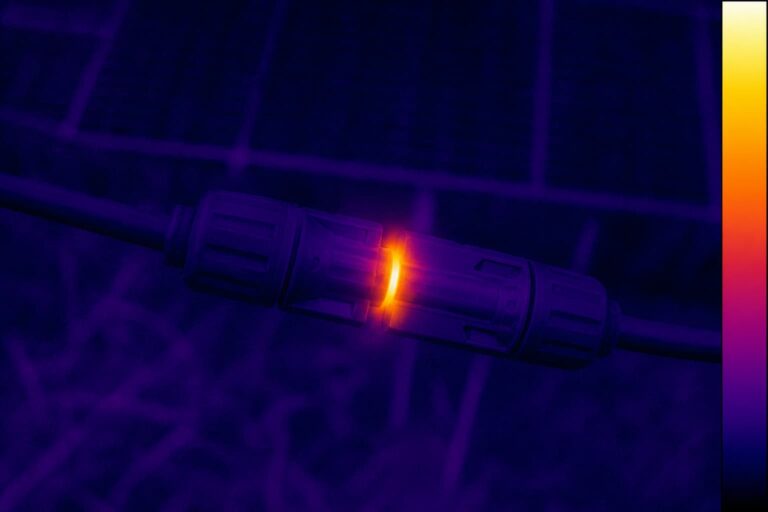
Contact interface. Every connect and disconnect rubs the contact surfaces together, which is why MC4 connector mating cycles are spec’d rather than assumed. Friction removes plating material, changes the surface finish, and can relax the contact force that holds the pin against the socket. Contact resistance climbs as the interface degrades. Under load, higher resistance means localized heating. A connector that runs warm at 30 A today can run hot after a few hundred cycles, and heat accelerates every other failure mode here. ( NREL research on PV connector failures ) traces most field failures back to degraded contacts, rising resistance, and heating.
Locking features. MC4-style connectors lock with tabs and clips. Repeated unlocking with a tool, or worse, twisting and pulling off-axis, stresses the locking geometry. A housing with a hairline crack at the latch still clicks together and looks fine. It also unlatches when you least expect it.
Seals. The rubber seal is compressed every time the pair is mated. Dust, sand, and salt grind into the seal surface. Seals take a set over time and stop springing back. A connector that passed IP68 testing when new can let moisture in after years of rough handling, especially if it was mated in a dusty environment.
Cable termination. This is the one people forget. If you pull on the cable instead of the housing to disconnect, the strain transfers to the crimp and the conductor. A crimp that was perfect at installation can loosen, and stranded conductors can fatigue where they enter the contact. This failure does not need hundreds of MC4 connector mating cycles. It needs one bad habit repeated.
The common thread: the connector can look intact while contact resistance, sealing, and locking are all degraded . Appearance is not a health check.


A fixed rooftop string mates a connector once. MC4 connector mating cycles barely register on a rooftop; they add up fast at a campsite. An RV, a balcony system, or a camping kit mates it every time the panels are packed or unpacked. The engineering question is not “is this a good connector?” but “is this connector being used inside its design duty?”
Portable use adds things the datasheet never assumed. Storage caps get lost, and open connectors collect dirt and grit. Panels ride on roofs and in truck beds, so the cable gets dragged across gravel, coiled tightly, and stepped on. UV exposure is the same, but the connector is now flexed and vibrated while it is hot. And the person handling it is not a trained electrician; it is a camper who wants power and does not think about crimp quality.
None of this shows on the outside. The connector clicks, the multimeter shows voltage, and the system works. The degradation is cumulative: each cycle adds a little wear, and the wear accelerates when the connector is dirty, hot, or loaded. A portable system can burn through its connector’s rated life in a season of camping trips without ever looking damaged.

If you disconnect PV connectors regularly, inspect them before every reconnection. The checklist assumes the system is isolated and verified de-energized. Let a qualified person verify if you are not sure. Do not work on live DC circuits.
If your system gets disconnected regularly, the question is not which connector survives best but which architecture needs the least wear. Four approaches, simplest to most robust:
Permanent PV connector plus service disconnect. Keep the module-side connection fixed and put a rated disconnect at an accessible point. The PV connector is mated once and stays; the disconnect handles the daily switching. This is the standard answer for RVs and portable systems.
Replaceable pigtail. Design the wear into an inexpensive, serviceable lead. A short pigtail with the PV connector on one end and a quick-disconnect on the other costs little, takes minutes to swap, and protects the fixed array cable. When the pigtail’s cycles are used up, replace the pigtail, not the array wiring.
Frequent-mating connector. For systems that need daily plugging, select a connector explicitly rated for the expected voltage, current, environment, and cycle count. Some manufacturers publish MC4 connector mating cycles well past 100 for exactly this duty. A connector rated for 1,000 cycles costs more than a standard PV connector and is worth it when your duty needs it. Our PV4 series is rated for over 100 cycles; for higher duty, specify your cycle requirement and we will match a connector to it.

DC isolator or breaker. For switching under load, use devices rated for switching. Do not treat an inline PV connector as a switch. DC arcs do not self-extinguish like AC arcs, and the connector is not designed to interrupt them.
| Approach | Ideal use | Benefits | Limits | Required ratings |
|---|---|---|---|---|
| Permanent PV connector + service disconnect | RVs, portable and seasonal systems | PV connector mated once; daily switching handled by a rated device | Needs space for the disconnect; one extra component | Disconnect rated for system voltage and current |
| Replaceable pigtail | Systems with a known wear point | Cheap to replace; protects fixed wiring | Consumable by design | Connector pair rated for system voltage and current |
| Frequent-mating connector | Daily or weekly plugging, testing | Built for repeated cycling; predictable life | Higher cost; fewer compatible pairs | Cycle count, voltage, current, IP rating |
| DC isolator or breaker | Load switching, maintenance isolation | Safe switching under load | Not a connector; does not mate cables | Switching rating and breaking capacity |
Before you buy connectors for a system that gets disconnected regularly, answer these questions. They are the same ones we ask when a customer sends a specification inquiry.
How many MC4 connector mating cycles per week, and over what expected service life? Ten cycles a week for two years is over 1,000 cycles. That number decides everything else.
What is the maximum system voltage, continuous current, and the fault conditions? The connector and any disconnect device must be rated for the worst case, not the typical case.
Will the connector face rain, dust, salt mist, vibration, or untrained users? Every environmental factor lowers practical life below the datasheet number.
What cable size, conductor class, and strain relief are required? The crimp and the cable gland are part of the connection. A connector rated for high MC4 connector mating cycles is still a failure if it is crimped wrong.
Is touch-safe design, keying, tool release, or a locking indicator required? For untrained users, keying and touch-safe contacts are not nice-to-haves. They are the difference between a safe system and an accident.
Answer these before you pick a connector, and you will replace fewer failed parts later.
A PV connector is reliable when it is used inside its intended duty. MC4 connector mating cycles are finite, and that is fine when the design accounts for it. A connector rated for 100 cycles, mated once, will outlast the solar modules it connects. The same connector, mated and unmated every day in a dusty truck bed, becomes a weak point within a season.
Frequent handling should be designed explicitly, not improvised. Check the datasheet for your connector’s cycle rating, inspect before every reconnection, and choose an architecture (disconnect, pigtail, or higher-cycle connector) that matches how the system is actually used.
You can, but standard MC4-style connectors are designed for limited mating cycles. Frequent unplugging accelerates wear on contacts, seals, and locking mechanisms. For daily use, choose connectors rated for higher connection cycles.
Yes. Contact wear, seal aging, and increased resistance can happen even when the connector still locks normally.
Reuse is not recommended. Replace damaged or removed contacts with new parts and follow the correct crimping specification.
No. Disconnecting a live PV connection may create an arc. Always isolate power before disconnecting.
The best connector depends on voltage, current, environment, and how frequently it will be connected and disconnected.

LET’S BUILD YOUR CONNECTION SOLUTION
Share your application, specifications, and estimated quantity. Our team will recommend a suitable connector solution and provide a quotation.
Low MOQ · OEM & ODM · Product Selection Support · Fast Quote Response