

Need waterproof connectors?Request a Quote →
You have a junction box full of terminals to land, and each one needs a screwdriver and a torque check. The two turns themselves are the easy part. Multiply that across a production run, and it stops being about skill and starts being about time. Tool-free wire connectors Tool-free wire connectors mean you can put the screwdriver down. That’s why they keep showing up in BOMs and installation specs. That’s why they keep showing up in BOMs and installation specs. But “tool-free” sounds like a marketing line, and your job is to verify, not to trust. This guide covers how push-in connectors actually work, where they hold up, where they do not, and what to check before you commit a connector family to a design.
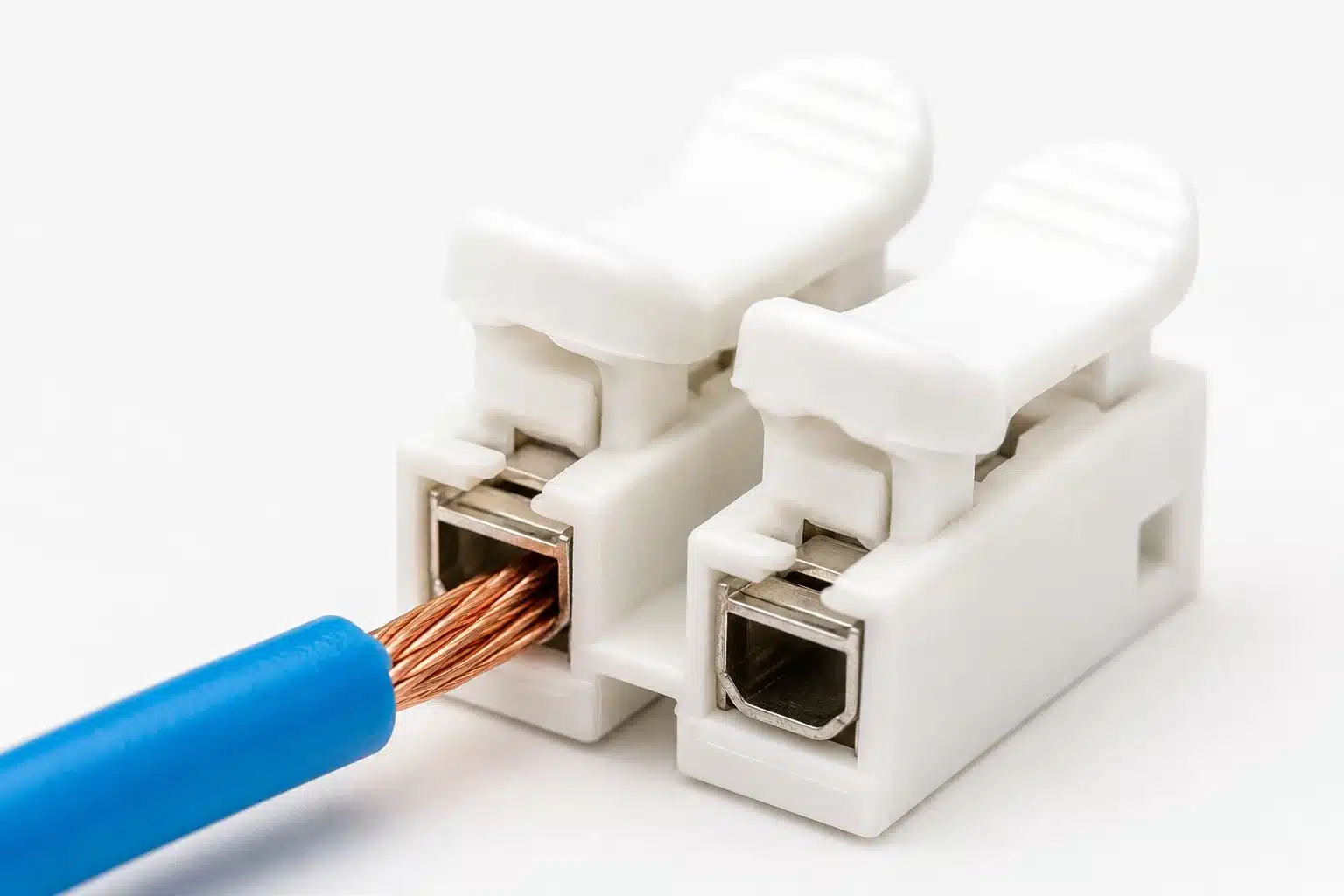
Tool-free wire connectors are a family of termination devices that hold conductors with spring force instead of a screw thread. Strip the wire, and push it. Strip the wire, push it in, and the connector clamps the wire. No torque spec to chase, and no second hand needed to hold the terminal. Three mechanisms sit under the same label, and they are not interchangeable.
Push-in spring clamp—A spring-steel blade inside the housing opens as the wire enters, then presses against the conductor once it seats. This is the mechanism most people mean by push-in. Insertion is one motion. Release needs a tool in most designs.
Lever-actuated clamp—You open a lever, insert the wire, and close the lever. The clamp force comes from the lever mechanism, and release is deliberate and visible. Lever types are typically the easiest to reuse.
Insulation displacement contact (IDC)—The wire is pressed into a slot that cuts through the insulation and contacts the conductor. The wire is pressed into a slot that cuts through the insulation and contacts the conductor. You will see it in data and flat-cable work more than in power wiring. The wire is pressed into a slot that cuts through the insulation and contacts the conductor. You will find it in data and flat-cable work. Power wiring, not so much. We keep this article to the push-in and lever types. Not the focus of this article.
One terminology note before we go further: quick connect wire connectors can mean blade-style disconnects in some catalogs. In this article, quick-connect refers to tool-free spring-clamp terminals, which is the usage you will see in push-in connector documentation.
The working principle is simpler than the marketing suggests. Inside the housing is a spring-steel element. When you push a stripped conductor into the entry port, the spring deflects to let the wire pass, then relaxes against the conductor. The contact force comes from the spring, not from how hard you push or how carefully you turned a screw. That matters in production: connection quality stops depending on the installer’s hands.
Two details decide whetheWire preparation — Strip length has to match the connector. Too short, and the spring clamps on insulation instead of copper. Too long, and bare conductor sticks out past the terminal and can touch a neighbor. [TECHNICAL VERIFICATION REQUIRED — insert exact strip length per series, e.g. “X mm ± Y mm for Series Z”]. Same for stranded wire: some push-in connectors take stranded conductors directly, others expect a ferrule first. [TECHNICAL VERIFICATION REQUIRED — ferrule requirement per series/gauge].
Push-in spring clamps usually need a release tool (a small screwdriver or a dedicated release pin) to open the clamp before the wire comes out. Whether a connector can be reused after release depends on the spring and housing design. Some series are rated for repeated use; others are single-install. [TECHNICAL VERIFICATION REQUIRED — reuse rating and release tool part number per series].
Push-in terminals earn their keep where three things are true: the wiring is repeated, the space is tight, or the installer wants connection quality that does not depend on torque discipline.
Ceiling lights, LED fixtures, recessed lighting, and junction boxesare the classic push-in territory. One hand holds the fixture, the other pushes the wire in. Re-terminating for maintenance is quick, which matters for fixtures that get serviced more than once. When you spec push-in for lighting, check the wire gauge range against your field wiring first. Lighting circuits often use 1.5–2.5 mm² or 14–12 AWG, and the connector must cover that range with margin. [TECHNICAL VERIFICATION REQUIRED — confirm exact gauge coverage per series].
Panel builders use lever and push-in terminals on DIN rails for internal wiring where install speed and clean layout count. The application question is mechanical: does the terminal fit the rail profile, and does the wiring layout give the installer room to push straight in? Bent insertions are the main cause of poor contact in panels.
→ Related: Industrial Automation Connectors
When the same connection gets made hundreds of times, tool-free termination removes a step from the cycle. The consistency argument from earlier applies here directly: spring clamping takes the operator variable out of the connection.
Tool-free wire connectors are not a universal replacement. Avoid them for high continuous current well above the connector’s rating, for sustained heat near the housing material’s limit, and for strong vibration unless the manufacturer documents the connector for that service. Outdoor and wet locations need an enclosure or a connector series designed for moisture; a general-purpose push-in terminal is not an IP-rated device. [TECHNICAL VERIFICATION REQUIRED — current, temperature, and vibration limits per series]. Aluminum conductors also deserve a specific compatibility check; do not assume a copper-rated terminal accepts aluminum.
Each termination method trades something. The table below compares them on the dimensions that show up in design reviews.r the connection is reliable.
| Dimension | Push-in / tool-free | Screw terminal | Crimp |
|---|---|---|---|
| Install time | Fast One motion per conductor |
Moderate, torque step per conductor | Fast with correct tooling; adds crimp tool and die |
| Force consistency | Set by spring, same every time | Depends on operator torque | Depends on crimp tool calibration |
| Rework | Release tool required; reuse per series | Easy Screw re-tightening |
Cut and re-crimp |
| Vibration behavior | Good when spring is retained (per series) | Can loosen; needs periodic re-tightening | Good Mechanical deformation |
| Tooling cost | Low (stripper plus release tool) | Low | Higher (crimp tool and dies) |
| Unit cost trend | Higher piece price, lower install and rework cost | Lower piece price | Material plus amortized tooling |
| Best fit | Junction boxes, lighting, panels, production wiring | Field repairs, mixed gauges, high-current terminations | Wire-to-wire, harnesses, high-reliability service |
A useful reference: connection devices with screwless clamping units for building wiring are commonly assessed against IEC 60998-2-2 or the equivalent UL requirement, but the standard class varies by market and series. [TECHNICAL VERIFICATION REQUIRED — confirm which standard class and listing applies to each series before quoting a standard here].
PVLinkTech publishes ratings, wire ranges, and installation requirements per series in datasheets, and we send the datasheet with every quotation. What we do not publish in a blog post is per-series certification details or test results; those are verified per series and shared on request.
Need a datasheet for a specific series before you finalize a design? Request a datasheet and quote and we’ll send the exact ratings for the series you’re evaluating.
For the product range and the selection factors that matter for bulk orders, see our Wholesale Push-In Wire Connectors page.
| Check | Why it matters | Ask the supplier |
|---|---|---|
| Current and voltage rating | The connector must exceed your circuit’s continuous and fault conditions | Rated current at what ambient temperature? |
| Wire range, solid and stranded | Wrong range means poor contact or no insertion | Which gauges are approved, with or without ferrule? |
| Standards and certification | Certification is what survives a plant audit or an inspector visit | Which UL/IEC/EN standards apply, and can you share the certificate? |
| Housing material and flammability | Plastics soften in heat; flammability class matters in some inspections | Material and flammability class per series |
| Release and reuse policy | Maintenance procedures depend on it | Single-install or reusable, and with which release tool? |
| Batch consistency for volume orders | A part number must behave identically across lots | How is the same part number controlled across production batches? |
A useful reference: connection devices with screwless clamping units for building wiring are commonly assessed against IEC 60998-2-2 or the equivalent UL requirement, but the standard class varies by market and series. [TECHNICAL VERIFICATION REQUIRED — confirm which standard class and listing applies to each series before quoting a standard here].
PVLinkTech publishes ratings, wire ranges, and installation requirements per series in datasheets, and we send the datasheet with every quotation. What we do not publish in a blog post is per-series certification details or test results; those are verified per series and shared on request.
Need a datasheet for a specific series before you finalize a design? Request a datasheet and quote and we’ll send the exact ratings for the series you’re evaluating.
For the product range and the selection factors that matter for bulk orders, see our Wholesale Push-In Wire Connectors page.
Tool-free wire connectors are not magic; they are a mechanism that trades a screwdriver for a spring, and the engineering question is whether that trade fits your application. Wire prep, gauge range, temperature, and reuse policy are the four numbers to verify before you buy. When those line up, push-in termination is usually the more consistent option on the bench and in the field.
Browse our full range of push wire connectors, or request a datasheet and quote first.

LET’S BUILD YOUR CONNECTION SOLUTION
Share your application, specifications, and estimated quantity. Our team will recommend a suitable connector solution and provide a quotation.
Low MOQ · OEM & ODM · Product Selection Support · Fast Quote Response