

Need waterproof connectors?Request a Quote →
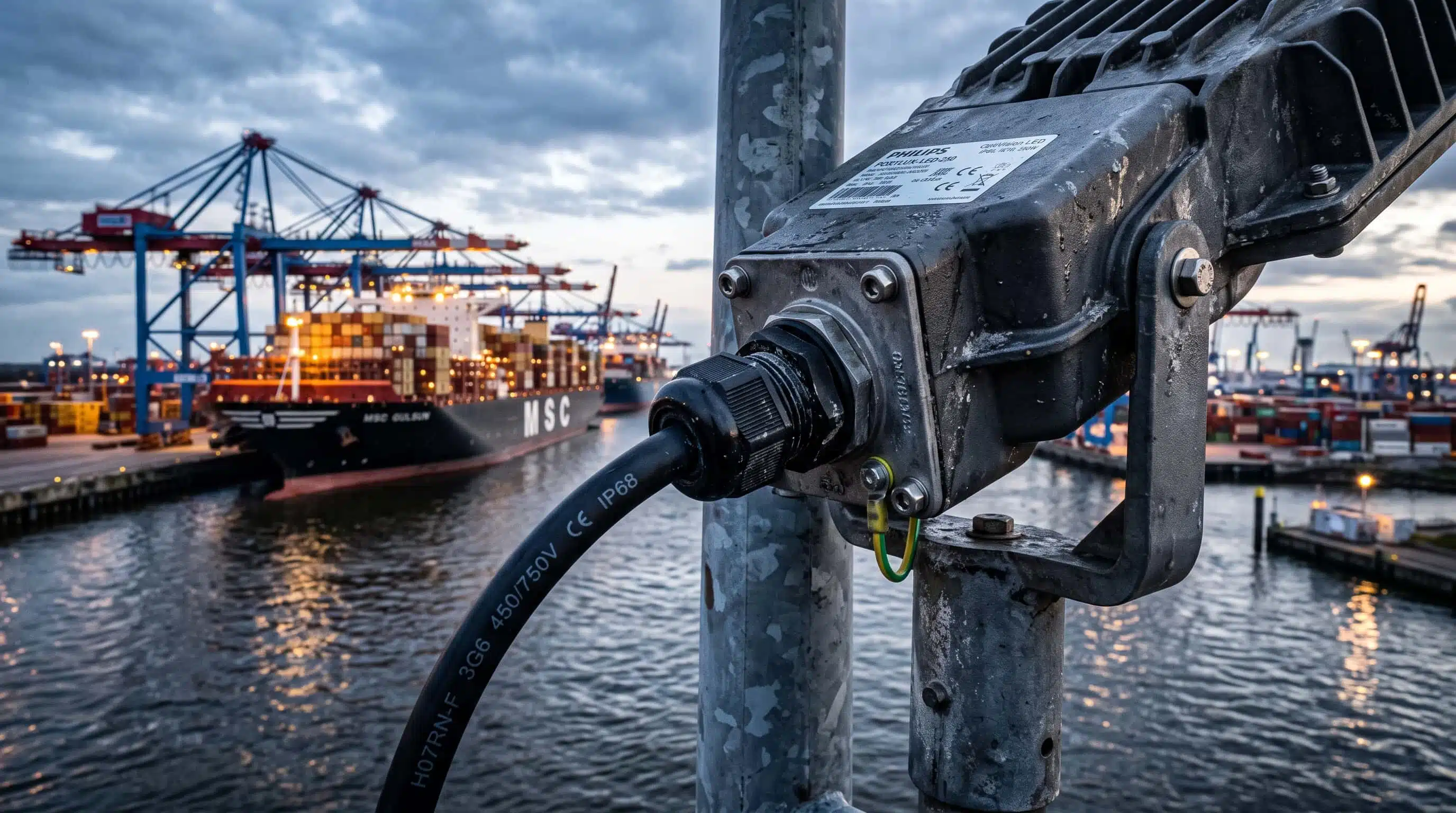
A waterproof connector coastal installation is decided by the material system, not by the IP rating alone. The housing, contact plating, fasteners, seals, cable jacket, and mating interfaces all sit in the same salt-laden air, and they corrode at different rates. A connector that passes IP68 immersion can still fail in a coastal project if the plating is wrong for the salt load or if two incompatible metals meet at the housing. Selection should start by mapping the site, then choosing each material layer, then validating the complete assembly under the project’s salt-fog, UV, and temperature conditions. This article follows that sequence and ends with a specification checklist you can hand to a supplier.
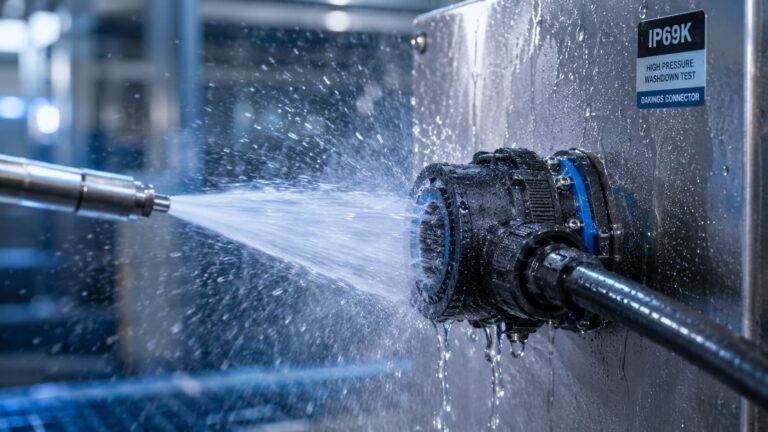
IP ratings come from IEC 60529 . The second digit describes water ingress under defined lab conditions. IP68 means dust-tight and continuous immersion, but the depth and duration are agreed between manufacturer and user — they are not fixed by the standard. On our own catalog, that single label covers different promises: the LP series lists IP68 at 1 m / 2 h as a customization, while the self-locking series is rated 2 m / 12 h. Both are “IP68.” Neither number says anything about salt.
The IP code does not test salt fog, UV, temperature cycling, or vibration. A waterproof connector can seal perfectly against fresh water and still corrode in coastal air. Salt deposits an electrolyte film on exposed metal. That film drives galvanic corrosion at dissimilar-metal junctions, attacks plating at pores and scratches, and works its way into crevices the seal cannot reach. UV does a separate job on the polymer housing and seal elastomer, months after the connector passed its lab test.
So the first decision is to stop treating “waterproof” as one requirement. Split it into water ingress and corrosion resistance, and evaluate both for the complete assembly.
Salt load is not a single value. It changes with distance from the surf line, prevailing wind, shelter, and how the equipment is washed. A connector behind a cabinet door one kilometer inland faces a different environment from one on an open deck edge. Map the site before picking materials.
| Exposure level | Typical location | Salt load | Main risks |
|---|---|---|---|
| C1 — Sheltered coastal | Inside cabinet or under canopy, >1 km from surf | Airborne salt, low | Condensation, humidity |
| C2 — Open coastal air | Rooftop, exterior wall, <1 km, no direct spray | Salt mist + UV | Plating corrosion, seal aging |
| C3 — Direct spray / splash zone | Dock edge, deck, port lighting, wave splash | Salt film, direct wetting | Galvanic corrosion, crevice corrosion |
| C4 — Permanent wet / submersion | Below waterline, tidal zone | Full immersion | Water ingress, electrolysis |
The distance line is a starting point, not a rule. Ask these five questions before you choose anything:
Washing changes the picture. A freshwater rinse removes the salt film before it concentrates. Leaving salt to crystallize and re-wet every day is harder on a connector than continuous mist.

Each material layer of a waterproof connector coastal installation has a job in salt-laden air. Choose them as a system, then check the metal combinations against the galvanic series.
| Component | Material options — catalog basis | What it does in coastal air |
|---|---|---|
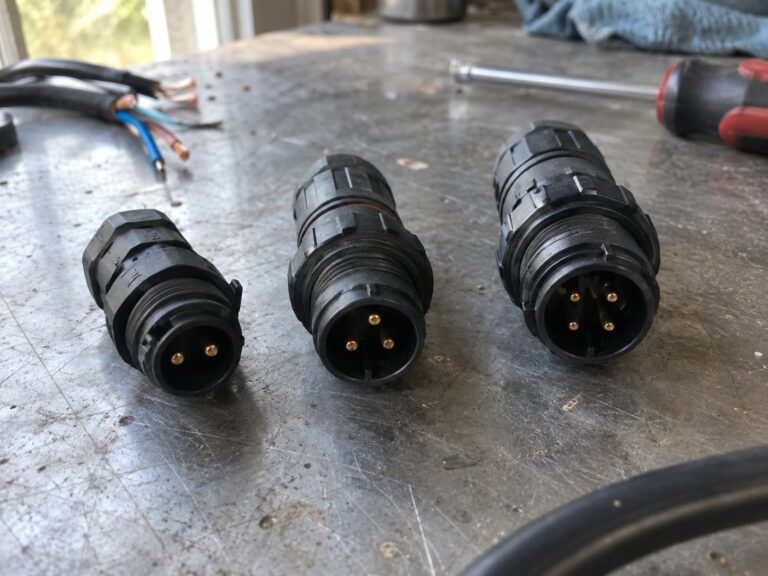
| Housing | PA66 / PA66+GF on PV4, energy-storage, and self-locking series; stainless steel option on LP; metal shell on SF | Polymer housings do not corrode and keep weight down; stainless is the choice where direct spray and washing hit the shell |
| Contacts | Copper alloy (purple copper T2 / beryllium copper), gold- or silver-plated on LP; silver/tin-plated on PV4 and energy storage | Plating carries the corrosion burden. Gold and silver keep contact resistance stable through salt exposure; bare copper forms oxide fast |
| Seals | Elastomer grade not stated in catalog — confirm for project | Seal aging under UV and salt is a separate failure path from the housing |
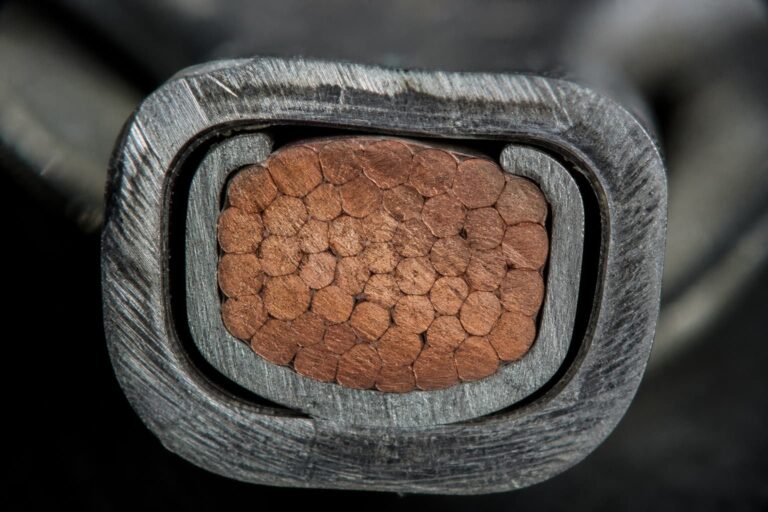
| Cable jacket | Confirm jacket material for your cable assembly (PVC / PUR / TPU options) | A cracked jacket lets salt reach the strands and wick toward the connector |
Two catalog details are worth noting. First, the PV4 and energy-storage housings use PA66+GF, which holds stable electrical and mechanical properties across the rated temperature range and resists the physical and chemical attack you expect in outdoor power circuits. Second, LP contacts are gold- or silver-plated copper rated to 1,900+ mating cycles; the plating, not the base metal, is what survives repeated unplugging in a coastal environment. For direct-spray duty, LP can be specified with a stainless steel housing.
Do not reach for a “marine grade” label. The term has no single definition. State the exact material, plating, and verification basis instead.
Galvanic corrosion happens when two dissimilar metals touch or are bridged by an electrolyte — and salt film is a strong electrolyte. The more reactive metal corrodes faster than it would alone. The usual sequence, from most to least reactive, runs roughly: aluminium, zinc, carbon steel, stainless steel (passive), tin, copper, brass, silver, gold.
| Couple in the Assembly | Risk | Typical Fix |
|---|---|---|
| Stainless Steel Fastener + Aluminium Housing | High — Aluminium corrodes at the junction | Isolate with a washer or gasket, or use compatible plating |
| Brass Gland + Untreated Steel Panel | High — Steel corrodes | Apply nickel or zinc plating on the panel side and keep threads sealed |
| Stainless Housing + Gold-Plated Contacts | Moderate — Large cathode / small anode ratio | Confirm plating compatibility and keep the salt path short and dry |
| Gold-Plated Contacts on Both Sides | Low | Standard practice in sealed connectors |
| PA66 Housing + Plated Contacts | Low — No metal couple at the housing | Verify contact plating quality instead |
The area ratio matters. A small anodic contact surrounded by a large cathodic shell corrodes quickly. Keep dissimilar-metal junctions out of the salt path, or isolate them mechanically.

The common salt-fog tests are ISO 9227:2022 (neutral salt spray, NSS) and IEC 60068-2-11:2021 (Test Ka: salt mist). Both run a continuous 5% NaCl fog at 35 °C and watch for red rust, white corrosion, and loss of function. The salt spray test is the standard way to compare coating quality and batch consistency.
Read what the standards say about their own limits:
A continuous salt fog is harsher than open coastal air in some ways and easier in others: it has no UV, no dry-wet cycling, no temperature swing, no vibration. A part that passes 500 h of NSS can still fail at the coast if the seal cracks under UV or a threaded gland works loose. So use the test as a comparative gate — plating quality, coating thickness, batch consistency — not as a lifetime certificate.
If the project is genuinely marine and you want a closer simulation, look at cyclic salt-mist tests such as IEC 60068-2-52 (Test Kb), which alternate salt exposure with humidity and drying phases at defined marine severity levels. ASTM B117 is the comparable US standard for continuous fog.
What matters in a waterproof connector coastal specification is not the hour count alone. Write down:
Without those five lines, “salt-spray tested” is a phrase, not a fact.
For a waterproof connector coastal run, installation geometry and habits decide how long salt stays on the part. A few rules of thumb:
Hand this checklist to the supplier when you specify a waterproof connector coastal project.Every line is a question a coastal waterproof connector spec should answer.
| # | Check | Why | Example / Note |
|---|---|---|---|
| 1 | Exposure Level | Defines salt load, UV, temperature swing | Use the C1–C4 map above |
| 2 | IP Requirement, with Conditions | “IP68” alone means nothing | 1 m / 2 h vs 2 m / 12 h vs 2 m / 24 h |
| 3 | Housing Material | Match to spray and washdown | PA66+GF for sheltered; stainless option for direct spray |
| 4 | Contact Plating and Thickness | Plating, not base metal, carries the load | Gold/silver (LP), silver/tin (PV4, energy storage) |
| 5 | Seal Elastomer and UV Resistance | Seal aging is a separate failure path | Confirm grade for your UV and temperature range |
| 6 | Galvanic Compatibility List | All metals in the assembly | Housing + fastener + contact + gland + panel |
| 7 | Salt-Fog Test, with Acceptance | Comparative gate, not lifetime proof | ISO 9227 / IEC 60068-2-11, duration, pass criteria |
| 8 | UV / Aging Evidence | Polymers change at the coast | PA66+GF UV stability, test records if available |
| 9 | Maintenance Access | Can you inspect and clean? | Design for inspection, not burial |
| 10 | Documentation | Datasheet, drawing, test records | Request what exists for the model |
Corrosion is visible before it is electrical. Catch it early and most failures are avoidable.
Our own quality control runs on the same idea: specification review, material check, assembly inspection, and final verification before dispatch, with inspection records and documentation available on request for the relevant model. For a coastal project, ask the supplier what documentation exists for the exact model you intend to buy — datasheet, dimensional drawing, test records, and what the test conditions were. If the record does not state the standard and conditions, it does not help you.
Send us the site conditions: exposure level, distance from the surf line, whether the connector faces direct spray, washing habits, temperature range, and the cable and current requirements. We will recommend a housing, contact plating, and seal combination from the catalog, and confirm what test documentation exists for the exact model. Start with a 1-piece evaluation order and validate the assembly under your project’s conditions before you scale.
Request a coastal material and validation recommendation →

LET’S BUILD YOUR CONNECTION SOLUTION
Share your application, specifications, and estimated quantity. Our team will recommend a suitable connector solution and provide a quotation.
Low MOQ · OEM & ODM · Product Selection Support · Fast Quote Response