

Samples in stock · Response within 12 hours. Request a Quote →

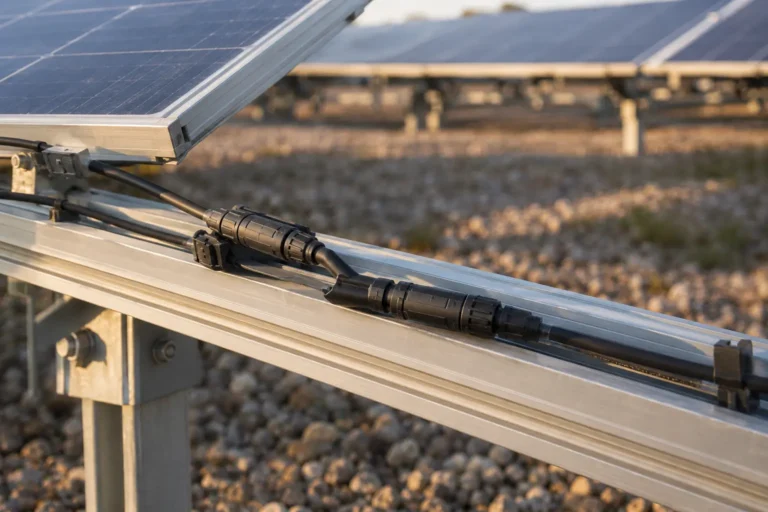
“What is an MC4 connector” is a question with three different answers, and which one you get depends on who is asking. To a trademark lawyer, it is one company’s product. A distributor’s catalog lists it as a family of physically similar connectors from at least ten manufacturers. On a roof, it is whatever is already bolted to the panel. Those three readings are not interchangeable, and the gap between them is where wrong orders and field failures come from.
The name is checked against the manufacturer’s own product page, the public record of how the connector evolved, and the qualification standards that govern it. No brand is ranked.
MC stands for Multi-Contact, the Swiss manufacturer that designed the connector and was acquired by Stäubli in 2002. The 4 is the contact pin diameter in millimeters. An MC3 connector, with a 3 mm pin, had been developed in 1996 and was discontinued in 2016; the MC4 was launched in 2004 as its successor (MC4 connector, Wikipedia).
The naming convention explains most of the confusion that follows. The term describes one company’s product line, built around one pin size. It was never a category name or a standard number.
| 1996 | Multi-Contact develops the MC3, a 3 mm pin connector | The first PV connector in this family; discontinued 2016 |
| 2002 | Multi-Contact is acquired by Stäubli | The MC4 is a Stäubli product by the time it reaches the market |
| 2004 | The MC4 is launched | Positive locking, tool-assisted release, 600 V initial rating |
| 2008 | The NEC bans connectors that can be disconnected under load | A certified, product-specific unlocking tool becomes a legal requirement in the US |
| Since 2011 | Other manufacturers introduce MC4-type products | The name becomes a market category rather than one product |
| 2016 to today | The MC4 EVO2 arrives; ratings reach 1500 V DC | The newer version stays backward-compatible with the older one |
Stäubli states the ownership plainly on its own product page: “MC4 is a protected trademark of Stäubli”, and the original MC4 is interchangeable with all connectors in the Stäubli MC4 family. Stäubli Electrical Connectors held roughly half of the global market for this connector family as of 2022.
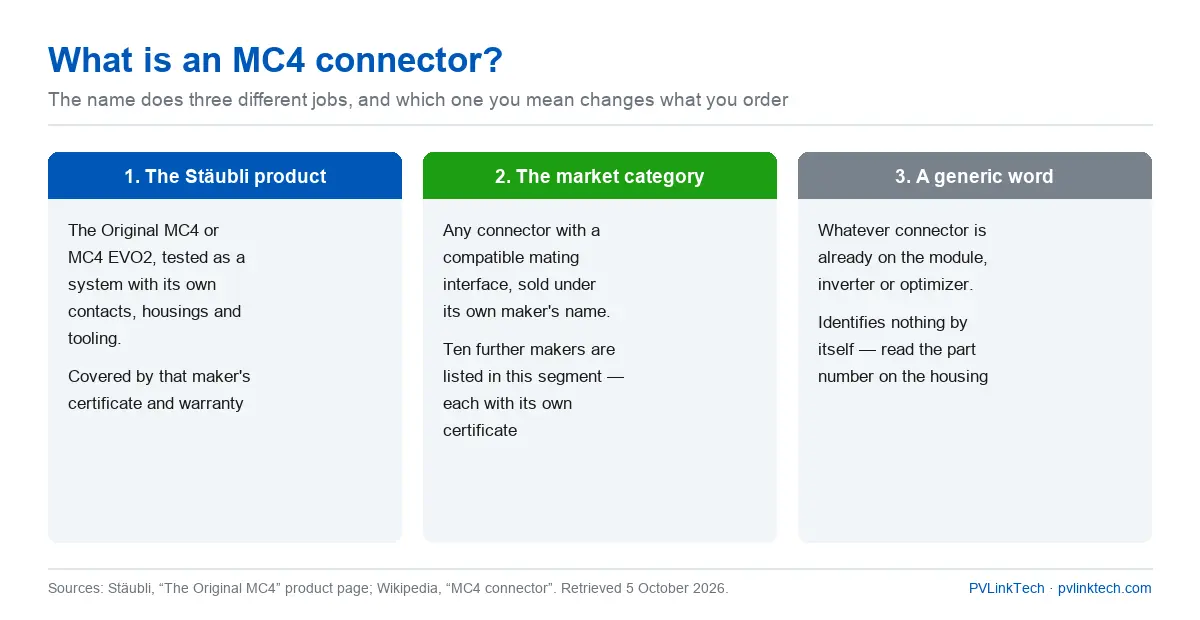
When a drawing, an email, or a marketplace listing says MC4, it is usually standing in for one of the rows below. Which row applies decides whether two connectors are interchangeable, and that is a question only documents can answer.
| The Stäubli product | The original MC4 or MC4 EVO2, tested as a system with its own contacts, housings and tooling | Whether the assembly is covered by Stäubli’s certification and warranty |
| The market category | Any connector with a compatible mating interface, sold by other manufacturers under their own names | Whether the two halves will physically join — which is not the same as being rated to join |
| A generic word for the DC connector | Whatever connector sits on the module, inverter or optimizer in front of you | Nothing on its own. You still have to read the part or the certificate |
The products in that second row are not variations on one item. The Wikipedia entry for the connector lists ten further manufacturers selling into this segment, each with its own contact geometry, housing, and certificate.
The second row causes most of the trouble, and the reason is mechanical. A mating interface can be copied closely enough to join by hand while neither product has ever been tested with the other. The joint works, and nothing in the paperwork covers it.
Sorting out what is an MC4 connector therefore starts with deciding which of those three rows you are dealing with, because only the first one is covered by a single manufacturer’s certificate.
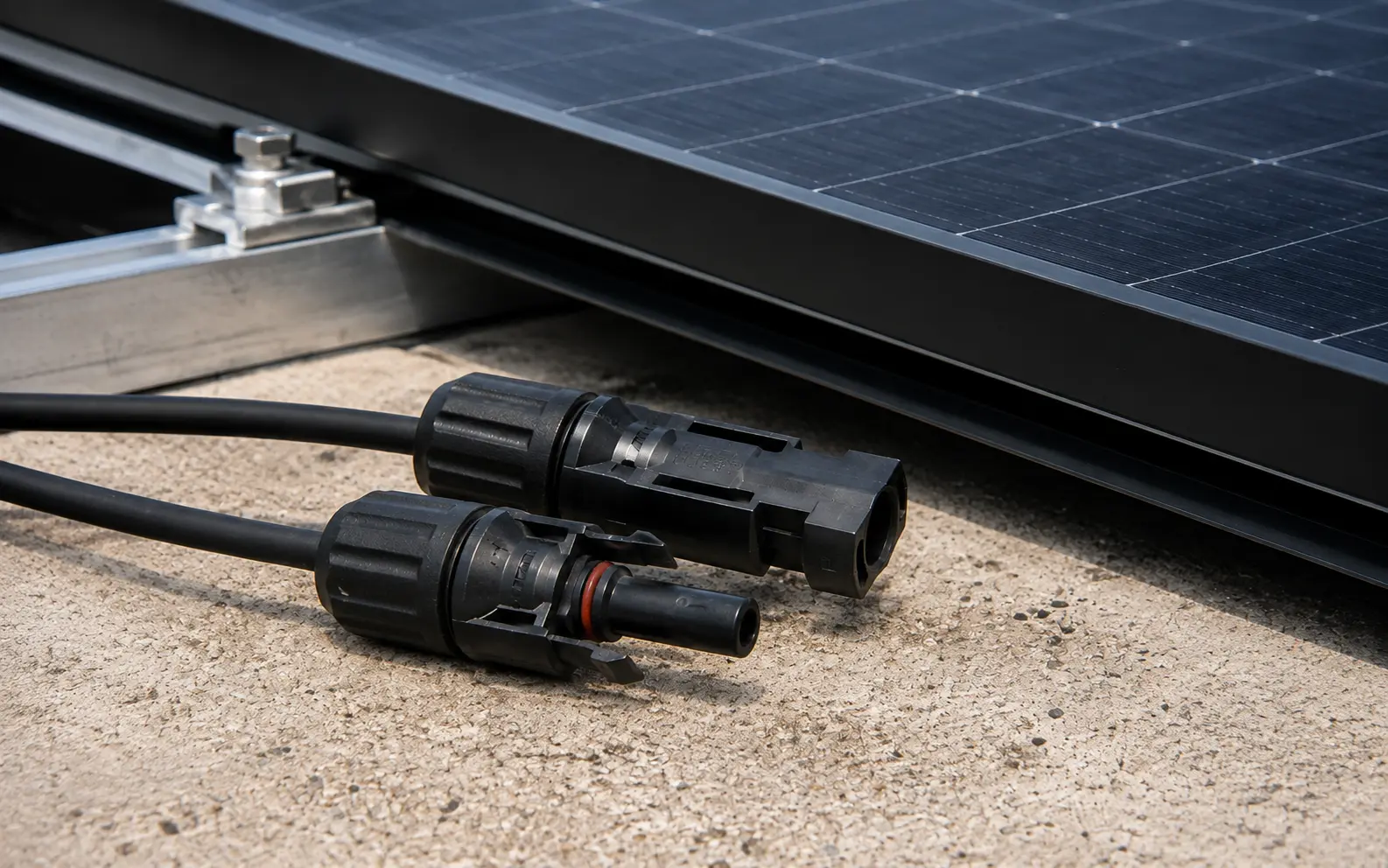
Two qualification standards govern the connector itself, and both describe it as a system — the contacts, the housing, the cable, and the crimping tool, tested together by one manufacturer. The other rows are the documents that turn up alongside them in a specification.
| IEC 62852:2014 with Amendment 1 (2020) | DC connectors for photovoltaic systems, rated up to 1,500 V DC and 125 A per contact, “without breaking capacity” | The test program evaluates a connector as a system, not an interface |
| EN 62852:2015+A1:2020 | The European adoption, text identical to IEC 62852:2014 | Same |
| UL 6703 | Connectors for use in photovoltaic systems (North America) | Applies to the listed connector, by part |
| UL 62852, Edition 1 (2022) | The UL publication of the IEC document | Same |
| IEC 62548 | Design requirements for PV systems | Requires PV connectors to be of the same origin |
| NEC 690.33(C) | The US installation code | Where mating connectors are not of the identical type and brand, they must be listed and identified for intermateability |
IEC 62852 and UL 6703 are written for connectors from one manufacturer. A certificate issued for a mated pair from one maker does not transfer to a pair assembled from two makers, even when the parts click together.
A paper by a Sandia National Laboratories researcher, written for the IEC TC82 working group now studying a universal PV connector standard, puts the situation bluntly: the qualification standards are intended to evaluate connectors from the same manufacturer and were changed to explicitly proscribe mating connectors from different manufacturers — while the industry has continued to design connectors that will commonly connect anyway. The paper calls this a violation of electrical codes worldwide, and describes the working group as a response to it.
Certification attaches to a part, and a brand name on the housing only tells you which family it belongs to. It does not tell you which part numbers carry a listing, or what that listing covers. That has to be read off the certificate, one part at a time.
Whatever the name means to you, the rule is the same across the family, down to 12 V and 48 V installations. Direct current keeps an arc alive once it starts, whereas alternating current tends to self-extinguish as the voltage crosses zero. So a connector opened or closed with current flowing can melt and pit its contacts, and the damage is not visible from outside.
That joint then runs hotter than it should for the rest of its service life. The locking mechanism that the 2008 code change made mandatory exists for the same reason: it makes accidental separation during a pull on the cable much less likely, and it requires a tool so that the release is deliberate.
If you are working on a live string, the sequence is: isolate, verify, and only then open the connector.
Reading the part is faster than guessing from the shape, because several of these connectors look alike.
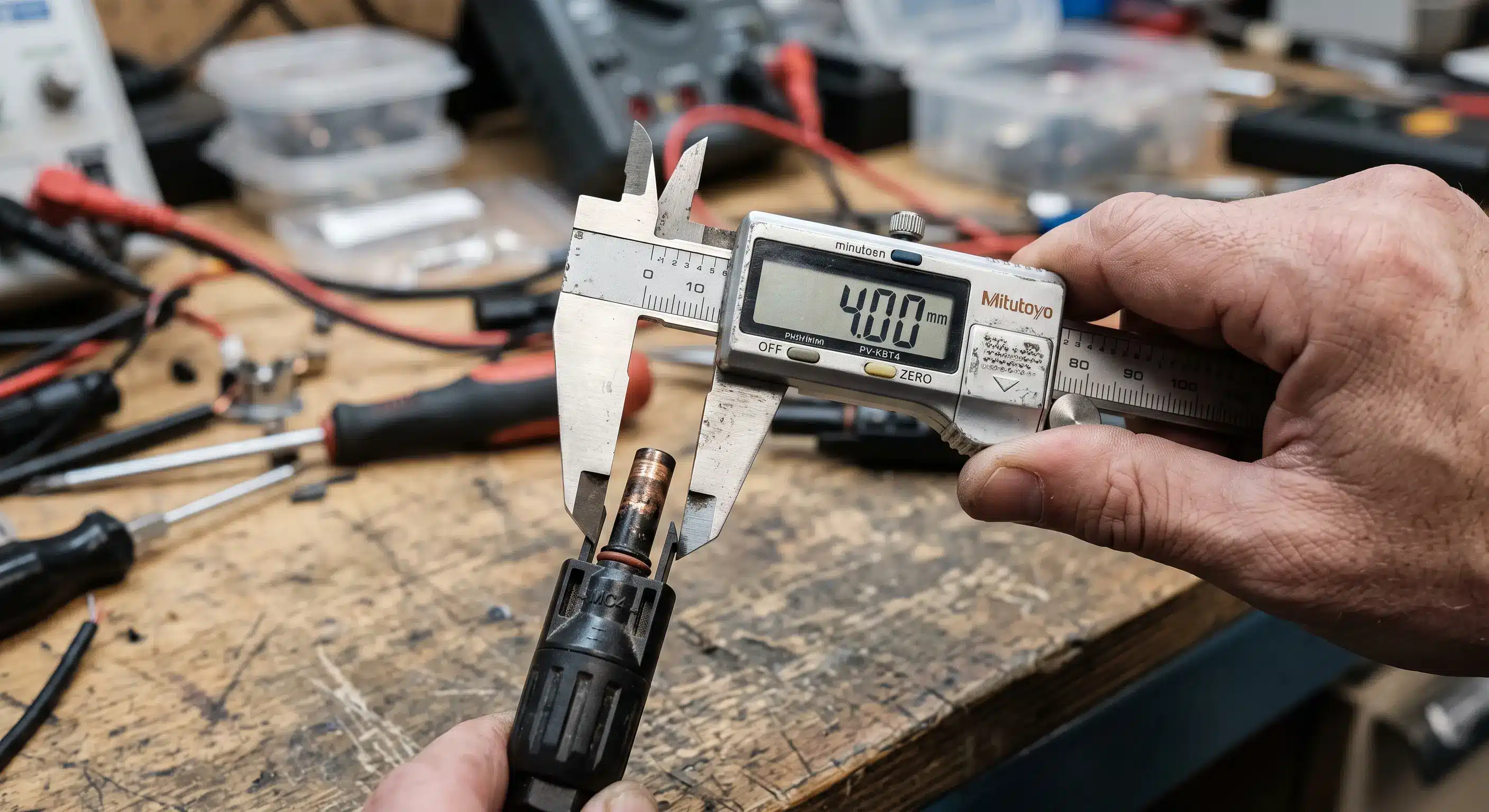
Steps 1 to 3 take about two minutes with the connector in your hand. Steps 4 to 7 need documents. Together they answer what is an MC4 connector for a part you already own.
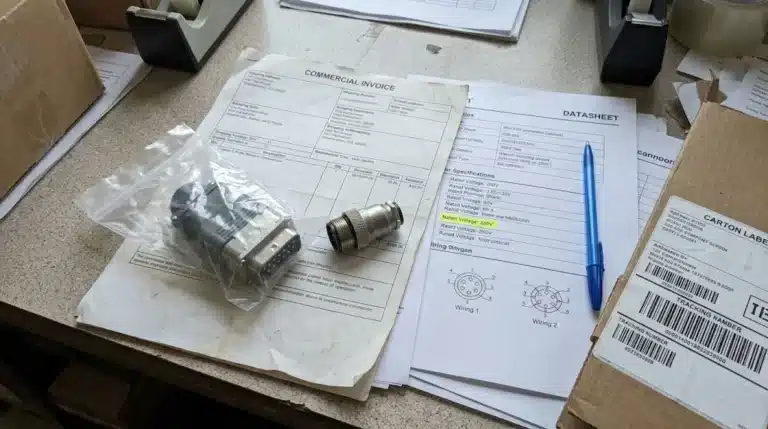
An order that says “MC4” and nothing else will be filled with whatever the supplier considers closest. The fields below turn a request into something a supplier can be held to.
| Manufacturer and exact part number | The certification belongs to the part | A family name with no part number |
| Certification and its scope | Tells you the tested system, voltage and current | “Certified” with no standard named |
| Rated voltage, and whether it is DC | Ratings are not interchangeable between AC and DC | An AC rating offered as if it covers DC |
| Rated current with its test temperature | A current figure without its ambient condition cannot be compared | A current figure with no temperature |
| Mated and unmated IP rating | These are separate conditions with separate ratings | One IP code with no condition stated |
| Cable range: cross-section and outer diameter | Both must match the cable you standardize on | A cross-section quoted alone |
| Test the pair was qualified as | A pair from one maker, or an intermateable set | A certificate with no identification of the tested pair |
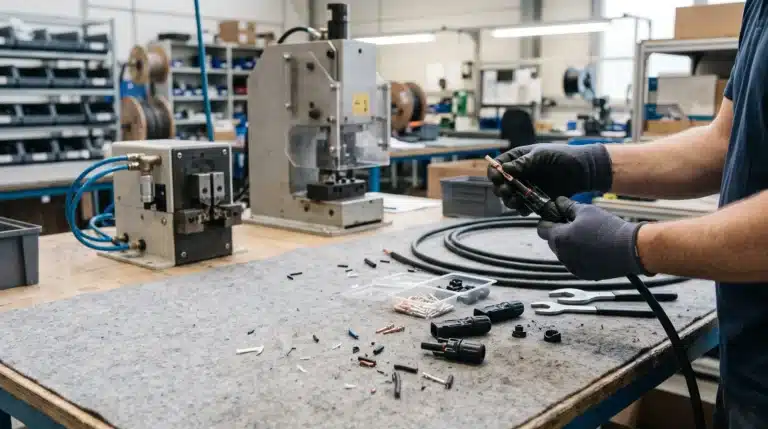
| Tooling and contact part numbers | The crimp is part of the tested system | A recommendation to “use a standard crimping tool” |
If a supplier pushes back on naming the test pair or the tooling part number, that is itself information about how the part was qualified. How the crimp is made and checked is covered in our crimping guide.
No, and the difference matters in procurement. Asking what an MC4 connector is is not the same as asking about solar connectors: MC4 is one trademarked product line inside a category that holds several interface families, and the market also uses the word loosely for compatible products. A drawing that says “solar connector” does not identify an interface; one that says MC4 identifies a family, but still not a part number. If the two families in front of you are the ones in question, our MC4 and PV4 comparison covers that pair directly.
Physically, often yes. That is exactly the problem the standards address. IEC 62852 and UL 6703 qualification is written for one manufacturer’s system, and US code requires connectors that are not the identical type and brand to be listed and identified for intermateability. Untested cross-mating is treated as a code issue, and inspectors write it up as one.
Because a locking mechanism is required, and release needs the matching tool. The requirement followed a 2008 code change prompted by separation under load. Forcing a connector apart with pliers damages the housing and the locking tabs, and it is a common cause of the water ingress that shows up much later.
Read the rating off the certificate or the drawing for that part. The first generation was rated at 600 V, and later versions reach 1,500 V DC, so the family name alone tells you nothing about the voltage. It is a per-part figure.
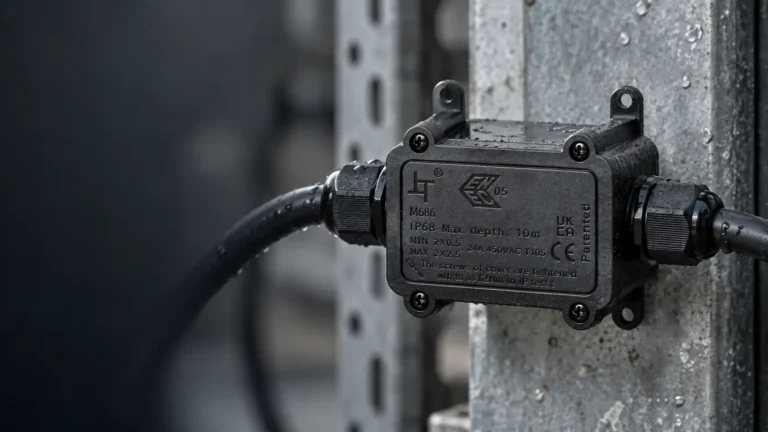
Not by itself. IP68 is a two-variable rating: IEC 60529 leaves the depth and the duration of the test to agreement between manufacturer and buyer, so two products carrying the same code may have been tested under different conditions. Ask for both numbers.
Ask for the certificate for the delivered part number and check it against the drawings, and confirm the contact, housing, and tooling part numbers match the qualification. Where that paperwork is missing, sending a sample for testing is cheaper than discovering the difference after commissioning. Our own PV connector pages publish the rated voltage, rated current, IP rating, and certification for each series, and we state when a rating does not apply to a series rather than leaving the field blank.
A name on a drawing is where the specification starts. What separates a correct order from a plausible one is whether the supplier can answer three things: which family the interface belongs to, which part number is being supplied, and what the certificate for that part covers. If two of the three come back vague, that tells you something about the supplier.
If you have a part in your hand and no documentation, send us the part number or a photo, and we will tell you which family it belongs to and what to ask the supplier for. The selection logic behind the interface, covering voltage, current, seal and environment, is set out in our solar connector selection guide.
All pages retrieved 5 October 2026.
Manufacturer and standards sources are listed by name, title and date. The one link kept below is a lookup tool the reader is asked to use directly.

LET’S BUILD YOUR CONNECTION SOLUTION
Share your application, specifications, and estimated quantity. Our team will recommend a suitable connector solution and provide a quotation.
Low MOQ · OEM & ODM · Product Selection Support · Fast Quote Response