

Samples in stock · Response within 12 hours. Request a Quote →
| Item | Value or source |
|---|---|
| Contact resistance test current | Not more than 100 mA, with test voltage not more than 20 mV (IEC 60512-2-1, Test 2a) |
| Crimp pull force | Taken from the standard’s table for the conductor size, for example 70 lb at 12 AWG (UL 486A-486B reference value) |
| IP test state | The state declared by the manufacturer: mated pair, unmated, or capped |
| IP68 test condition, M686 junction box range | 2 m for 120 hours, as declared for that series |
| Insertion force, CN series | 75 N or less |
| Mating cycles, CN series | 500 or more before replacement |
| Panel opening, CN06 | 18 mm, tolerance ±0.1 mm |
| What to keep | One signed record per sample and per lot |
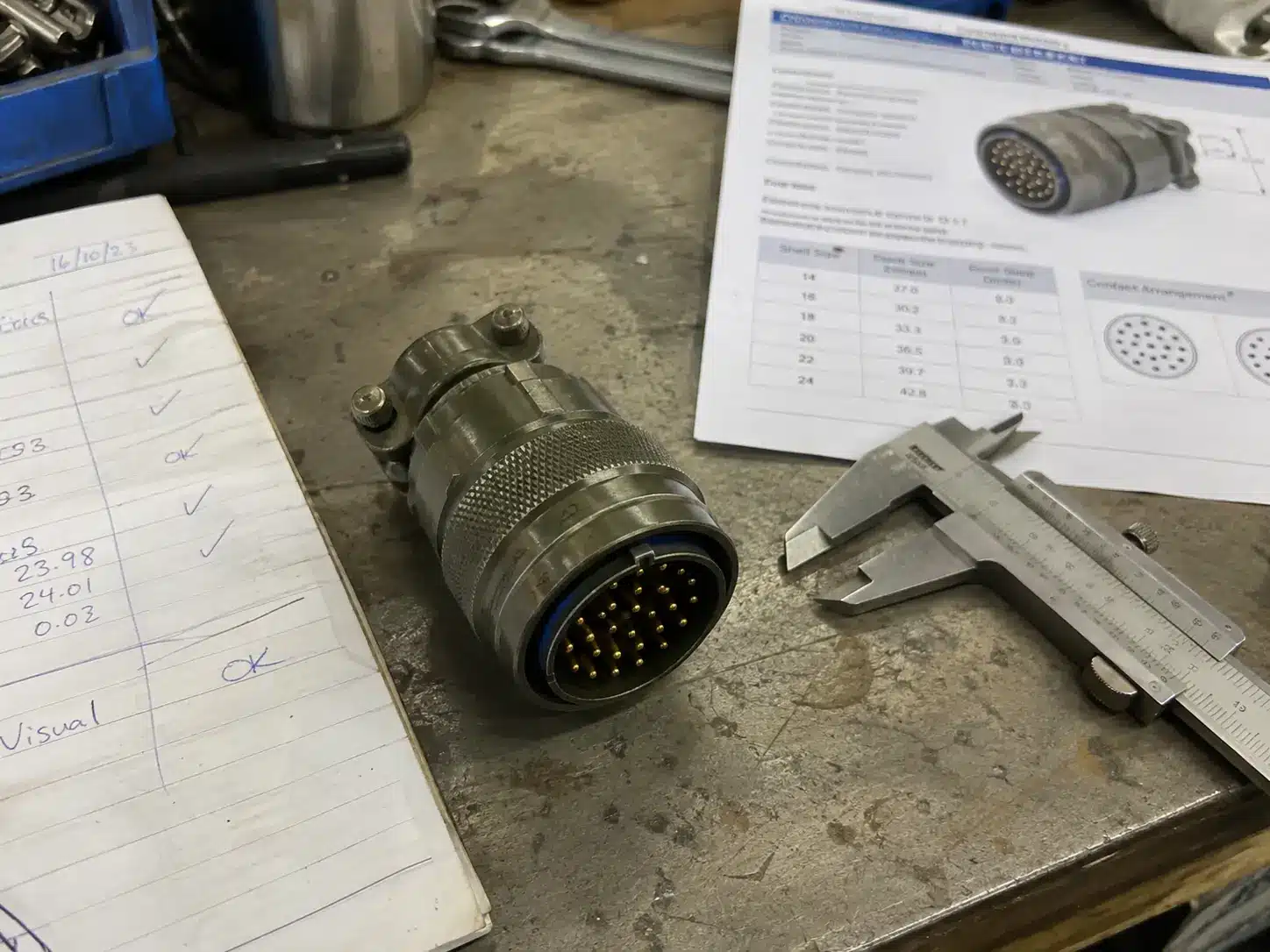
Criteria come from three places, and the order matters: a datasheet value, a drawing tolerance, and your own note on the cable you actually use, the panel you actually drill and the environment the connector will live in. Write them down before the connector sample is unpacked, because the party who writes them decides the outcome. Where the datasheet is silent, agree the number in writing before the order. A value invented at the bench after a failure is a value nobody will accept.
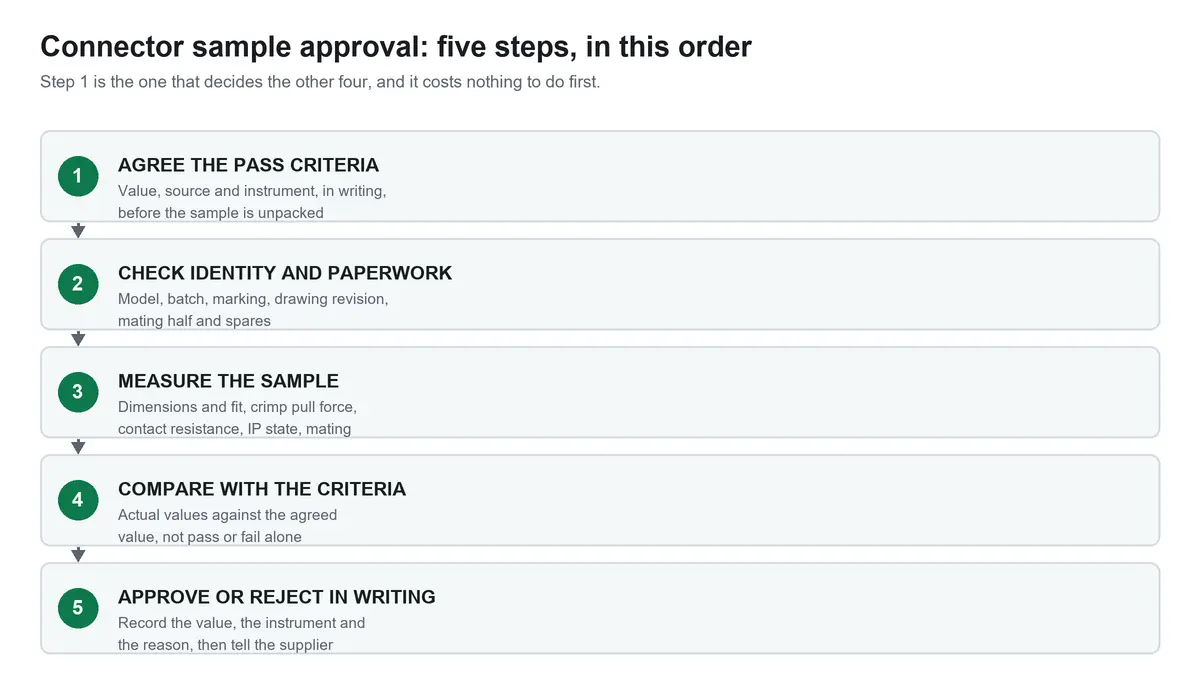
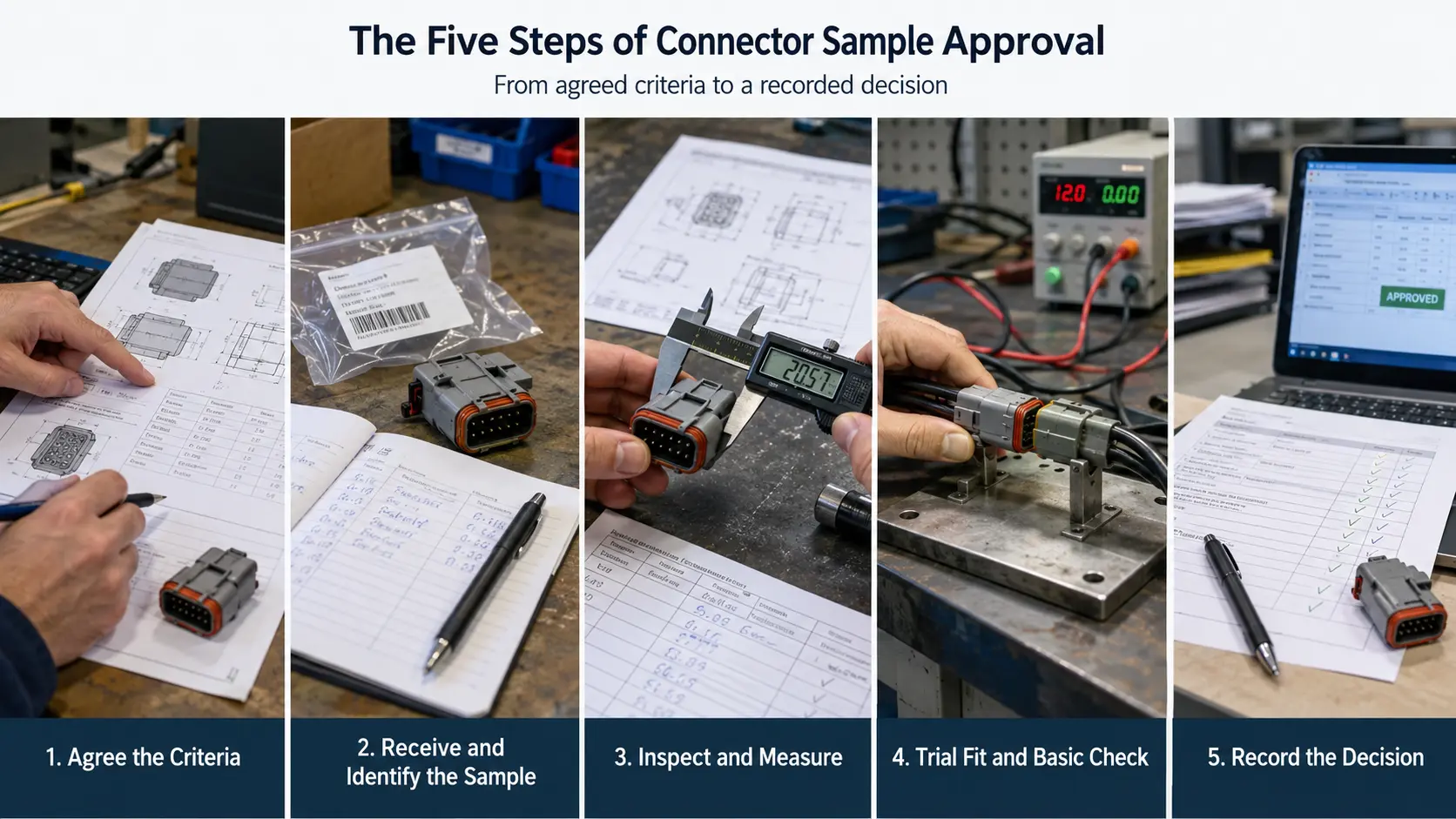
The five steps of a connector sample approval, from agreed criteria to a recorded decision
The criteria also decide which checks matter. A sample for a sealed outdoor run needs the IP state confirmed, a cabinet build needs seating, keying and cable entry, and a field-crimped piece needs the terminal interface.
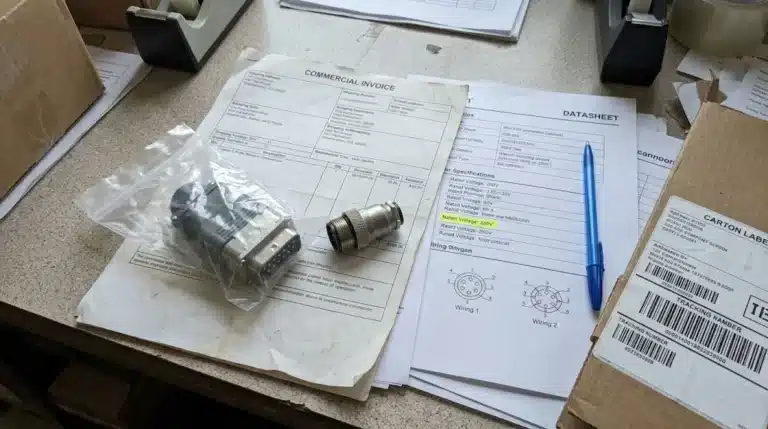
Check the paperwork before the connector sample goes to the bench, because a wrong part wastes the session. The packing should identify the model, the date code or batch, and the quantity, and the documents should match the part you receive: the datasheet revision relevant to that model, the dimensional drawing, and any test report the supplier holds for it. If the connector is supplied as one half of a pair, ask for the mating half with the sample, since the fit that decides approval is the pair.
Ask for a spare seal or gland in the range you specified, and for the terminal that goes with the conductor you will crimp. On a screwless waterproof connector the contact sits inside the housing, so the spare that matters for a connector sample is the seal rather than the terminal. Small accessories decide more approvals than the housing does: a seal that is one step off the jacket diameter, or a terminal that will not take the strand class, turns a good connector sample into a rejected one. Where the product is supplied as a cable assembly, check that the assembly drawing, the length and the marking are on the documents rather than agreed in an email.
| What to check | Instrument | Where the limit comes from |
|---|---|---|
| Panel opening and mounting holes | Vernier caliper, pin gauges | Drawing, for example 18 mm ±0.1 mm on the CN06 opening, 4 × M4 fixing |
| Mating travel and full seating | Depth gauge, visual witness mark | Drawing or a mating check against the mating half |
| Keying and coding features | Visual, then a deliberate wrong-pairing attempt | Drawing, plus a mate test with the wrong half |
| Thread and fastener condition | Thread gauge, torque wrench | Datasheet or drawing for the fixing |
| Cable entry range against your jacket | Caliper on the jacket, then assembly | Datasheet seal range against the actual outer diameter |
| Marking and labels | Visual against the order | Drawing, packing list, label artwork |
Measure the connector sample with the cable you intend to use. A seal range that reads well on paper can still be a poor fit on a stiff or out-of-round jacket, and that shows up in five minutes at the bench rather than in a complaint from the field. Check the mating half at the same time, because the fit that matters is the pair, not the single piece in your hand.
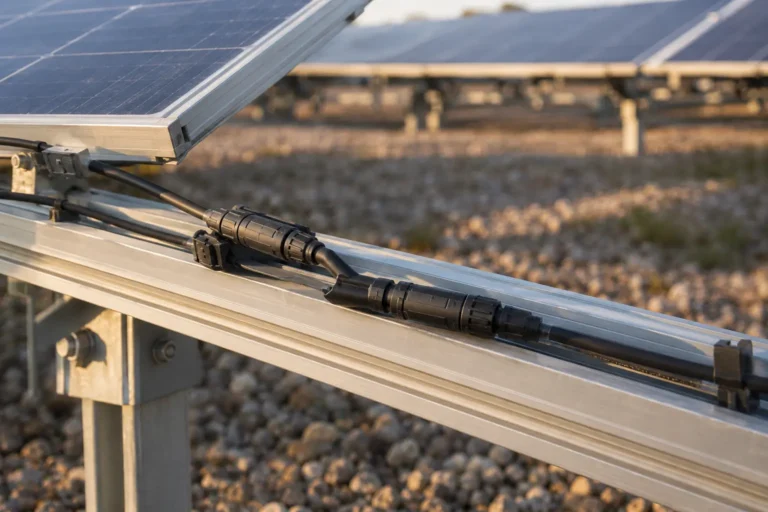
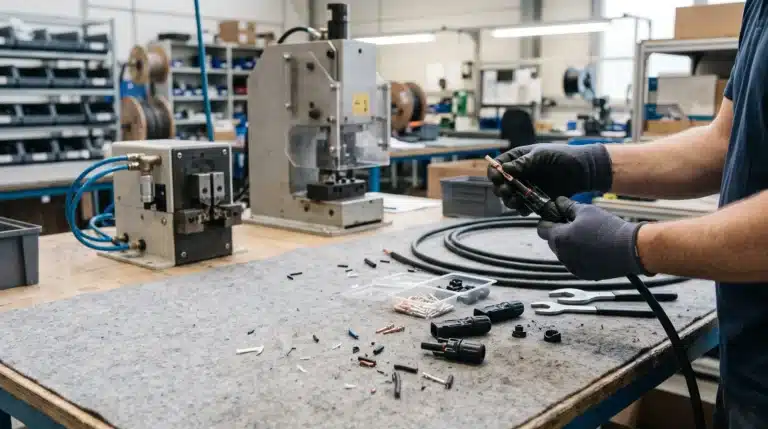
Start the pull test on a connector sample you can afford to lose, because it ends with a number and a destroyed specimen. Pull along the axis of the conductor, hold the load for one minute, and watch for slip, strand breakage or any movement at the terminal. On a MC4 solar connector the load lands on the crimp inside the housing rather than on the shell, which is why the terminal and the die matter more than the name on the body. Published reference values scale with conductor size, and the table below lists the common ones from the UL secureness test.
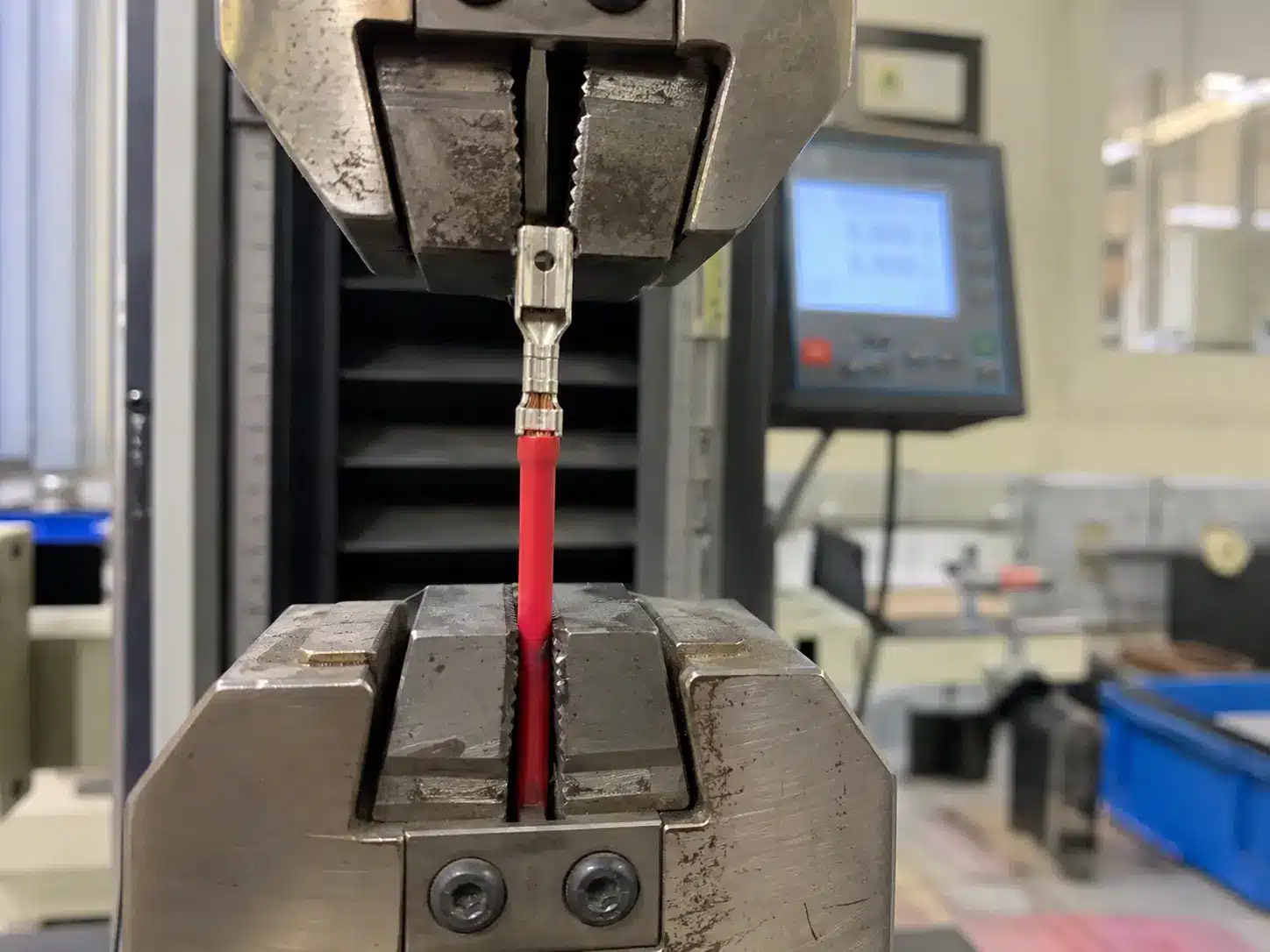
| Conductor size | Reference pull force (UL 486A-486B table) |
|---|---|
| 18 AWG | 20 lb |
| 16 AWG | 30 lb |
| 14 AWG | 50 lb |
| 12 AWG | 70 lb |
| 10 AWG | 80 lb |
| 6 AWG | 100 lb |
| 4 AWG | 140 lb |
| 1 AWG | 200 lb |
Two cautions. The applicable value depends on conductor class and terminal type, so quote the table for the construction you are buying rather than the nearest row, and for metric cable classes follow the standard’s own index (IEC 60352-2 for crimped connections). Second, a pull test destroys the specimen, so keep one piece out of the run for it and record which one it was.
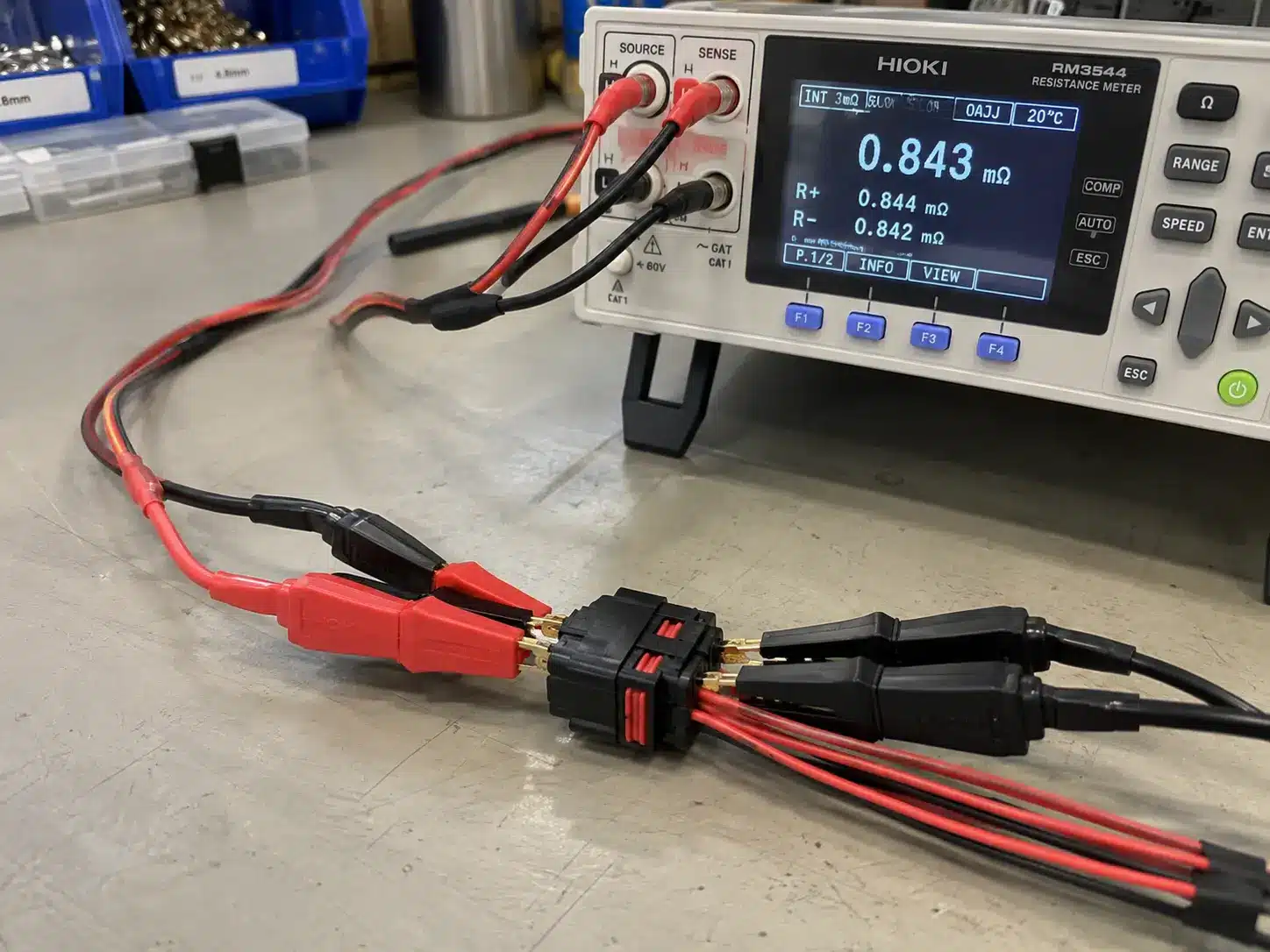
Two benches can disagree about the same connector sample, and the method is usually the reason rather than the product. IEC 60512-2-1 defines the millivolt level method: test current not more than 100 mA and test voltage not more than 20 mV. The contact stays undisturbed while the voltage is applied, and the reading is the average of a forward and a reverse current measurement. Test voltage stays low so an insulating film on the contact is not broken down by the measurement itself, which would flatter a poor contact.
A two-wire multimeter reading includes the resistance of the leads and the probes, which is often larger than the contact resistance you are trying to measure. Use a four-wire or differential reading, subtract cable and fixture resistance where the measurement points are not directly accessible, and record the corrected value. Compare the result with the datasheet. The CN series holds contact resistance at 0.2 mΩ or less on the smaller models and 0.5 mΩ or less on the larger ones, measured at 100 mA. A reading in the tens of milliohms points at a crimp, a seating or a fixture problem rather than a material problem.
Temperature rise needs a load bank and a stable ambient, so most buyers run it on the first article rather than on every connector sample. The current, the cable and the contact resistance drive the number, and the point of measuring it early is to catch a connector sample that runs hotter than its rating suggests.
IEC 60529 defines the code, and the manufacturer declares the depth and the duration. That single sentence explains most IP disagreements: IP68 on a sample means the supplier’s declared condition, not an unlimited promise, and a second sample can carry the same code with a different condition behind it. So read the condition before you plan a test.
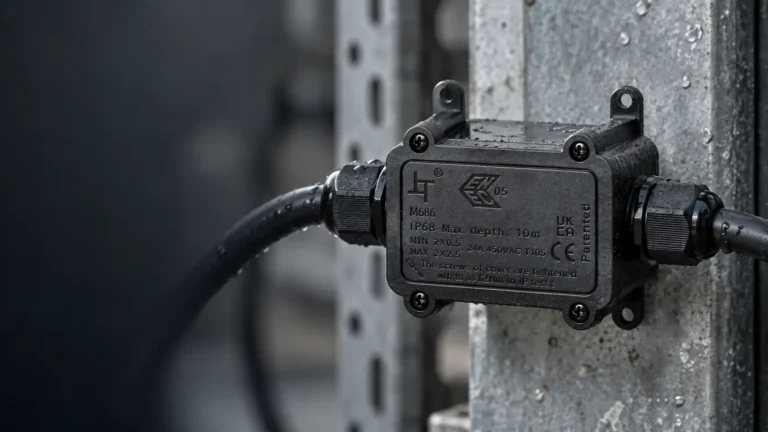
A sample certified as a mated pair is not proven unmated, a panel-mounted half is not the same as a cable assembly, and an unused port needs a cap to hold the rating. An IP68 waterproof junction box is a different test object for a connector sample: one seal, several cable entries, and a lid that opens in service.
Our own declared conditions follow that pattern: the CN series is IP67 on the mated pair, and the M686 junction box range carries a declared condition of 2 m for 120 hours.
Where your process allows it, immerse the assembled sample before you spend an hour on measurements, because a seal fitted the wrong way shows up in water far sooner than in any reading. Keep the water shallow, dry the piece before opening it, and inspect for moisture at the seal and the terminal. Treat the result as a workmanship check on your assembly, not as a repeat of the type test.
Seat the two halves together before you trust any single measurement, because mating exercises the housing, the contacts and the lock in one movement. Seat the halves by hand, feel for the point where the lock engages, and confirm full seating on a witness mark or a gap check. Then try to pair the wrong halves: a connector sample whose keying allows a wrong pairing on the bench will allow it in a cabinet at night. Release should be deliberate and possible by hand with the tool the design calls for, and put the datasheet retention number next to the bench when the connector sits on a moving assembly.
Never mate or unmate a connector under load, and prove the absence of voltage before any measurement on an installed string. A live DC string turns a bench slip into an arc, and no reading is worth that.
| Item | What to record | Why it matters later |
|---|---|---|
| Identity | Model, series, date code or batch, supplier | Ties the result to the parts actually received |
| Criteria source | Datasheet revision, drawing number, agreed value | Shows what the connector sample was judged against |
| Measurements | Actual values, not pass or fail only | Lets you compare the next lot against this one |
| Instruments | Caliper, pull tester, milliohm meter with model | Makes the result repeatable by someone else |
| Result | Pass, fail, or pass with a condition | Feeds the approval decision and any claim |
| Action | Approve, rework, reject, request a new sample | Closes the loop with the supplier in writing |
Write the result down even when the sample passes, because those numbers become the baseline for every later lot. When the production lot arrives, the same measurements on a few pieces tell you whether the process held, and when a part fails in the field the record tells you what the approved part actually measured. Keep it short enough that someone fills it in at the bench.
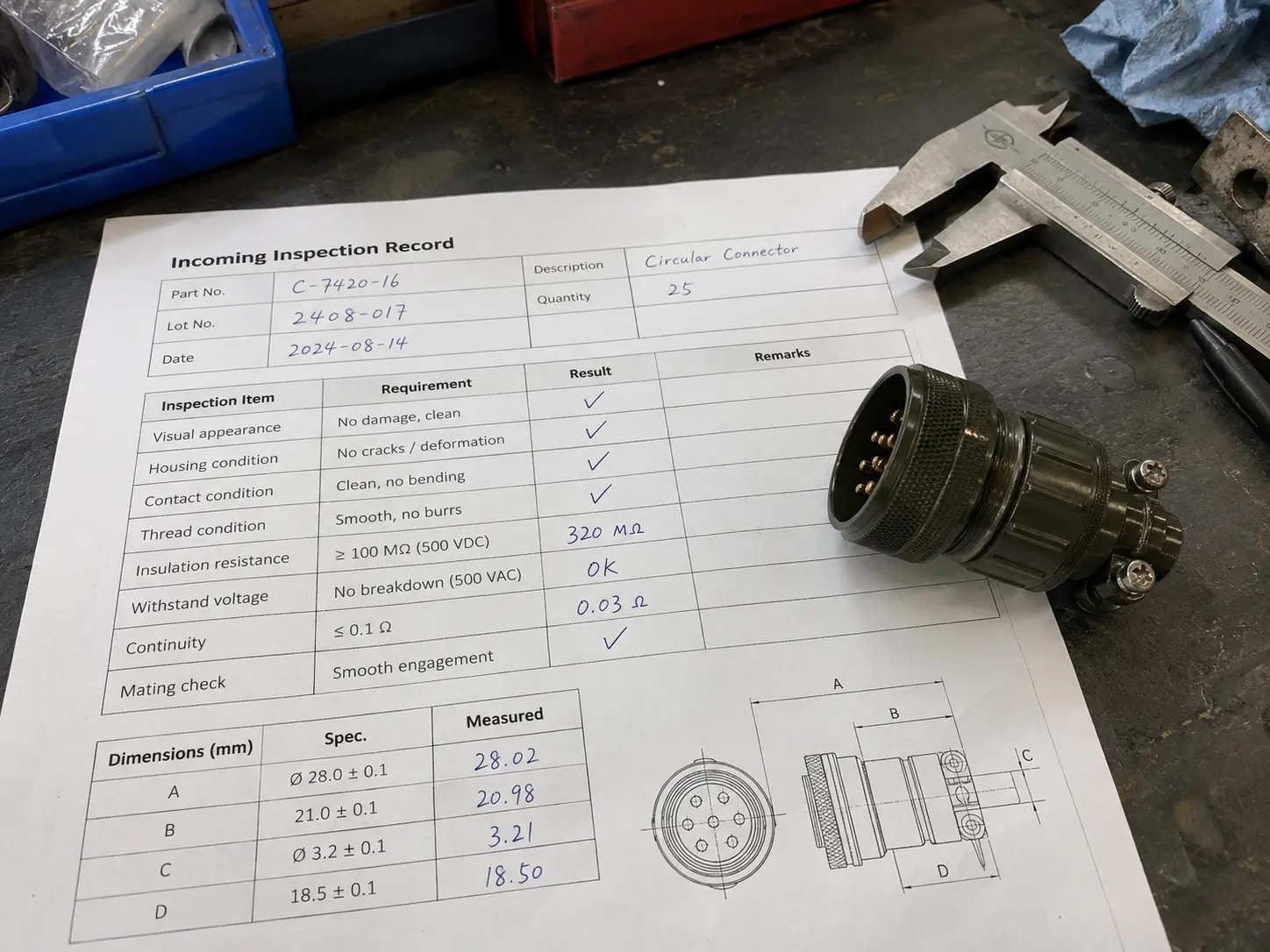
One sample proves the design on the day it was made. A lot proves the process over time, so the checks split differently. Measure a few pieces per lot rather than everything, run the destructive pull test on one piece, and compare the numbers against the baseline from the approved connector sample. If a number drifts between the two, ask the supplier before the next order.
What happens before dispatch is the supplier’s side of the same system, and PVLinkTech quality control covers the specification review, material checks, assembly inspection and final verification we run on connectors. The checks above are the buyer’s side, and a supplier who welcomes them will answer a criteria question faster than one who does not.
Test all of them for identity, marking and visible damage, and one of them to destruction for pull force. Dimensions and mating take a few minutes per piece, so measure every connector sample if the quantity allows it. Contact resistance and immersion checks only need one or two pieces to establish a baseline.
Dimensions, mating, keying, marking and a simple immersion check need no laboratory. Pull force needs a tester with a known calibration, and a trustworthy contact resistance reading needs a four-wire meter. If you have neither, ask the supplier for the test report from the connector sample you received and confirm which piece it covers.
That is what the record is for. Re-run the measurements on a few pieces from the lot and compare them against the connector sample baseline. A shift in pull force usually points at a crimp tool or an operator, and a shift in contact resistance points at plating, seating or cleanliness. Ask for the lot’s inspection record before you accept a repeat.
No. The IP code is declared against a defined condition and confirmed by the manufacturer’s type test, so repeating it at the bench proves workmanship rather than the rating. Test your assembly for assembly faults, keep the declared condition on file, and check that the condition matches your installation: mated or unmated, panel or cable, capped or open.
Yes, whenever the connector sample will be crimped onto your cable. Seal range, jacket hardness, conductor class and terminal fit all change the result, and a connector sample that passes on the supplier’s cable can still fail on yours. Send the cable specification with the sample request so the seal range is checked against it before shipment.
Rarely. A failed connector sample with a specific number attached is the most useful message you can send a supplier: which check, which value, which instrument. Most failures traced this way come from a crimp setting, a seal fitted the wrong way, or the wrong model for the jacket diameter, and a corrected sample arrives without a design change.


LET’S BUILD YOUR CONNECTION SOLUTION
Share your application, specifications, and estimated quantity. Our team will recommend a suitable connector solution and provide a quotation.
Low MOQ · OEM & ODM · Product Selection Support · Fast Quote Response