

Samples in stock · Response within 12 hours. Request a Quote →
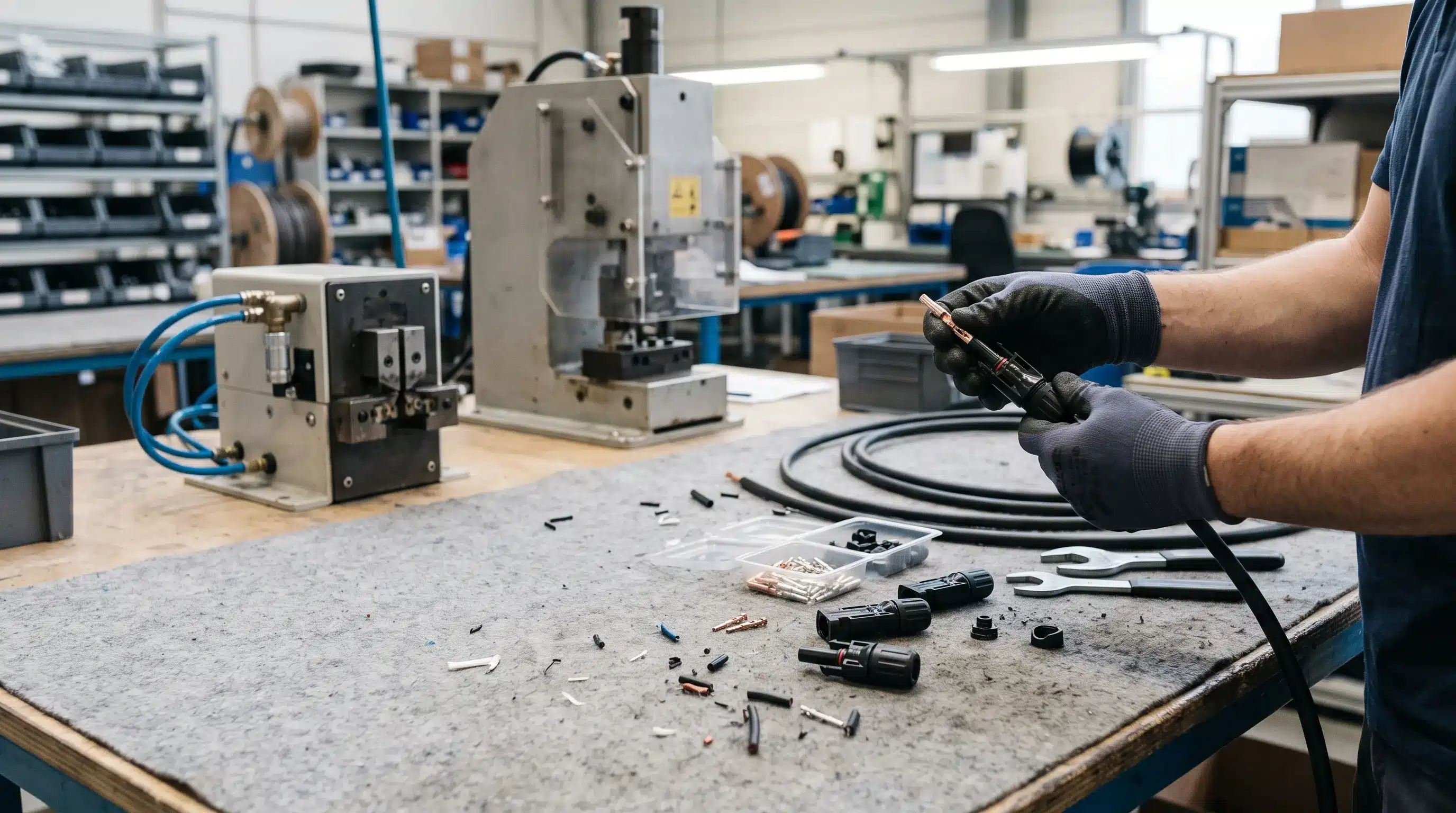
A connection carries three costs: the part, the labor that installs it, and the work that follows a bad one. Connector assembly time is the second, and on a project with 200,000 connections a few seconds per connection add up to hundreds of assembly hours. This page shows how a time study is built, publishes one measured at 23.4 seconds per finished end, and explains how to read a supplier’s number.
Key takeaways
- A quote prices the part. The labor to install it is paid on every connection.
- Assembly times are comparable only when the method, the allowance and the tooling are stated.
- Our record: 23.4 seconds per finished end, six operations, lot LOT-20261007-01, with the pull-out and seal records printed below.
A connector buyer receives a unit price, an MOQ and a lead time. The number that decides the project’s labor bill rarely appears, because labor sits with the installer. The gap shows up later, when a crew that budgeted 20 seconds per connection spends 40.
| Cost group | Who usually quotes it | What decides it |
|---|---|---|
| Part and tooling | The connector supplier | Material, plating, MOQ, tool and die, certification |
| Installation labor | Nobody, unless it is asked for | Assembly time multiplied by the crew rate |
| Failure and rework | Nobody | Crimp quality, seal fit, workmanship, lot traceability |
The third row is where a cheap connector gets expensive. A remade termination costs the second connection, the removed part, the second seal check and the decision time.
A standard time is the time a trained operator needs for one operation at a defined pace, plus an allowance for fatigue and small delays added to the observed net time. The method belongs to the work measurement branch of industrial engineering, and a time and motion study is direct observation of one operator with a timing device. A supplier’s number is usable only if the six fields below travel with it.
| Field | What it means | How to tell it was measured, not estimated |
|---|---|---|
| The unit | One end finished, or a complete assembly with two ends and a test | The figure doubles or halves depending on the answer |
| Method | Continuous timing of a real operator over repeated cycles, or a table of predetermined times | A method name and a cycle count, not a single figure |
| Net time per operation | The observed time before the allowance | Per-operation values, because the total hides where the time sits |
| Allowance | The percentage added for fatigue and delay | A stated percentage, applied at a stated point |
| Tooling and station | Manual station, semi-automatic press, torque driver, test fixture | A number from one tool set does not transfer |
| Content of the number | Cutting, stripping, crimping, sealing, torquing, testing, packing, handling | Testing and handling are frequently left out |
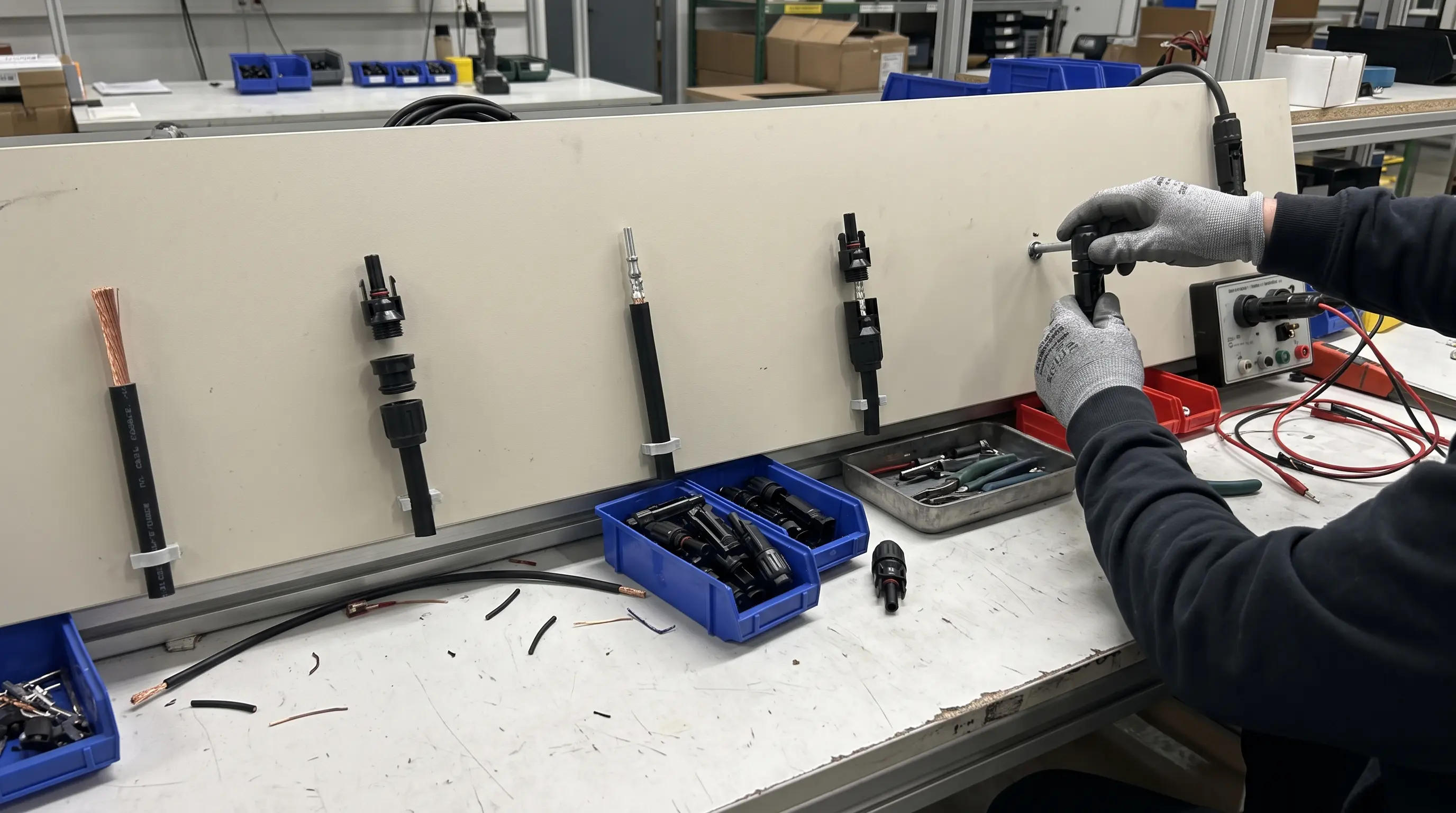
The record below is from our production line, lot LOT-20261007-01, timed 2026-10-07: continuous timing over ten cycles, 10% allowance per operation, one end of a sealed connector assembly on 4.0 and 6.0 mm² solar cable.
| Step | Operation | Work instruction and tooling | Net time | Standard time |
|---|---|---|---|---|
| OP10 | Cable cutting and stripping | Pneumatic stripping machine: jacket strip 25 mm, conductor strip 7.5 mm | 3.5 s | 3.9 s |
| OP20 | Fitting the seal parts | Tail cap, seal claw and silicone seal ring slid on in order | 2.8 s | 3.1 s |
| OP30 | Conductor crimping | Semi-automatic press with an in-position microswitch, one foot stroke | 4.2 s | 4.6 s |
| OP40 | Contact insertion | Contact pushed in until the clip clicks, then pulled back lightly to verify | 3.0 s | 3.3 s |
| OP50 | Tail nut tightening | Electric torque driver to 2.5 N·m, clutch release | 4.5 s | 5.0 s |
| OP60 | Electrical test | Dedicated fixture: loop resistance at or below 5 mΩ, no open and no short | 3.2 s | 3.5 s |
| One finished end | Total, flow-line work | 21.2 s | 23.4 s |
The standard times are rounded to 0.1 s, so their sum is 0.08 s above 21.2 × 1.10.
Half the time sits in two steps, the crimp and the torque, because both have a controlled setting that a machine has to reach and hold. The crimp also carries the electrical and mechanical joint of the assembly. A crimped joint is a cold weld between strands and barrel; a soldered joint on a crimp-designed terminal sits outside the certificate that covers the contact, the cable and the tool. Our comparison of crimped and soldered PV terminations has the detail.
Three things move the number, and only some sit inside the supplier’s control.
| Finished ends | Assembly hours at 23.4 s | Assembly hours at 17.5 s |
|---|---|---|
| 10,000 | 65.0 | 48.6 |
| 100,000 | 650.0 | 486.1 |
| 1,000,000 | 6,500.0 | 4,861.1 |
The 25% cut in that table is 163.9 assembly hours per 100,000 connections. On a delivered 120 MW floating and ground-mount array, the process change recorded against the previous method produced a reduction of that order, with no connection failures in the 18 months after delivery. We publish the time and not a price, because the labor rate is yours.
A shorter standard time is worth having only if the joint behind it is still good. The lot that was timed was also pulled to destruction and immersed.
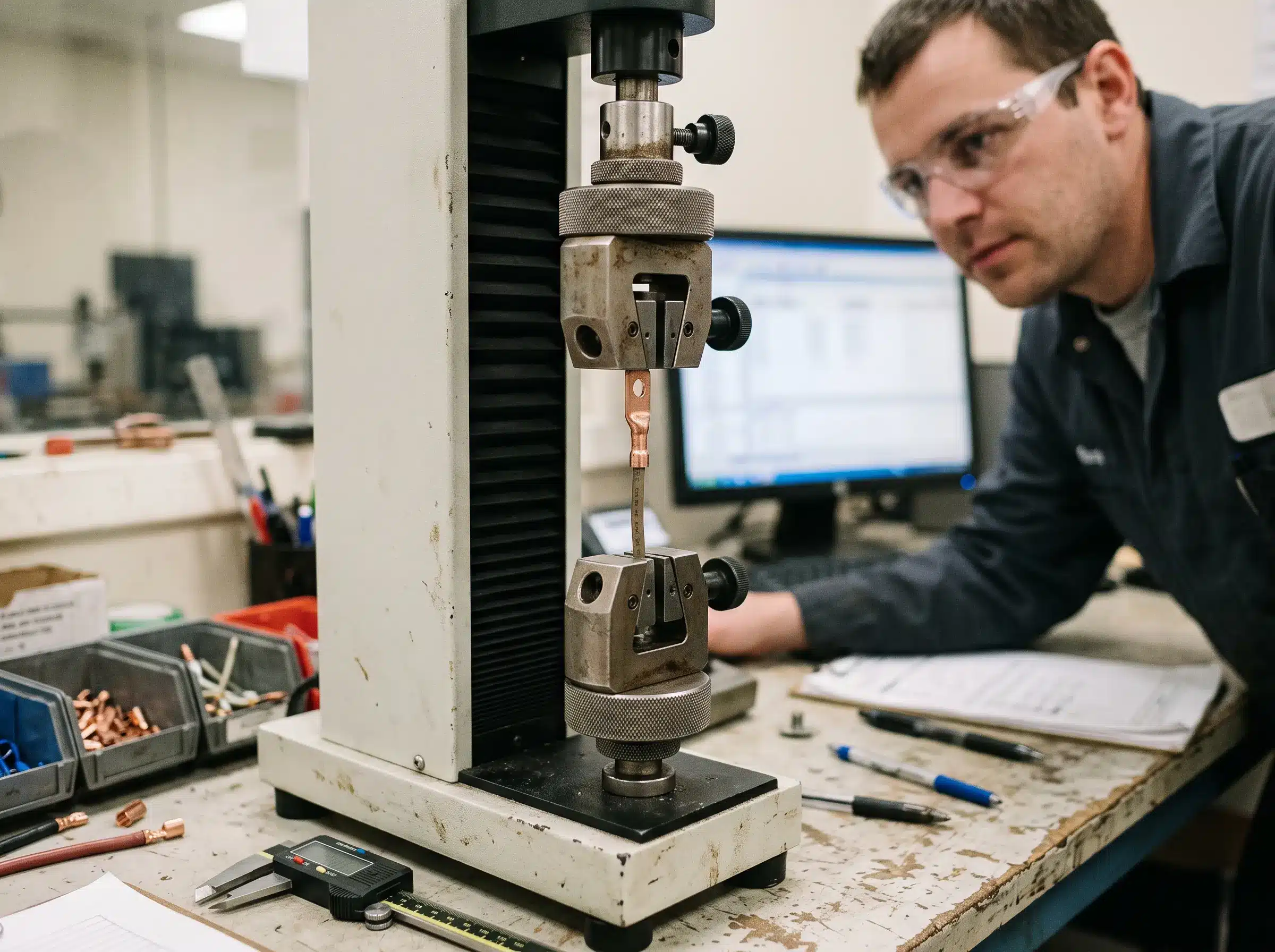
Five specimens, axial pull to failure at 25 mm/min. The limits are the pull-out values published for EN 60352-2 at these cross-sections: 310 N at 4.0 mm² and 360 N at 6.0 mm². The same two sizes cross-check against the UL 486A-486B conductor table, which prints 70 lb (311 N) at 12 AWG and 80 lb (356 N) at 10 AWG.
| Specimen | Conductor | Terminal | Crimp setting | Failure mode | Limit | Measured |
|---|---|---|---|---|---|---|
| 1 | 4.0 mm² | Stamped open barrel, H62 brass, tin-plated | CH 2.18 mm / CW 3.92 mm | Conductor broke at the neck outside the crimp | 310 N | 386.4 N |
| 2 | 4.0 mm² | Stamped open barrel, H62 brass, tin-plated | CH 2.19 mm / CW 3.90 mm | Strands parted at the crimp edge, no slip-out | 310 N | 372.1 N |
| 3 | 4.0 mm² | Machined solid barrel, copper, silver-plated | Indentation depth 2.45 mm | Conductor pulled out of the barrel | 310 N | 428.5 N |
| 4 | 6.0 mm² | Stamped open barrel, H62 brass, tin-plated | CH 2.52 mm / CW 4.45 mm | Conductor broke at the neck outside the crimp | 360 N | 492.3 N |
| 5 | 6.0 mm² | Machined solid barrel, copper, silver-plated | Indentation depth 2.80 mm | Conductor broke at the neck outside the crimp | 360 N | 540.8 N |
The three 4.0 mm² specimens averaged 395.7 N and the two 6.0 mm² specimens 516.5 N, so the lowest reading in each group sits 20.0% and 36.8% above its limit. Note the size mismatch before reusing the AWG rows: 4.0 mm² is nearer 11.2 AWG and 6.0 mm² nearer 9.4 AWG, so the metric table is the right reference. Specimen 3 reached 428.5 N, above its limit, but the conductor left the barrel instead of breaking outside it, and an acceptance rule that reads only the force will pass both patterns. A claimed listing can be checked in UL Product iQ.
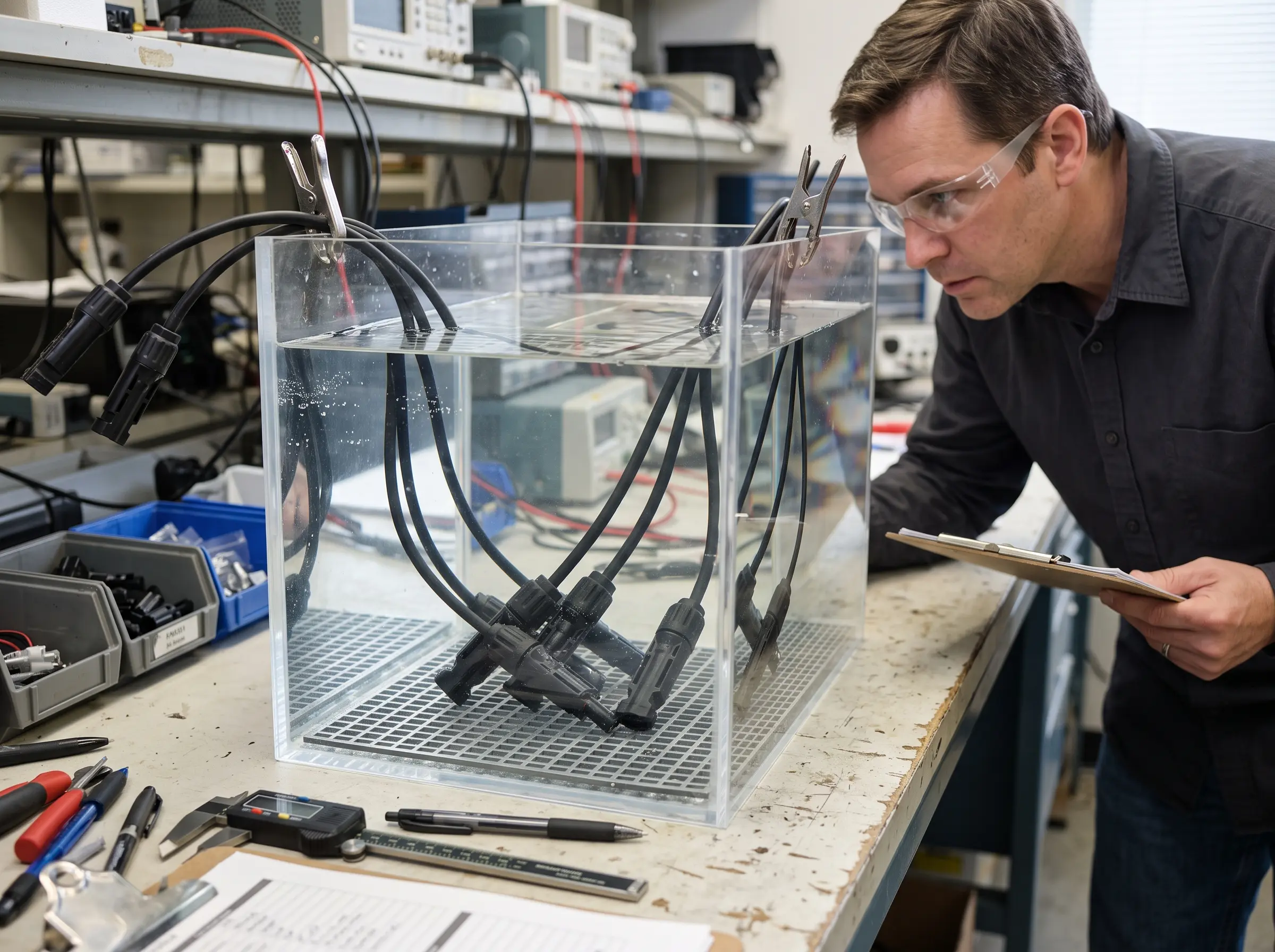
Five assembled samples, static immersion at 1.5 m for 24 hours, insulation resistance at 500 V DC against an internal criterion of 100 MΩ.
| Sample | Description | Tail torque | Before immersion | After 24 h | Internal inspection |
|---|---|---|---|---|---|
| 1 | Matched plug and socket, cable OD 7.8 mm | 2.5 N·m | above 500 MΩ | above 500 MΩ | Cavity dry, no water traces |
| 2 | Matched plug and socket, cable OD 8.2 mm | 2.5 N·m | above 500 MΩ | above 500 MΩ | Cavity dry, no water traces |
| 3 | Threaded panel socket with silicone O-ring | 2.0 N·m | above 500 MΩ | 450 MΩ | Seal groove even and dry |
| 4 | Screwless push-in type, latch engaged | not applicable | above 500 MΩ | above 500 MΩ | Absorbent paper inside dry |
| 5 | Energy storage outlet assembly | 3.0 N·m | above 500 MΩ | above 500 MΩ | No condensation at the pins |
IEC 60529 defines the IP code and the method, and the depth and duration are declared by the manufacturer. A sample that holds 1.5 m for 24 h has held the condition it was tested against, and that result does not extend the rating to another cable diameter or an unmated half. Sample 3 is the one reading that fell, to 450 MΩ, still inside the criterion.
These records show that the standard time was not bought by narrowing the crimp or skipping the seal check. Five specimens from one lot is production sampling, in the same family as the checks a buyer runs before approving an order. A type test is a different exercise, run against the connector system standards IEC 62852 and UL 6703, which qualify a contact, a cable size and a crimp tool together. Our quality control page lists the checks behind this record.
| If your priority is | Start here instead |
|---|---|
| Approving a sample before you place the order | Connector sample testing: what to check before you approve |
| Writing the RFQ so the answers are usable | Connector RFQ checklist: the fields suppliers need |
| Finding the connector family this record covers | MC4-compatible PV4 solar connectors |
Where a connection has to be reopened for maintenance, build time matters less than the reopening procedure. Where the failure cost is high and the crew is not under your control, a pre-assembled cable assembly moves the work into a controlled line.
The tables come from PVLinkTech production QC, lot LOT-20261007-01, tested 2026-10-07 at 23.5 °C and 54% RH by inspector QC-03. The three tables are available as downloads.
Standards are listed by name and number rather than linked:
All pages were retrieved on 2026-10-07. The acceptance limits were cross-checked against two published reproductions of the EN 60352-2 table and the UL 486A-486B table.
There is no single number. It depends on the parts, the tooling, the cable, and whether testing is included. A two-part connector on a prepared cable can be finished in seconds, while a sealed assembly with several seal parts, a torqued tail nut and a 100% electrical test takes longer. The record here is 23.4 seconds per finished end.
Only when the joint behind it holds. A process that is fast because the test was dropped, or because the seal was simplified, moves cost from the line into the field, where a remake costs a second connection plus the labor of finding the fault. Compare speed with the pull-out and seal records of the same lot.
The common method is continuous timing with a stopwatch over repeated cycles. An observer follows one operator for ten or more cycles, records the net time of each operation, then adds a stated allowance for fatigue and delay. Predetermined time systems estimate the same work from tables of elemental motions instead.
No. Five specimens per characteristic is production sampling, and it shows the process was centred on the day it ran. Approval of a connector system normally rests on a type test against the connector standards, on a defined specimen set, with the cable size and the crimp tool inside the qualification.
Usually not. The unit price covers the part, and assembly labor belongs to whoever installs it. That changes when the supplier delivers a finished cable assembly, because the line time then sits inside the price. The usable comparison becomes installed cost per connection.
Send the cable construction, the connector family and the annual quantity through the quote page. We will answer with the measured assembly time for the part number you select, the tool and die it was qualified with, and the lot records behind it.
Request a waterproof connector quote
LET’S BUILD YOUR CONNECTION SOLUTION
Share your application, specifications, and estimated quantity. Our team will recommend a suitable connector solution and provide a quotation.
Low MOQ · OEM & ODM · Product Selection Support · Fast Quote Response