

Samples in stock · Response within 12 hours. Request a Quote →
UL 1977 (4th Edition) is the UL safety standard written for general data, signal, control, and power component connectors up to 6,000 V, whereas UL 4128 is the dedicated Outline of Investigation for intercell and intertier connectors inside a battery energy storage system (BESS) rated up to 3,000 V DC (non-load-break). Because they evaluate different product scopes, a supplier quote naming only UL 1977 answers a question you did not ask and can stall your UL 9540 cabinet approval. A certificate names the exact construction that was evaluated, the ratings it was evaluated at, and the conditions of its use. Read it that way and two things become checkable before a purchase order goes out: whether the document covers the part you are buying, and whether the cabinet can still be listed. If both hold, the connector stops being the risk in the approval.
| Item | Detail |
|---|---|
| UL 1977, current edition | Standard for Safety, fourth edition dated 7 December 2022 |
| UL 4128, document type | An Outline of Investigation, not a full consensus standard |
| UL 4128, scope | Mating halves of intercell and intertier connectors: cable connector, cable, mating inlet |
| UL 4128, voltage | Up to 3,000 V DC in the current outline; earlier issues stated 2,000 V DC |
| Load-break | Not permitted: the outline excludes connection or disconnection under load |
| What governs the installation | NFPA 855 and NEC Article 706 |
| Where a certificate is verified | UL Product iQ, by file number (E-number) and CCN (e.g., ECBT2 / ECBT8 for UL 1977) |
Start with the title, which does more work than the logo. UL 1977 is the Standard for Safety for Component Connectors for Use in Data, Signal, Control and Power Applications, and its scope runs to single and multipole connectors assembled in a factory onto copper or copper alloy conductors or printed wiring boards, for use within and between electrical equipment. The fourth edition is dated 7 December 2022.
Crimp, solder, quick-connect, insulation displacement and insulation piercing terminals, pressure terminals and wire-binding screws all sit inside the scope, which is why a UL 1977 file turns up on terminal blocks, control-panel connectors, appliance connectors and industrial power connectors alike.
What the file says is narrower than the title. A recognition or listing is granted to a construction: a housing, a contact system, a terminal style and a set of ratings. Change one of those and you have a different product, whether or not it looks the same from outside.
That is the first thing to read on a UL 1977 certificate, and the reason two connectors from one family can carry different coverage.
A geographic limit gets lost in translation. UL Solutions evaluates component connectors against UL 1977 for the United States, CSA C22.2 No. 182.3-16 for Canada, and IEC 61984:2008 for the EU, China, Brazil and India.
One file does not travel, and three marks without three file numbers tell you nothing you can check.
Where this becomes commercial: UL Solutions states plainly that customers seek connector certification to demonstrate compliance with NEC 110.3, and that connectors without it risk not being accepted at the installation by the authority having jurisdiction. An inspector reaches for that document once the equipment is on site.
UL draws a line that buyers cross constantly. A UL Recognized Component Mark means the part was assessed for use inside a larger UL Certified end product, with conditions of acceptability attached, while UL Listing applies to a complete product intended for field installation. A connector is a component, so a UL 1977 or UL 4128 file recognizes the connector, not the cabinet.
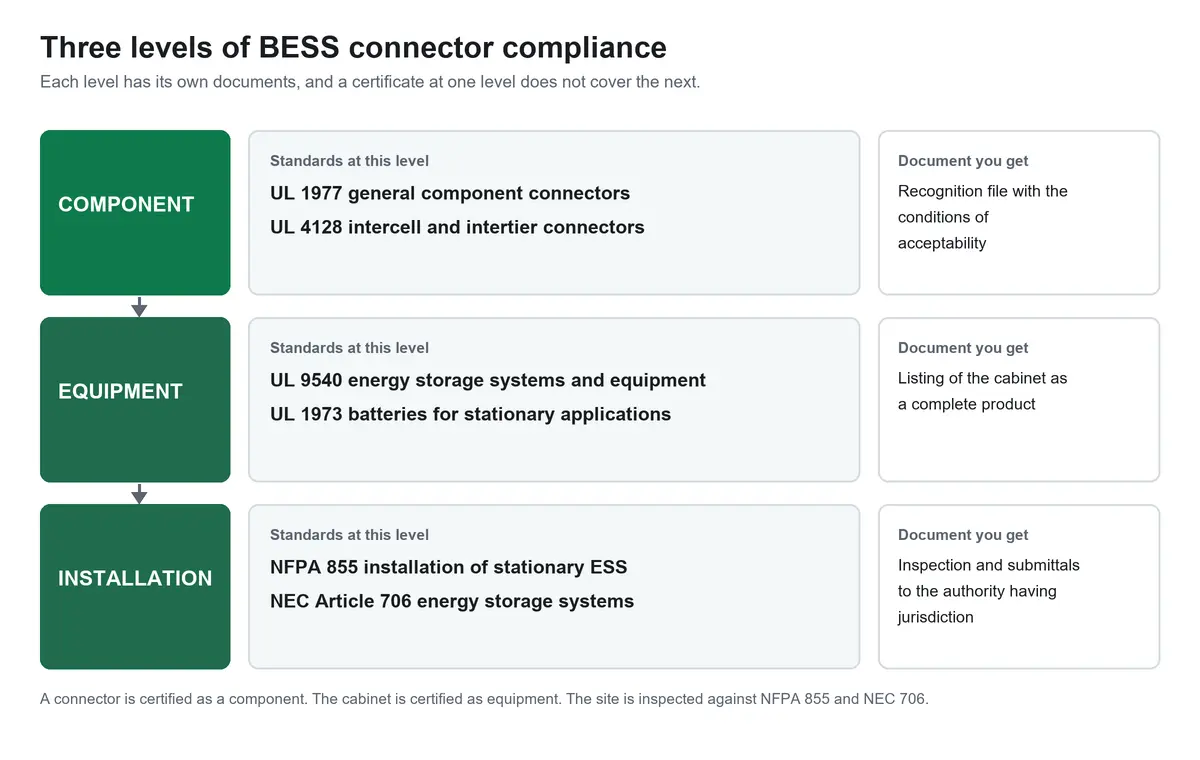
Component, equipment and installation levels of BESS connector compliance, with the document produced at each level
Equipment is judged on its own terms. A storage cabinet is evaluated as equipment under UL 9540, Energy Storage Systems and Equipment, and its battery modules under UL 1973. UL 9540 states that installation requirements fall outside its scope and points to NFPA 70 and NFPA 855. The chain runs component, then equipment, then installation, with a different document and a different responsible party at each step.
Read the chain that way and “the connector is UL certified” becomes incomplete rather than wrong. The useful version names the standard, the file number and the product.
UL 4128 carries a long title on purpose: Outline of Investigation for Intercell and Intertier Connectors for Use in Electrochemical Battery System Applications
. Two words matter. Intercell and intertier mean the link between cells and between the layers of a stack, which is where a storage connector sits in a cabinet.
What the outline actually covers is the mating halves of the assembly: a cable connector, the cable and the mating inlet it plugs into. In the current outline they are rated up to 3,000 V DC, where earlier issues stated 2,000 V DC, and they are not intended for connection or disconnection under load. Assembly is to copper or copper alloy conductors rated 90°C or higher, at the factory or in the field, indoors or outdoors. Hazardous locations sit outside the outline.
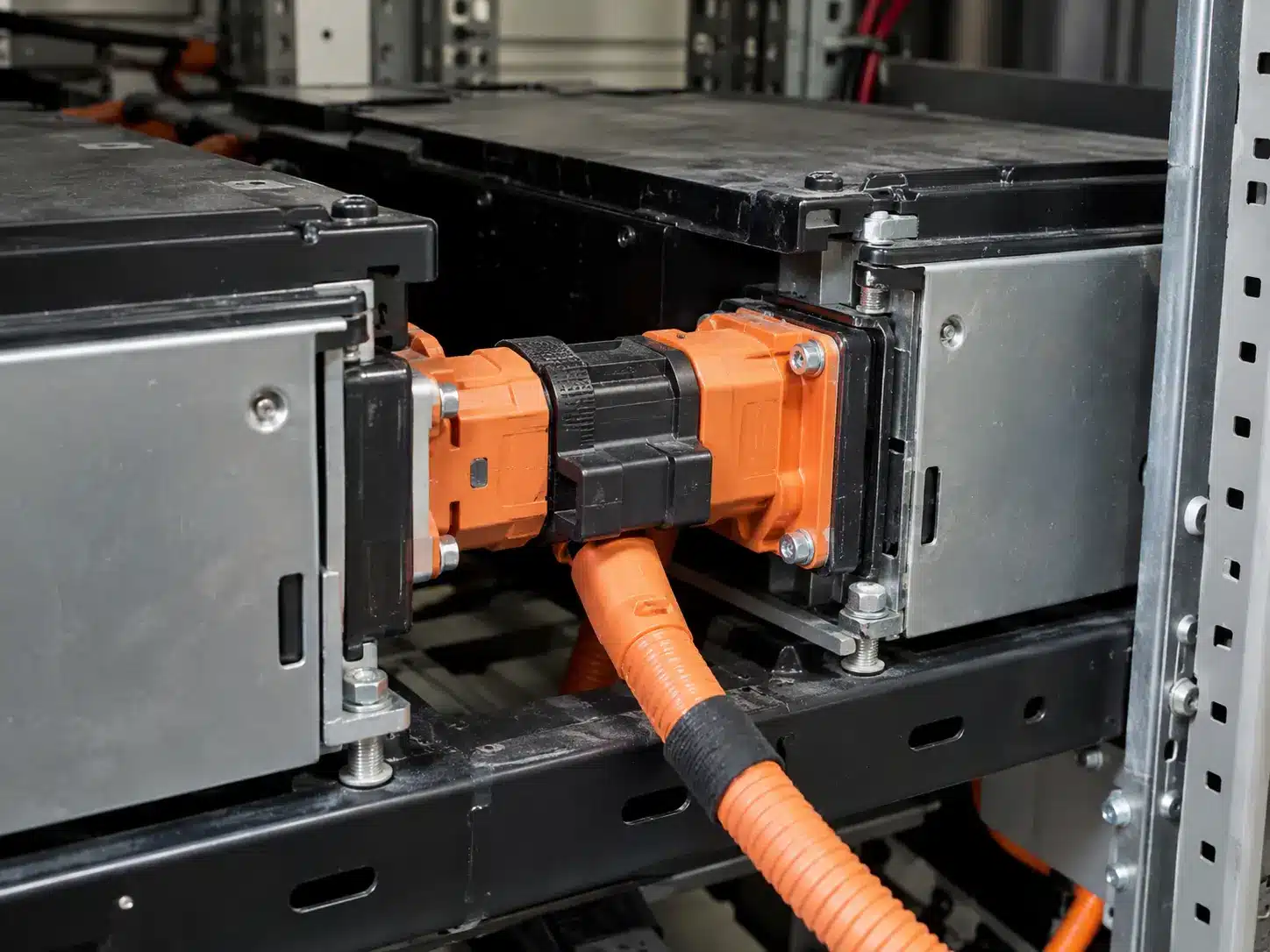
Sealing, environment and spacing at DC are the concerns of a battery interconnect, and the standards UL 4128 references show it: UL 157 for gaskets and seals, UL 50E for enclosures and environmental considerations, UL 94 for the flammability of plastic materials, and UL 840 for insulation coordination including clearances and creepage distances. The test basis for each of them is pulled from a standard that already exists rather than written from scratch.
An Outline of Investigation is not a standard, and that one word carries weight. UL publishes outlines for a category before a full standard exists, and products can be certified against them. The storage industry cites it as the battery connector document, but it is not the same kind of document as UL 1977, so a specification asking for both is asking for two different things.
| Aspect | UL 1977 | UL 4128 | IEC 61984 |
|---|---|---|---|
| Document type | Standard for Safety, 4th edition, 2022 | Outline of Investigation | International standard, 2008 edition |
| Product covered | Component connectors for data, signal, control and power | Intercell and intertier connectors in battery systems | Connectors with safety requirements and tests |
| Voltage classes | Type designations, from Type 0 below 30 V to Type 5 up to 6,000 V | Up to 3,000 V DC | Above 50 V up to 1,000 V AC and DC, 125 A per contact |
| Load-break | Not investigated for current interruption unless the Recognition notes it | Excluded by the outline | Declared by the manufacturer |
| Used by UL for | United States | Battery system applications | EU, China, Brazil and India |
| What none of them cover | The installation | The installation | The installation |
A storage DC interconnect is the case UL 4128 was written for. A general power, panel or signal connector in the same cabinet is a UL 1977 case. Some industrial families—such as PVLinkTech’s CN-series BESS connection solutions
(rated 70A–500A at 1,500 V DC, IP67)—hold both UL 1977 and UL 4128 files, which is no contradiction, since the documents cover different uses of the same hardware. Treat that claim like the rest of the quote and check the file number against the model.
At the product level, nothing. NFPA 855 is the Standard for the Installation of Stationary Energy Storage Systems , and its second edition dates from 2023 on a three-year revision cycle. It sets the rules for the installation: separation distances, fire suppression, explosion control, exhaust ventilation, gas detection, thermal runaway mitigation, and the submittals an installer makes to the authority having jurisdiction.
An NFPA 855 compliant connector does not exist, because 855 does not certify connectors. What exists is an installation that complies with 855, built from equipment that is listed and components that are recognized. A tender that asks for both is asking for two layers of evidence, not one.
NFPA 855 is concerned with how a stationary energy storage system is installed, protected and presented for approval. Its requirements address the broader safety environment around the ESS, rather than certifying an individual connector as a standalone component.
The connector still needs evidence appropriate to its own construction and application, but that evidence comes from the relevant component certification or recognition, not from NFPA 855 itself.
This is why an ESS project can require both an installation standard and separate certification documents for the components used inside the system.
NEC Article 706 covers energy storage systems: the system has to be listed, and a disconnecting means has to be able to disconnect it from all wiring systems, including other power sources, utilization equipment and premises wiring.
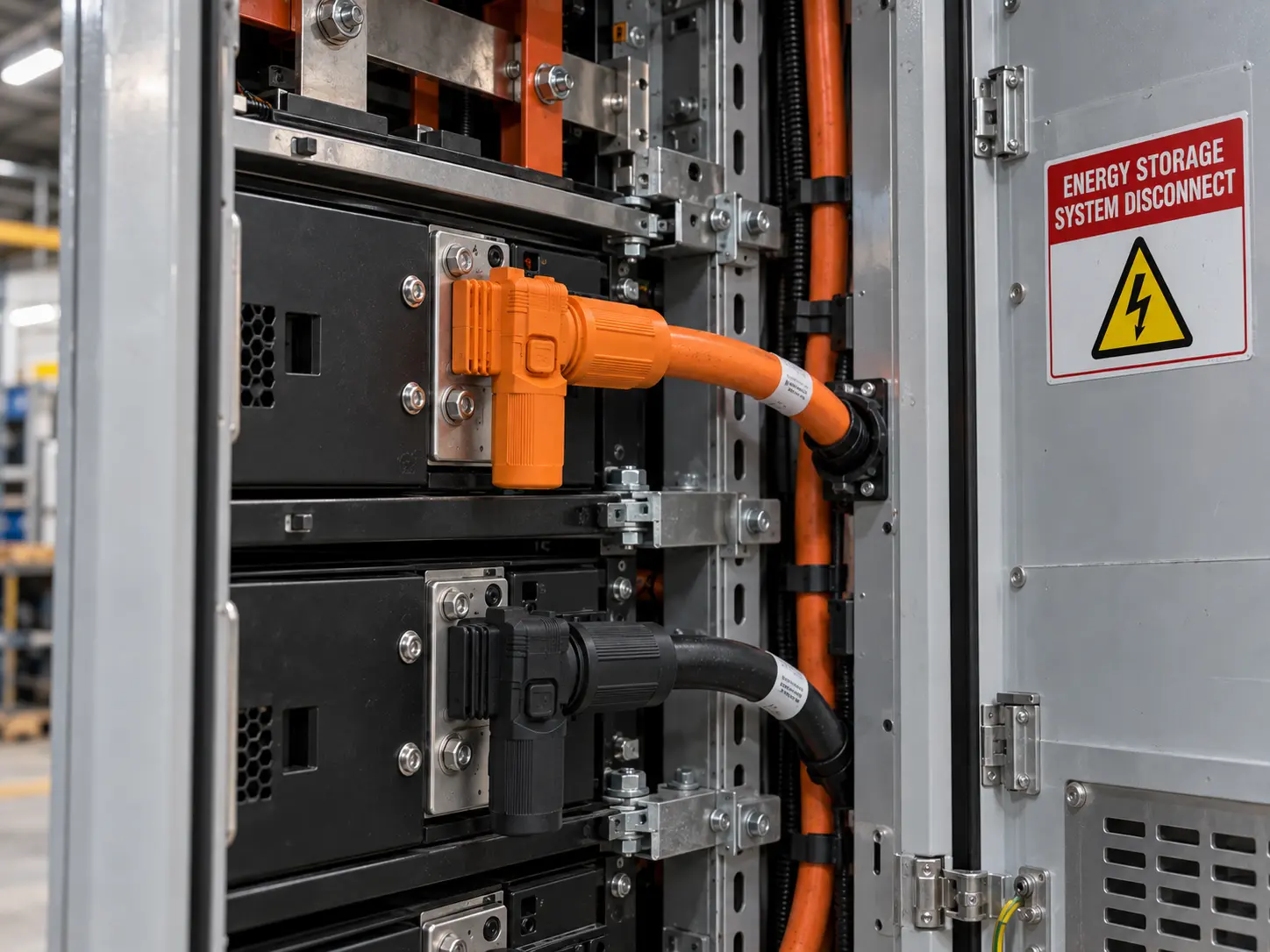
None of those clauses name a connector. They sit above the product and decide which devices have to exist, and those devices carry their own documents. A manual service disconnect (such as a 350A, 1,500V DC IP67 MSD) is the clearest example: it exists because of a system requirement and is certified as a product in its own right.
| Document | What it proves | How to check it |
|---|---|---|
| File number and CCN for the exact model series | The evaluation exists, is current, and belongs to that construction | Search UL Product iQ by file number; the guide information carries the conditions of acceptability |
| The certificate or recognition card with ratings | Which construction and which ratings were evaluated | Match the model, housing, contact and cable range against the drawing you are buying |
| Test report, declaration of conformity and material declarations | What the destination market asks for beyond UL | The declaration is signed by the manufacturer; keep it separate from the UL file |
The file number is the document. A certificate image without one cannot be checked, and a logo on a datasheet is no substitute. Ask for the number with the quotation and check it before the purchase order, while changing supplier is still cheap.
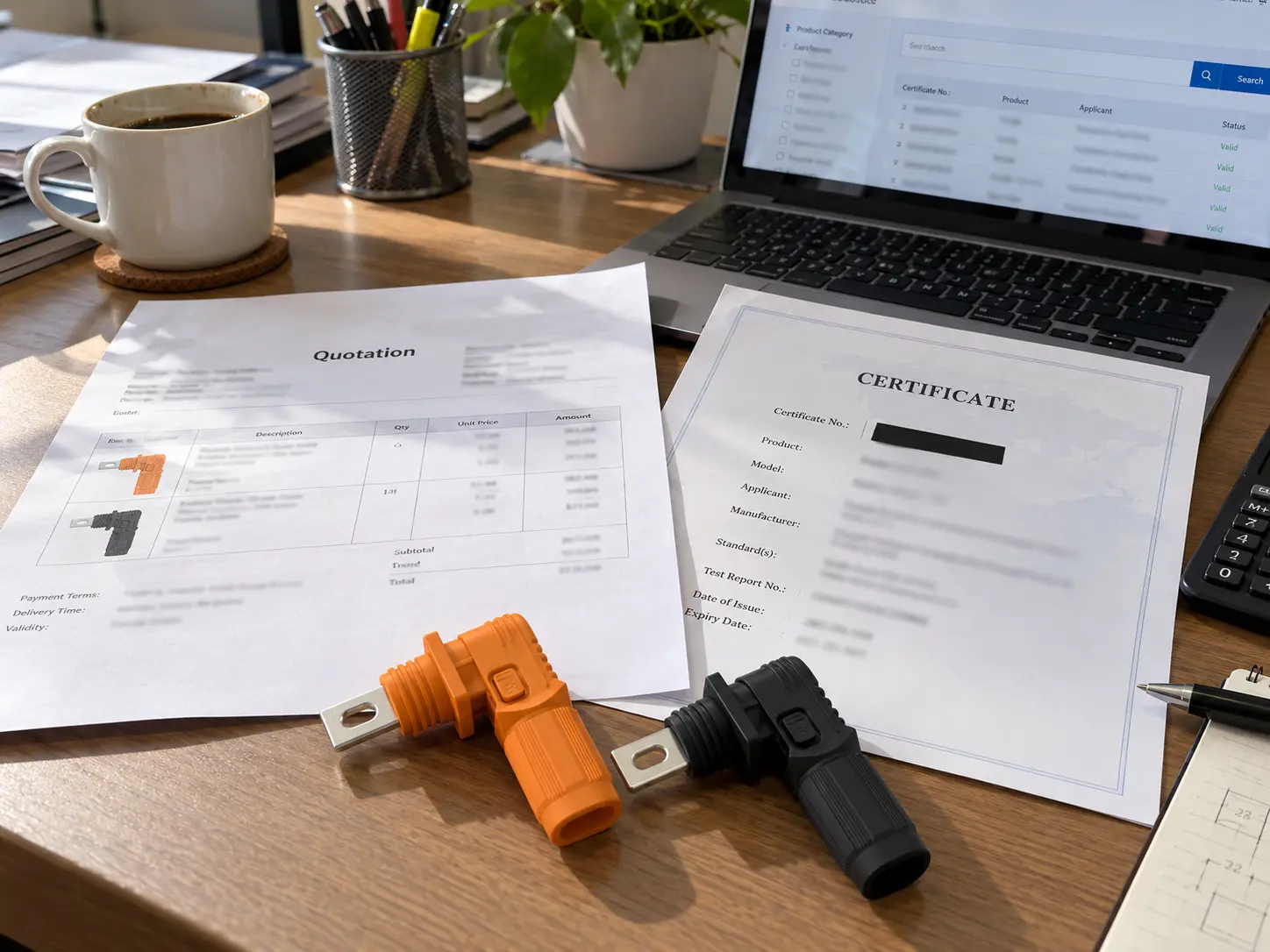
Most ordering mistakes start with four sentences that sound right in a specification meeting.
| What gets written | Where it goes wrong | What to check instead |
|---|---|---|
| “The connector is UL certified, so the cabinet is covered” | A UL 1977 or UL 4128 file certifies a component; UL 9540 certifies the equipment | Ask for the file that names the cabinet, not the part |
| “We need an NFPA 855 certified connector” | 855 is an installation standard, and a UL 1977 certificate is not one | Split the requirement into product certification and installation compliance |
| “Any UL mark covers our 1,500 V DC battery interconnect” | Voltage class, construction and conditions of acceptability decide that | Match the standard to the application, and read the UL 4128 voltage line |
| “The custom version keeps the certificate” | The evaluation was built on materials, dimensions, cable, terminals and ratings | Review the change against the file before the version is quoted as covered |
The third mistake costs the most on a 1,500 V DC battery interconnect, where the system voltage sits above what several general-purpose connector files cover.
UL Product iQ is the public route. Search by file number, CCN (such as ECBT2 / ECBT8 for UL 1977) or keyword, then read the guide information that states what the recognition covers and under which conditions.
Do not rely only on a screenshot sent by the supplier. Search the file number directly in the public database and confirm that the record exists.
The guide information explains the scope of the recognition and the conditions under which it applies. A certificate number alone does not tell you whether every product in a supplier’s catalogue is covered.
Compare the model shown in the database against the model on the quotation, not simply against the family or series name. A UL 1977 file and a UL 4128 file are looked up the same way, and the check takes a minute.
Small suppliers work through partner factories, and the documents may sit with whoever holds the certificate. The sequence matters: ask before the deposit, get the number in writing, and treat an unanswered request the way you would treat an unverified test report .
Across our eight waterproof and energy storage connector families, PVLinkTech confirms certificate scope per model and shares the relevant UL file numbers, drawings, and test reports for project review, which is the standard we suggest applying to any supplier in this market.
Send the model, the destination market and the document your project requires, and we will confirm the certificate scope for that part before you commit to tooling or a production order.
Practical answers to common questions about UL 4128, UL 1977, NFPA 855 and connector certification for battery energy storage applications.
It is an Outline of Investigation. It is how UL writes requirements for a category that has no standard yet, and a product can still be certified against it. The storage trade cites it as the battery connector document. If your specification says “UL 4128 standard”, you are describing an outline, and the supplier can still produce a file number for it.
Not on its own. UL 1977 covers the connector as a general component. Inside a battery system, UL 4128 is the battery-application outline, and the cabinet itself is evaluated under UL 9540. Ask the supplier which document covers the model, and check that the file matches the part you are buying.
The current outline covers intercell and intertier connectors rated up to 3,000 V DC. Earlier issues of the outline stated 2,000 V DC, so read the issue date when a supplier quotes the scope. The same outline also rules out mating or unmating while the circuit is live.
No. Mating or unmating under load sits outside the outline, and the same holds for other high-voltage DC interconnects unless the datasheet says otherwise. Isolate the circuit, prove the absence of voltage, and follow the lockout procedure in place for the site.
No. NFPA 855 is the installation standard for stationary energy storage systems, and it covers separation, fire protection, ventilation and submittals to the authority having jurisdiction. Connector certification comes from product evaluations such as UL 1977 and UL 4128. A tender can require both, but they are different layers of evidence.
No, and the difference is who signs it. A declaration of conformity is issued by the manufacturer for the European market, while a UL recognition or listing is third-party certification tied to a file number you can look up, and that number names the standard, for example UL 1977 or UL 4128. Products destined for both markets usually carry both, and each is checked in its own way.
Only if the review covers the change. Certifications are scoped to the construction that was evaluated, and materials, dimensions, cable, terminals and electrical ratings are part of that construction. A customized version should be reviewed against the existing file before it is quoted as covered, and any new testing is a separate step with its own lead time.

LET’S BUILD YOUR CONNECTION SOLUTION
Share your application, specifications, and estimated quantity. Our team will recommend a suitable connector solution and provide a quotation.
Low MOQ · OEM & ODM · Product Selection Support · Fast Quote Response